Employee Handbook
G7.02 Employee Handbook for Administrative, Professional, and Support Staff Employees
Preface
This handbook has been prepared by the Office of Human Resources as a guide to inform
Missouri State University employees of their responsibilities and benefits. This is
the handbook of employment policies and procedures. Employees are strongly encouraged
to read this handbook and keep it available for reference. Every attempt has been
made to ensure that this handbook is complete and that the policies and procedures
contained herein conform to local, state and federal requirements, as well as to recognized
principles of employment practices and standards. Employees who have questions about
employment policies or procedures that are not answered in this handbook should contact
their supervisor, departmental administrator or the Office of Human Resources for
assistance. This employee handbook also is available on the Missouri State University website.
It is our sincere hope that all Missouri State University employees find their employment
to be both personally and professionally rewarding. To this end, our goal is to create
a work environment which is fair to all employees and which is conducive to the attainment
of excellence in supporting the university's vital mission. All Missouri State University
employees should understand the university's mission and be dedicated to the ultimate
goal of providing the very best educational experience possible for the men and women
attending Missouri State University.
We sincerely hope employees find opportunity and satisfaction in their work and become
valuable and loyal members of the Missouri State University campus community.
Notice
This handbook is not a contract of employment. Administrative, professional, and support staff employees
are employed at the will of the Board of Governors. Employment may be terminated at
any time, with or without cause, subject only to any rules or policies the Governors
may have approved. The university retains the right to change, modify, suspend, interpret,
or cancel in whole or in part any of its published or unpublished policies or practices
without advance notice. If handbook statements are found to be in conflict with existing
or future state or federal laws, regulations, policies or procedures, such rules shall
supersede and prevail over the handbook statements. This edition of the Employee Handbook supersedes previous editions of the Employee Handbook.
Regulations and policies contained herein shall cover all administrative, professional,
and support staff employed by Missouri State University. Policies pertaining to faculty
members are in the Faculty Handbook.
Employee handbook policies
Employee handbook policies include:
G7.02-1 About the University
1.1 History
Missouri State University was founded in Springfield in 1905 as the Fourth District
Normal School. The institution's primary purpose during its early years was the preparation
of teachers for the public school systems in the southwest region of Missouri. The
first name change came in 1919 when the school became Southwest Missouri State Teachers
College, reflecting its regional mission. By the mid-1940s, the university had expanded
its instructional program beyond teacher education to include the liberal arts and
sciences; and as a consequence in 1945, the Missouri legislature authorized an official
change in the institution's name to Southwest Missouri State College. As additional
programs were implemented at the undergraduate level and with the development of graduate
education, the university became an educationally diverse institution by 1972. Recognition
of this further growth and development again resulted in an official change in name
to Southwest Missouri State University. In 1995, Senate Bill 340 was signed into law,
giving Missouri State University a statewide mission in public affairs. On the 100th anniversary of the founding of the university, in 2005, the name changed to Missouri
State University. This name change identified the institution as a multipurpose, metropolitan
university providing diverse instructional, research, and service programs.
Missouri State University-West Plains was established in 1963 as the West Plains Residence
Center and has been a semiautonomous, two-year campus within the Missouri State University
system since 1971. Consistent with the Missouri State-West Plains is a teaching and
learning institution of higher education offering two-year associate degrees, certificates
and a variety of continuing education courses as needed by the employers and citizens
of the area.
The Missouri State University Mountain Grove Research Campus, originally established
as the Missouri State Fruit Experiment Station by a legislative act in 1899, is the
oldest identifiable segment of Missouri State University. Until 1974, it operated
as a state agency under a board of trustees appointed by the Governor. As a result
of the Omnibus State Reorganization Act of 1974, administrative responsibility of
the Station was given to the Board of Governors of the university. In 2006, the Station
was integrated into the Department of Agriculture in the College of Natural and Applied
Sciences as part of a reorganization of the university. In 2009 the Department of
Agriculture was renamed the William H. Darr School of Agriculture in honor of Mr.
and Mrs. Darr. In 2016 the name changed to the William H. Darr College of Agriculture.
Missouri State Branch Campus, located at Liaoning Normal University in the People’s
Republic of China, offers a two-year Associate of Arts degree through the West Plains
campus and a Bachelor of Science in General Business degree through the College of
Business on the Springfield campus. The Branch Campus programs are accredited by the
Higher Learning Commission of the North Central Association of Colleges and Schools.
Today, the university functions as a multi-campus system that is integrated to address
the needs of its constituents.
1.2 Mission
Missouri State University is a comprehensive institution offering undergraduate and
graduate programs, including the professional doctorate. The university educates students
to be global citizen scholars committed to public affairs.
1.3 Missouri State University system
The Missouri State University campuses are structured to address the special needs
of the urban and rural populations they serve. Missouri State University-Springfield
is a selective admissions, graduate level teaching and research institution. Missouri
State University-West Plains is an open admissions campus serving seven counties in
south central Missouri. Missouri State University-Mountain Grove serves Missouri’s
fruit industry through operation of the State Fruit Experiment Station. The China
Branch Campus at Liaoning Normal University (LNNU) operates in Dalian, China.
The university also operates various other special facilities, such as the Darr Agricultural
Center in southwest Springfield, the Jordan Valley Innovation Center in downtown Springfield,
the Bull Shoals Field Station near Forsyth, Baker’s Acres and Observatory near Marshfield
and the Missouri State University Graduate Center in Joplin. In addition, Missouri
State has the operations and program offerings of one entire academic department,
its department of defense and strategic studies, located near Washington, D.C. in
Fairfax, Virginia.
1.4 Governing board
The governing authority at Missouri State University is vested in the Board of Governors
(Chapters 172 and 174, Missouri Revised Statutes). The Board of Governors of the university
is the final appointing and approval authority.
1.5 Organization
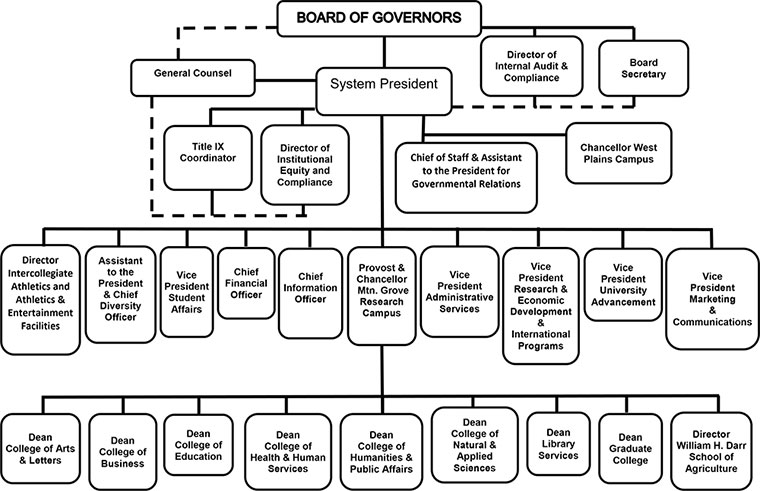
Executive Administration - The current executive administrative organizational structure at Missouri State
University is depicted in the Organizational Chart in 1.6. Departments are aligned
under this structure and are given responsibility and authority as specified by the
Board of Governors.
Administrative Responsibility - Policies and procedures relating to personnel administration of employees are applicable
throughout the university in order to provide equitable treatment and consistent relationships
with all employees. Departmental administrators and supervisors are responsible for
adherence to university personnel policies and procedures in their respective departments,
for providing direction and supervision, and for establishing standards of quality
and quantity of work performance.
Office of Human Resources - The office of human resources, under the Vice President for Administrative Services, provides various support services to all departments in order to attract, develop,
and retain the human resources needed to support the university's teaching, research,
and administrative functions. The office administers certain employee-related programs,
maintains personnel records, interprets university personnel policies and procedures,
and carries out functional responsibilities related to the university's personnel
programs, including: salary administration, applicant recruitment, referral and employment,
employee development, orientation, benefits administration, and employee and labor
relations activities.
In providing these services, the office of human resources seeks to coordinate the
personnel needs of the university with those of the employees. As a service-oriented
unit, the office of human resources is available to support departments in their administration
of personnel programs and in their direct support of employees. The employee should
make suitable arrangements with his/her department supervisor prior to leaving the
work area to visit the office of human resources
Staff Senate – The staff Senate promotes and fosters the welfare and growth of university staff
through a fact-finding, deliberative and consultative body of representatives which
makes studies, reports, and recommendations to the administration on behalf of its
constituency.
The twenty-seven (27) Senators represent all major occupational categories (except
faculty) and include seven (7) divisional representatives at large, representing the
president and each vice presidential unit. The Senate also includes one representative
from Faculty Senate and one representative from Student Government Association as
non-voting members. Employees are eligible to become Senators after serving one year
at the university. The university encourages employees to attend Senate meetings when
possible and participate in Senate membership activities. Supervisors should use student
workers, forward phone calls and take other measures to allow as many employees as
possible to attend and participate.
The Staff Senate meets the first Thursday of each month in Plaster Student Union.
All Senate meetings are open to everyone, but staff members, in particular, are encouraged
to attend. For agenda and other Senate information, visit the Staff Senate website or email StaffSenate@MissouriState.edu. For the West Plains campus, visit the West Plains Staff Advisory Council website or email WPStaffSenate@MissouriState.edu.
1.6 Organizational chart
View the Missouri State University System Organizational Chart or read the accessible System Organizational List.
G7.02-2 University Policies
This chapter provides summaries of key policies with links to the complete policies
where applicable.
2.1 Non-discrimination policy statement
Missouri State University is a community of people with respect for diversity. The
University emphasizes the dignity and equality common to all persons and adheres to
a strict non-discrimination policy regarding the treatment of individual faculty,
staff, and students. In accord with federal law and applicable Missouri statutes,
the University does not discriminate on the basis of race, color, national origin
(including ancestry, or any other subcategory of national origin recognized by applicable
law), religion, sex (including marital status, family status, pregnancy, sexual orientation,
gender identity, gender expression, or any other subcategory of sex recognized by
applicable law), age, disability, veteran status, genetic information, or any other
basis protected by applicable law in employment or in any program or activity offered
or sponsored by the University. Sex discrimination encompasses sexual harassment,
which includes sexual violence, and is strictly prohibited by Title IX of the Education
Amendments of 1972.
This policy shall not be interpreted in a manner as to violate the legal rights of
religious organizations or of military organizations associated with the Armed Forces
of the United States of America.
The University maintains a grievance procedure incorporating due process available
to any person who believes he or she has been discriminated against. Missouri State
University is an Equal Opportunity employer. Inquiries concerning the complaint/grievance
procedure related to discrimination on the basis of a protected class, including sexual
harassment and sexual assault, or compliance with federal and state laws and guidelines,
should be addressed to the Director, Office for Institutional Compliance, Carrington Hall 205, 901 S. National Ave., Springfield, Missouri 65897, Compliance@MissouriState.edu, 417-836-4252.
2.2 Prohibition of discrimination and harassment
In furtherance of the university’s commitment to non-discrimination, the Board of
Governors has adopted G1.31, Reporting Allegations of Discrimination on the Basis of a Protected Class, which can be accessed in the Policy Library, located on the university’s website.
All forms of discrimination and harassment degrade the academic and working environment
of the university, and are wholly inconsistent with the university's public affairs
mission. Sexual harassment is especially troubling in the academic environment due
to the unique relationship between student and faculty member or supervisor and subordinate,
and the inherent inequities in power that exist in such relationships. Sexual harassment
not only violates the law and university policy but also can damage personal and professional
relationships, cause career or economic disadvantage, expose the university to legal
liabilities, a loss of federal research funds, and other financial consequences.
Any member of the university community who believes that he or she has been the subject
of discrimination on the basis of any protected class (i.e., sex, sexual orientation,
marital status, family status, pregnancy, gender identity, gender expression) should
immediately report such concerns to the Office for Institutional Compliance (OIC), which is located in Carrington Hall 205, 901 S. National Ave., Springfield,
Missouri 65897, and who may be contacted at Compliance@MissouriState.edu or 417-836-4252.
Allegations of sexual harassment that meet the definition of jurisdictional requirements
of Title IX of the Education Amendments of 1972 (“Title IX”) and its implementing
regulations will be addressed as set forth in Op1.02-11 Title IX Sexual Harassment Grievance Procedure Policy. All other allegations of discrimination or harassment (including sexual harassment
as defined by the Title VII of Civil Rights Act of 1964 (“Title VII” will be addressed
in a manner consistent with Op1.02-2 Discrimination Complaint and Investigation Procedures. Employees who are found to be responsible for engaging in acts of discrimination
and/or harassment will be subjected to disciplinary action up to and including termination
of employment.
2.2.1 Discrimination and harassment training policy
To create a positive learning, working and living environment, the university must
provide an atmosphere free of discrimination and harassment. The most effective way
to prevent discrimination and harassment is through awareness and education. There
are at least four goals to be achieved through education: (a) ensuring that all alleged
victims (and potential victims) are aware of their rights; (b) notifying individuals
of conduct that is proscribed; (c) informing administrators about the proper way to
address complaints of violations of this policy; and (d) helping educate the community
about the problems this policy addresses.
To achieve these goals, the Division of Legal Affairs and Compliance has developed
a training program to inform, educate and guide members of the university community on sexual harassment
and discrimination. New employees must complete both the Discrimination Awareness
in the Workplace Online Training Program and Title IX: Roles of Responsible Employees
Online Training Program within 30 calendar days of commencing employment with the
university. Every three (3) years, all university employees are required to repeat
the Compliance Training.
2.2.2 Reporting discrimination and harassment policy
All employees are required to report any concerns or allegations of discrimination
or harassment involving members of the campus community (i.e., faculty, staff, and
students) of which they become aware.
Reports should be made as soon as possible, but in no event later than three (3) calendar
days after learning of such concern or allegation. Additionally, reports must be made
to either the Title IX Office or the OIEC, as indicated above. Reporting a concern
or allegation of discrimination or harassment to a supervisor, without also reporting
to the Title IX Office or the OIEC (as applicable) does not satisfy an employee’s
reporting obligation under this policy. An employee who refuses or otherwise fails
to report an allegation or concern under this policy is subject to disciplinary action
up to and including termination of employment.
2.2.3 Guidelines for responding to and reporting child abuse/neglect or victims of
violence or harassment
In acknowledging its responsibility for promoting a positive learning environment
and understanding that there may be occasions when staff receive information regarding
possible child abuse or neglect or acts of violence or harassment to another person,
the university has developed guidelines for responding to such incidents. Under Missouri
law, certain professions are “mandated reporters” with respect to suspected or reported
child abuse and neglect. Such positions include physicians, nurses, psychologists,
social workers, day care center workers, other childcare workers, teachers, principals
or other school officials, or other persons with responsibility for the care of children.
The university has established Op7.09 Guidelines for Faculty/Staff in Dealing with Reports of Child Abuse/Neglect to outline the statutory requirements for employees who are deemed “mandated reporters”
under the law. Employees who need guidance regarding “mandated reporter” obligations
may contact the Division of Legal Affairs and Compliance at 417-836-8507 for assistance.
2.2.4 Consensual sexual or romantic relationships
There are special risks in any sexual or romantic relationship between individual
in inherently unequal positions, and the party who holds the position of greater authority
or power assumes such risks. In the university context, such positions include (but
are not limited to) supervisor and employee, senior faculty and junior faculty, mentor
and trainee, professor and student. Because of the potential for conflict of interest,
exploitation, favoritism, bias, and the appearance of impropriety, such relationships
undermine the real or perceived integrity of the supervision and evaluation provided.
Additionally, such relationships may be less consensual than the individual whose
position confers power or authority believes. The relationship is likely perceived
in different ways by each of the parties to it, especially in retrospect.
Moreover, such relationships may harm or injure others in the academic or work environment.
Relations in which one party is in a position to review the work or influence the
career of the other may provide grounds for complaints by third parties when that
relationship gives undue access or advantage, restrict opportunities, or creates a
perception of these problems. Furthermore, circumstances may change, and conduct that
was previously welcome may become unwelcome. Even when both parties have consented
at the outset to a romantic involvement, this past consent does not remove grounds
for a charge based upon subsequent unwelcome conduct.
Where such a relationship exists, the person in the position of greater authority
or power will bear the primary burden of accountability, and must ensure that he or
she – and this is particularly important for faculty members – does not exercise any
supervisory or evaluation function over the other person in the relationship. Where
such recusal is required, the recusing party must also notify his or her supervisor,
department head, or dean, so that such head, dean or supervisor can exercise his or
her responsibility to evaluate the possibility and adequacy of alternative supervisory
evaluative arrangements. Staff members, may instead, as an option, notify the Office
of Human Resources. To reiterate, the responsibility for recusal and notification
rests with the person in the position of greater authority or power. Failure to comply
with these recusal and notification requirements is a violation of this policy, and
therefore grounds for disciplinary action up to and including termination of employment.
With students – The university will view it as unethical and a violation of this policy
if university employees engage in sexual or romantic relationships with students enrolled
in their classes or subject to their supervision. Such employee-student relationships
may include, but are not limited to, faculty and student, advisor and advisee, teaching
assistant and student, coach and athlete, and the individuals who supervise the day-to-day
student living environment of student residents. The behavior is, in most cases, unethical
even when the relationship is consensual (i.e., both parties have consented), because
the voluntary consent of the student is in doubt, given the power imbalance in the
student-employee relationship. Even if consent were to be shown, a clear conflict
of interest would still exist which might create the appearance of discrimination
or favoritism in grading or access to educational opportunities. Employees who violate
this policy are subject to disciplinary action up to and including termination of
employment.
Relationships between a graduate student and an undergraduate student, when the graduate
student has some supervisory responsibility for the undergraduate student, are prohibited
by this policy.
2.3 Disability and reasonable accommodation
Missouri State University is committed to providing an accessible and supportive environment
for employees with disabilities. Equal access for qualified employees with a disability
is an obligation of the university under Section 504 of the Rehabilitation Act of
1973 and the Americans with Disabilities Act of 1990. Missouri State University does
not discriminate on the basis of disability against otherwise-qualified individuals
in any program, service or activity offered by the university. The university is committed
to ensuring that no otherwise-qualified individual with a disability is excluded,
denied services, segregated or otherwise treated differently than other individuals
because of the absence of auxiliary aids or other appropriate services; however, accommodations
cannot result in an undue burden to the university or fundamentally alter the essential
functions of the job.
The complete Disability Accommodations Policy can be found in the university's policy library, available on the website. An employee
needing to request a reasonable accommodation for a disability should contact the
Deputy Compliance Officer, whose office is located at Carrington Hall 205, 901 S.
National Ave., Springfield, Missouri 65897, and who may be reached at 417-836-8507
or DeputyComplianceOfficer@MissouriState.edu. Employees of the West Plains campus should contact the Affirmative Action Liaison,
University/Community Programs Office, West Plains Civic Center at 417-255-7966.
2.4 Drug-free workplace
Employees are expected and required to report to work on time and in appropriate mental
and physical condition for work. Each employee is responsible to help ensure a drug-free,
healthful, safe and secure work environment. The unlawful manufacture, distribution,
dispensing, possession, or use of a controlled substance on university premises or
while conducting university business off premises is absolutely prohibited. Violations
of this policy will result in disciplinary action, up to and including termination,
and may have legal consequences. Employees must, as a condition of employment, abide
by the terms of this policy and report to the university any conviction under a criminal
drug statute for violations occurring on or off university premises. A report of a
conviction must be made to the Office of Human Resources within five days after the
conviction.
2.5 Alcohol/drug abuse policy
It is the policy of Missouri State University to prohibit the unlawful possession,
purchase, manufacture, use, sale or distribution of illicit drugs and alcohol by employees
on university property or as part of any of its activities. The university has the
right to require an employee to undergo alcohol and/or drug testing when there is
a reasonable suspicion that the employee might be under the influence of alcohol or
drugs. If an employee is found in violation of university policy, federal or state
laws, or local ordinances, the circumstances accompanying each individual case will
be considered when determining the consequences. Violations of this policy will result
in disciplinary action, up to and including termination, and may have legal consequences.
The university does not condone the abuse of alcohol and drugs; it does, however,
recognize that employees with alcohol or drug-related problems should be encouraged
to seek help in dealing with such problems. Employees are encouraged to use the university's
counseling services, campus-related self-help groups (Adult Children of Alcoholics,
Alcoholics Anonymous, or Narcotics Anonymous) and health insurance plans, as appropriate,
when facing alcohol or drug-related problems.
The use of a legal substance/drug, or the use of marijuana under applicable Missouri
law, does not allow an employee to report to work under the influence. If an employee
believes that he/she needs an accommodation due to the use of a legal drug or for
the use of marijuana, the employee shall request an accommodation pursuant to the
university’s Disability and Reasonable Accommodation policy found in Section 2.3 of the Employee Handbook.
2.6 Tobacco use policy
The university recognizes that tobacco smoke is a hazard to the health of the university
community. Because of the harmful consequences of tobacco use, both active and passive,
the university has adopted the following policies:
- The university designates all buildings as smoke-free. Therefore, smoking is prohibited
in university buildings including offices and hallways, and in the outside areas surrounding
fresh air intakes. This policy applies to all university buildings on and off campus.
- Smoking at outdoor events (specifically including those in the stadium) is restricted
to designated areas.
- Smoking is prohibited in vehicles leased or owned by the university.
- The use of smokeless tobacco is prohibited in all locations on campus, where smoking is prohibited.
- Visitors to Missouri State University are included under this policy as temporary
members of the university community.
To the extent possible, the university will provide access to cessation programs to
help those who presently use tobacco products and desire to quit. Magers Health and
Wellness Center offers smoking cessation programs. The success of this policy depends
on the thoughtfulness, consideration, and cooperation of smokers and nonsmokers. The
university community shares in the responsibility for adhering to and enforcing this
policy. Access the complete tobacco use policy.
2.7 Solicitation policy
As used in this handbook, solicitation means the attempted sale, lease, rental, or
offer for sale, lease, or rental of any property, product, merchandise, publication,
or service, whether for immediate or future delivery; the oral, written, or electronic
appeal or request to support or join an organization other than a registered student,
faculty, or staff organization; the receipt of or request for any gift or contribution; or the distribution of information in support of these activities.
Only registered student organizations, university organizations, and university departments
may solicit on campus. All sales persons or agents for any product or proposition
or cause whatsoever are prohibited from soliciting members of the faculty, staff,
or the student body in any building or on any part of the campus of Missouri State
University, or by any electronic means, except as provided herein. Door-to-door solicitation
in university residence halls, academic, or administrative buildings is strictly prohibited.
Space for sales and solicitation must be reserved through the event and meeting services office, 417-836-5653. Unless otherwise noted in this policy, such activities are facilitated
in designated locations in, or directly outside of, the Plaster Student Union. Questions
regarding this policy should be directed to the Director of Plaster Student Union.
Events otherwise approved according to the university's policies that commonly sell
merchandise may be permitted to do so if approved according to the contract or other
arrangement for the event. During working hours, university employees are not to engage
in such activities as unauthorized pools, collections, sales of tickets or merchandise,
political campaigning or passing of handbills. Registered student organizations, university
organizations, and university departments who want to conduct solicitation activities
on campus must comply with the procedures outlined in the solicitation policy. A complete
copy of the university's solicitation policy is available from the office of student engagement. The solicitation policy for the West Plains campus is available on the Student Life website.
2.8 Advertising and distribution policy
Missouri State University recognizes the importance of campus advertising of sanctioned
events and activities in fostering an active and involved university community. At
the same time, the university recognizes that an attractive and well maintained physical
campus environment is essential to the overall advancement of the university. Therefore,
it is necessary that printed posters, signs, notices, and other materials disseminated
on campus be posted in a manner that does not detract from the physical appearance
of the campus or result in damage to building surfaces. Advertising (and publicity)
shall be defined as any method or device for disseminating commercial information/promotional
materials on the campus of Missouri State University. The university retains the exclusive
right for promotion of university activities through advertisement and endorsement
by commercial enterprises and products. Advertisement on campus or in university publications
and activity programs does not imply official endorsement by Missouri State University.
Questions regarding this policy should be directed to the assistant to the vice president
for student affairs/director of Plaster Student Union. A complete copy of the university's
policy on advertising and distribution is available from the office of student engagement. The advertising policy for the West Plains campus is located on the Student Life website.
2.9 Outside activities and other employment
Employees are expected to be able to perform their work as efficiently and effectively
as possible at all times. While work other than for the university is not prohibited,
hours worked in outside employment must not coincide or conflict with hours of work
for the university. Outside employment and activities must not detract from work responsibilities
at the university nor create a conflict of interest. Questions about whether an outside
activity or other employment would constitute a conflict of interest should be directed
to supervisors.
2.9.1 Extra compensation for externally sponsored projects
Exempt employees (review Section 4.4.2 in this handbook for the definition of exempt employees) are expected to perform
their regular duties and responsibilities as assigned by the university without regard
to work hour limitations. Compensation for exempt employees above and beyond their
annual base salary is not permitted for performance of the regular duties and responsibilities
assigned by the university. In certain cases, however, compensation in excess of an
exempt employee's annual base salary is permitted for activities performed under externally
sponsored projects and other internally funded activities. Externally funded projects
are defined as those for which the university administers funds under a contract,
grant or other agreement from a federal, state or local government agency, not-for-profit
entity, or business. Exempt employees who anticipate participating in an externally
funded project should contact the office of research administration for the complete policy on extra compensation for externally sponsored projects.
2.10 Conflict of interest
A Conflict of Interest Policy has been adopted by the university's Board of Governors.
This policy sets forth provisions to assist governors, officers, faculty and employees
in avoiding improper outside influences on institutionally related decisions and activities,
or using their position or property of the university for their personal, financial,
or political gain. The general policy specifically addresses outside interests and
compensation; use and disclosure of confidential information; financial and political
gain; selling, renting, leasing of property; faculty consultation activity; contracting
procedures; and prohibited services after termination of office or employment.
An employee must disclose to his or her supervisor all relevant facts related to activities
which might involve a conflict of interest. This disclosure obligation includes involvement
in a consensual romantic relationship, as set forth in Section 2.2.4. A copy of the complete Conflict of Interest Policy is available upon request from
the Department Head or the Office of Human Resources. Missouri statutes require any
officer or employee of the university who has direct administrative and operating
authority to approve, disapprove, or make binding decisions for the university or
to authorize or enter into any contract on behalf of the university to provide annual
financial disclosure statements. The statement must be completed and filed within
30 days of employment or within 30 days of being transferred or promoted into a position
determined to be covered by the statutes (e.g., vice-president, director, and manager).
The university will determine and annually notify employees required to complete the
financial disclosure statements. The completed statement should be submitted to the
Missouri Ethics Commission.
2.11 Receipt of gifts policy
No employee should accept any personal gifts or favors exceeding the amount provided
in Section 105.485.2(8) R.S. Mo, as amended, (currently $200.00) in monetary value
in any calendar year from any single person, company or firm which transacts, or wishes
to transact business with the university. This is not intended to be applicable to
meals/functions conducted at the initiative of the university and involving university
purposes or business, or to compensation or fringe benefits provided by the university.
Any exceptions to this policy require a written approval of the employee's supervisor
and vice president (if applicable), based on a written explanation for the requested
exception.
2.12 Employment of relatives - nepotism policy
The university's policy regarding the employment of relatives is set forth in the
nepotism provision of the Conflict of Interest Policy, G1.02-7.
2.13 Political activities policy
Following is the policy concerning political activity and holding of public office
by members of the university faculty and staff. The policy is subject to any applicable
provision of law or determination of the Missouri Ethics Commission.
2.13.1 Activity in political party organizations
Employees may engage in lawful political activities:
- Of organizations of political parties qualified to place candidates on the ballot
in accordance with Missouri Statutes or of political parties seeking such qualification.
- Of nonparties or bipartisan groups seeking the election of candidates to public office
or the approval or disapproval of issues which are or may be submitted to the voters
for approval.
- On behalf of individual candidates for public office, including candidates for membership
of any political committee established by Section 115.611 R.S.Mo., et seq., (formerly Chapter 120, R.S.Mo.).
Such activity, like any other personal, non-official undertaking, must be done on
the individual's own time and should not interfere with university duties. Employees
may contribute funds to the above parties, groups, or candidates or expend funds on
behalf of the above parties, groups, candidates or issues, subject only to state and
federal laws which regulate political contributions.
2.13.2 Election to or holding public office
Consistent with state law, employees are permitted to run for any elective office,
including any partisan political office. Such campaign activity must be conducted
on the employee’s own time and shall not interfere with university duties.
To avoid any actual or apparent conflicts of interest, employees are not permitted
to maintain full-time employment with the university while holding an elected, partisan
position at the county, state, or federal level.
The policy is subject to any applicable provision of law or determination of the Missouri
Ethics Commission.
2.14 Emergency procedures
The Office of University Safety is responsible for development and ongoing maintenance
of a campus crisis/emergency action plan. The plan is designed to protect human life
and university property by minimizing the danger to employees, students, and visitors
from natural or man-made emergencies. A crisis may be sudden and unforeseen with little
or no advance warning. The campus crisis/emergency action plan is activated whenever
a crisis disrupts campus operations, threatens life, creates major damage, or occurs
within the university community and its environs. The campus crisis/emergency action
plan provides specific procedures to be followed in the event of any of the following.
- Floods
- Bomb Threats
- Medical Emergencies
- Chemical Spills
- Poisons
- Disturbances
- Power Failures
- Earthquakes
- Threats
- Fire or Explosions
- Tornadoes
- Suicides or Attempted suicides
- Animal Attacks or Bites
Employees with questions regarding a crisis or emergency situation should contact
the University Safety Department at 417-836-5509 or visit the department's website
for a complete copy of the university's emergency operations plan and how to respond to emergencies is located on the University Safety website. For
the West Plains campus refer to the Campus Safety website or contact the Chair of the Safety Committee at 417-255-7225.
If the emergency action plan is activated during an employee's normal work hours,
employees are considered to be in pay status. Employees who choose to leave their
work station during such an emergency must return to work within 30 minutes after
the cancellation of the emergency alert to remain in pay status. However, employees
need not return to work if the alert extends beyond their normal work schedule, unless
they have tools, materials, equipment, or a university vehicle that must be returned.
In this case, employees must return such items before leaving work. Any time that
nonexempt employees remain at work beyond their normal work schedule in order to return
such items, they should enter the time on their time sheet.
2.14.1 Missouri State Alert notification system
Missouri State Alert is the university’s mass notification system, which uses a variety
of methods to contact students, faculty and staff in the event of an emergency or
school closing. Depending on your subscription, the system will make contact with
you through text messages, emails, instant messages, phone calls or pager messages.
You can subscribe to Missouri State Alert.
The Missouri State Alert system will be used in the following situations:
- Immediate threat/violent situation on campus
- Security alert
- University closings, early dismissal, delayed start
- Severe weather alerts
- Other emergency situations of an extreme nature
- Periodic testing of the system
2.14.2 Emergency procedures during a tornado
Employees should familiarize themselves with the siren and other warning systems used
at the university. The sirens will be activated when a tornado warning has been issued
by the National Weather Service. When the tornado warning is issued the following
safety procedures are advised:
- Proceed to the nearest designated shelter area in the building.
- Whenever possible, go to an interior hallway on the lowest floor.
- Whenever possible, employees should protect themselves from exterior walls, windows,
and doors, with another wall.
- Avoid windows and exterior doors.
- When walking to shelter, avoid elevators and areas with exterior windows.
- Avoid auditoriums and gymnasiums or other structures with wide, free-span roofs.
- Avoid low-lying areas that could flood.
- Employees should stand or sit near the base of a wall and protect themselves from
debris with a table, desk, chair, or other appropriate cover.
- Employees should remain in the shelter location until the "all clear" notification
is provided. The "all clear" information will be provided by the University Safety
Department through radio or television stations, or when warning sirens have stopped.
2.15 University closings
There are a variety of reasons why the university may be officially closed on a day
(or portion of a day) other than one of the recognized holidays referenced in Section 7.17 of this handbook. The reasons include, but are not limited to, severe weather, or
an on-campus emergency situation which requires evacuation of a building, a part of
or the entire campus, or an unplanned event of significance which warrants closure
(e.g., death/funeral of a national or state leader).
2.15.1 University cancellation/closure
When university classes are canceled or delayed, a decision will be made as to whether
other university operations will also be closed or delayed. The decision to cancel
classes, close the university and/or delay start times will typically be announced
to the news media prior to 6:00 a.m. Since the decision to cancel/delay day classes
does not pertain to evening classes or second or third shift employees, a separate
decision will be released to the media at least two hours prior to the start of the
cancellation. If closed or delayed due to inclement weather, an official announcement
will be issued through the public media (television and radio), through the Missouri State University home page and on social media. If no announcement is made, employees should assume that activities
will continue as normal. Review the inclement weather procedures for more information.
If classes are cancelled, but all other university operations remain open, employees
should report to work as scheduled. If the university is closed, employees are not
to report to work unless they are notified or have been given prior instructions to
report as part of essential services. It is the responsibility of each vice president
to designate which employees are to report to work. The major administrator of the
operation will be responsible for ensuring that needed employees are notified.
Essential employees are required to report to work, and the failure of essential employees
to report for work because of weather conditions is not an acceptable excuse and may
result in employee discipline. Loss of work time because of weather conditions when
the university continues operations will not be considered an excused absence. Such
time lost must be taken as paid leave or the employee will not receive pay for the
time missed due to the university closing.
2.15.2 Compensation during university closings for full-time employees
When the university officially closes under such circumstances, if the announcement
of the closing occurs before the start of an employee's work shift, the hours of the
employee's work shift that the university is closed will be paid at the employee's
regular straight time rate. If the university officially closes during an employee's
work shift and the employee is sent home, the remaining hours in the employee's work
shift will be paid at the employee's regular straight time rate. The hours that are
paid when the university is officially closed will not count as "hours worked" towards
40 hours for the purposes of payment of overtime.
An employee who is on leave without pay (including Family and Medical Leave and workers'
compensation absence) when the university is officially closed under the circumstances
described in this section will not be paid for the hours that the university is closed
nor use it as paid leave in the future. Employees on a paid absence, however, will
be paid for the hours the university is closed and should record the appropriate number
of hours as university closing rather than paid absence. Employees supplementing the
payments from workers' compensation with vacation, sick leave or compensatory time
off should record the appropriate number of hours as university closing rather than
paid absence.
Nonexempt staff required to work during the hours the university is officially closed
will be paid at their straight time rate in addition to regular pay and the hours
actually worked will count toward 40 hours of work for overtime purposes. Employees
required to work over 40 hours and eligible to receive overtime compensation will
be paid according to the university's normal policies on overtime compensation and
hours worked. Due to budget restrictions, departments may adjust work hours within
the workweek in which the event occurs in lieu of compensation.
When the university is officially closed for a day under such circumstances, a day
is normally defined as eight (8) hours. Employees whose regular workday is more than
eight (8) hours, (e.g., employees working four 10-hour days) will be paid for 8 hours.
Such employees will need to use vacation, compensatory time, or actual work hours
during the workweek in which the university officially closes as described in this
section in order to be paid for the remaining two hours of their work shift that the
university was closed. Employees whose regular workday is less than eight (8) hours,
(e.g., employees working 6-hour days) will be paid for six (6) hours.
2.16 Zero tolerance of workplace violence and threats
Missouri State University recognizes that in order to effectively fulfill its stated
mission and goals the work environment needs to be free of violence and threats for
all members of the university community. Missouri State University is committed to
providing a work environment that is free from violence and threats of violence and
will not tolerate workplace violence of any type, from any source.
Workplace violence, as defined for this policy, is any physical assault, threatening
or intimidating behavior, bullying or verbal abuse occurring in the work setting whether
direct or through the use of university facilities, property or resources. It includes,
but is not limited to beatings, stabbings, shootings, sexual assault, domestic/dating
violence, oral or written statements, psychological traumas such as threats, obscene
phone calls, an intimidating presence, gestures and expressions, stalking, swearing
or shouting, and bringing prohibited weapons onto university property.
The university's Zero Tolerance policy applies to all work locations, including offices,
work sites, vehicles, field locations or other locations where university business
is conducted. All members of the university community are covered under this policy,
including faculty, staff, and students and prohibit threatening or violent actions
by employees directed against other employees, by employees directed against students,
or visitors, and by students or visitors directed against university employees or
other students or visitors.
The university considers threats and acts of violence on campus as a serious violation
of university policy and will respond promptly to reports of violence and/or threats
including prompt investigation and timely involvement of law enforcement agencies,
when appropriate. Review the Workplace Violence web page for more information on violence
and threats of violence, including domestic/dating violence, in university facilities
and on university property.
2.17 Domestic/dating violence in the workplace
Missouri State University seeks to create a supportive workplace environment in which
employees feel comfortable discussing domestic/dating violence and seeking assistance
for domestic/dating violence concerns. The purpose of this policy is to increase awareness
of domestic/dating violence and to provide guidance to employees and management in
addressing domestic/dating violence issues and their effects in the workplace.
Domestic/dating violence, as defined for this policy, is any physically, sexually,
and/or psychologically abusive behavior that a household member or dating partner
uses to establish and maintain control over another person. Such behavior can be violent
or threaten violence and may result in physical or emotional harm or otherwise place
a person's safety and productivity at risk. Domestic/dating violence is a serious
problem that affects people from all walks of life. It can adversely affect the well-being
and productivity of faculty and staff members who are victims, as well as their co-workers.
Missouri State University does not tolerate domestic/dating violence in the workplace,
including offices, work sites, vehicles, field locations or other locations where
university business is conducted. Accordingly, allegation or concerns of domestic/dating
violence involving members of the university community (i.e., when both the alleged
victim and the alleged perpetrator are faculty, staff, and/or students) should be
reported to the Title IX Office (located in Carrington Hall 205, and available at
417-836-8507). Such allegations or concerns will be processed via Op1.02-11 Title IX Sexual Harassment Grievance Procedure Policy, as domestic/dating violence constitutes sexual harassment as defined by Title IX.
Employees who engage in domestic/dating violence in the workplace, who use university
facilities, property or resources to engage in domestic/dating violence, or who are
criminally charged with domestic/dating violence offenses are subjected to disciplinary
action, up to and including termination of employment.
The university is committed to working with faculty and staff members who are victims
of domestic/dating violence to prevent such violence from occurring in the workplace
and to reduce its impact on employee well-being and productivity. No faculty or staff
member will be penalized or disciplined solely for being a victim of domestic/dating
violence. Faculty and staff members who are victims of domestic/dating violence are
expected to cooperate with the university in instituting approaches to create a safe
working environment for them, as well as their co-workers. Additionally, the Title
IX Office (located in Carrington Hall 205 and available at 417-836-4252), is available
to meet with employees who are experiencing or have concerns about domestic/dating
violence in order to discuss available options and resources. Employees may also contact
the Family Violence Center, 417-837-7700, 24 hour hotline 417-864-SAFE (7233) or 800-831-6863
or the Missouri Coalition of Domestic Violence, 573-634-4161 or The Victim Center,
417-836-7273.
2.18 Possession of firearms policy
It is the policy of Missouri State University to prohibit the unauthorized possession
of ammunition, firearms, explosive weapons, and other weapons. The Possession of Firearms Policy (G2.02) can be found in the Missouri State Policy library.
2.19 Workplace surveillance and searches
The university may utilize reasonable surveillance and search measures, (to include
video in areas where notice of such surveillance has been posted or where crimes have
occurred or are reasonably expected to occur), that ensure the proper work environment.
The university reserves the right to inspect and search all work areas, desks, file
cabinets, lockers, lunch boxes, containers leaving university premises, and personal
vehicles on university premises. All records contained in computers (including email)
and storage devices should be business-related and therefore are open to inspection
by the university.
Surveillance cameras are positioned at several locations throughout the campus to
enhance campus safety. Cameras are located inside and outside university academic
and administrative buildings as well as in parking facilities. Cameras monitor nearly
every area of campus from a central control facility. These cameras are monitored
throughout the day and also provide video surveillance.
2.20 Information technology policies
Taxpayers, students, and others providing funding for Missouri State University technology
resources expect that these assets will be used and offered equitably. Further, they
expect use of these resources to support the university's mission of developing educated
persons and in its mission in public affairs.
Acceptable uses of computers, networks, electronic mail, and other information technology
can help enhance university communications and build a sense of community. Unlawful
or inappropriate uses, however, reduce the amount of resources available to satisfy
the university's purpose and can infringe upon the rights of others.
Use of university computer resources is a privilege. The university expects all authorized
users to use information technology in a responsible, acceptable manner – users may
not use information technology to violate the university's purpose or mission, university
policy, faculty or employee handbooks, Board bylaws and rules, contractual obligations,
or local, state, or federal laws and regulations. Failure to comply with university
computer use policies can result in immediate disabling of computer resources, reactivation
fees, removal of material violating policy, and/or disciplinary action including dismissal,
civil action or prosecution. The university reserves the right to monitor computer
use/communication if it has reason to do so, and to limit, revise or prioritize its
computer resources as it deems appropriate.
To ensure compliance with these expectations, and applicable laws, the university
requires its authorized users of the information technology resources to follow the
policies regarding information technology use.
2.21 Children in the workplace
The university values family life and has worked to develop employment policies and
benefits that are supportive of families. While the university seeks to focus on providing
an environment open to work and family issues, it also believes that the work place
should not be used in lieu of a child care provider. Further, the university believes
that it is inappropriate for minor children of employees to be in work areas during
work hours for several reasons:
- The potential liability to the university.
- Risk of harm to the children.
- Decreased employee productivity due to distractions and disruptions.
It is the policy of the university that minor children in an employee’s care not be
present at an employee's workplace (e.g., office, classroom, shop area, university vehicle), in lieu of other child care arrangements, during the employee's working hours.
The supervisor is responsible for enforcing this policy in their respective work areas.
This policy is not intended, however, to prohibit children from the campus when the
purpose of their visit is to attend classes or to participate in activities specifically
scheduled for their benefit (e.g., Fine Arts Academy, summer sports or activity camps,
or other similar university-sponsored events).
2.22 University signature policy
Missouri State University's Signature Policy delineates when signatures can be specified
on university documents and the specific approvals required to include those signatures.
Within this policy, the term "document" refers to both hardcopy and electronic formats.
The term "signature" refers to the handwritten, personalized signing of an individual's
name and serves as his/her legal identifier, either in original or digitized form.
No university member's signature shall be included on hardcopy documents unless that
person has specifically signed the original document being copied for distribution
or has specifically authorized the signing of his/her name. No university member's
digitized signature shall be included on any hardcopy or electronic documents without
that person's specific, written approval. In lieu of an approving authority's signature,
the specification of the signatory's name and title is encouraged to be used (e.g.,
John Doe, Director of Acme Department).
University officials wishing to include the President's signature on a document shall:
(a) have that document reviewed and approved by the appropriate vice president or
chancellor in advance of distribution to the President, and (b) have that document
reviewed and approved by the President prior to general distribution. This policy
applies to all university faculty, staff and students.
G7.02-3 Employment Policies and Procedures
3.0 Employment Policies and Procedures
At Missouri State University, all applicants for employment will be treated courteously
and given fair and equitable consideration for employment in accordance with the university non-discrimination policy (2.1) within this handbook. All new employees are selected on the basis of experience,
education, ability, training and other job-related factors.
The university is committed to maintaining an environment that encourages full utilization
and adequate reward of the individual employee's effort, achievement and cooperation.
Every employee is given a fair opportunity to advance in the university organization
as the employee's abilities warrant and as job openings occur.
The office of human resources is responsible for the employment process for staff
positions in all departments of the university. Staff positions include administrative,
professional and support staff. Administrators and search officials are designated
as decision-makers for recruitment and hiring actions and are responsible for compliance
with Op7.10 Guidelines for Hiring Faculty, Academic Administrators and Executive, Administrative
and Professional Staff. No employment offer may be made until all employment guidelines have been followed.
Chairs of search committees or hiring officials are required to complete a training
session annually through the Office for Institutional Compliance on how to conduct
a legal and effective search.
3.1 Posting
A posting must be initiated on the Applicant Tracking System to fill a personnel vacancy.
The posting must be submitted online for approval before the office of human resources
can post the vacancy on the applicant portal.
3.2 Recruitment of personnel
3.2.1 Full-time employees
All recruiting activities for full-time, regular staff positions will be noted on
the posting and reviewed and approved as the posting is routed online during the approval
process.
3.2.2 Part-time employees
The hiring procedures for part-time employees differ from those followed for full-time
employees. The office of human resources website includes a Part-time Employee Hiring Checklist which should be followed by departments when hiring a part-time employee. Additional
information related to part-time employees can be located on the 1,000 Hour Guide page.
3.3 Job descriptions
Job descriptions are prepared for each position classification and describe the minimum
qualifications and essential job functions for each position. Job descriptions assist
in the selection process, wage and salary administration, the identification of training
needs, the performance appraisal process, and communication between employees and
their supervisors about job responsibilities. Job descriptions should serve as a broad
outline of the responsibilities and duties of a position classification. They are
not restrictive in the sense that they may exclude the assignment of other duties
and responsibilities; further, they can be expected to change as the university accomplishes
its mission and departments modify their goals and objectives.
3.4 Job posting
University system-wide vacancy announcements of full-time positions are available:
3.5 Application for vacant positions
Each position announcement that is posted or advertised specifies the application
procedures for the applicant or employee to complete. To be considered for a specific
position, it is the responsibility of all applicants, internal or external, to monitor
vacancies at jobs.MissouriState.edu and complete the online application form before the posted closing date.
Falsification of application materials, is grounds for termination of employment or
non-selection of an applicant.
A current employee interested in being considered for transfer or promotion to a vacant
position at the university should apply online at jobs.MissouriState.edu. (See Section 4.3.5 of this handbook for specifics regarding transfers.)
Individuals not employed by the university on a full-time basis are not eligible to
apply for positions posted with the statement "Internal posting for promotion and
transfer consideration of full-time, regular university employees only." However,
in rare cases of business necessity upon the recommendation of the vice president
of the area in which the vacancy is being posted and with the prior approvals of the
director of human resources and the director of institutional compliance, an individual
not employed on a full-time basis may be allowed to apply.
3.6 Screening of applications
3.6.1 Support staff positions
Applications for support staff positions are screened by the hiring department to
determine whether the applicant meets the minimum qualifications to be considered
for the position. The most qualified candidate(s) will be invited for an interview.
3.6.2 Administrative and professional positions
The departmental administrator may wish to be involved in the initial screening process
or may form a search committee to assist in the recruitment and screening process
for administrative and professional positions. Prior to interviews being conducted,
the hiring administrator and major administrator will review the list of applicants
for the position. For complete instructions regarding screening of applications for
administrative and professional positions, refer to the Guidelines for Hiring Faculty, Academic Administrators and Executive, Administrative
and Professional Staff document.
3.7 Criminal background checks
Missouri State University conducts background checks as outlined in the Operational Policy Chapter 7/Op7_05Criminal Background Check. Consideration will be given to the relationship between a conviction and the responsibilities
of the position that is or will be held. A relevant job-related conviction is grounds
for termination of employment or non-selection of an applicant. For positions that
require operation of a motor vehicle, a conviction shall include misdemeanor traffic
violations.
Employees must notify the office of human resources within five (5) days of an arrest
for a felony, a misdemeanor (excluding traffic violations), or any drug, alcohol,
or sex-related offense. Failure to report such conviction is grounds for disciplinary
action up to and including termination of employment or non-selection of an applicant.
Supervisors should notify the office of human resources immediately upon being informed
of any such arrest.
3.9 Appointment of employees
All full-time appointments for employment at the university are subject to the approval
of the president and the Board of Governors. Any service performed by an employee
before such approval is given will be considered temporary employment. Employment
approval for other than full-time regular appointments (i.e., part-time positions)
can be delegated by the university president, without submission to the Board of Governors.
The types of appointments are described below.
3.9.1 Full-time regular employees
Employees who have been recommended for employment with the university and who work
a minimum of 75% of a full-time equivalency are full-time regular employees. Full-time
equivalency is defined as a 40-hour workweek for a 12-month period. These employees
fill positions that have been approved and budgeted as full-time regular positions.
3.9.2 Part-time employees
Policies applicable to part-time employees are also applicable to Graduate, Research
and Teaching Assistants.
3.9.2.1 Part-time regular employees limited to 1,560 hours
Employees hired to work for the university 1,000 hours or more but less than 1,560
hours in a rolling 12-month period, which equates to less than 75% of full-time equivalency.
Eligible for participation in the MOSERS retirement system.
3.9.2.2 Part-time regular employees limited to 1,000 hours
Employees hired to work for the university with the understanding that they are to
work less than 1,000 hours in a rolling 12-month period. These part-time employees
may work 40 hours a week or less, but they will be employed for less than 1,000 hours
in a rolling 12-month period.
3.9.2.3 Part-time occasional, irregular, or short-term assignment limited to 1,000
hours
Employees hired to work for a short period of time, such as for peak workload periods
or on an as-needed basis with no regular schedule.
3.10 Orientation
New full-time employees will attend an orientation program conducted by the office
of human resources. During orientation, employees receive information regarding university
policies, compensation and benefit programs, and other general information about the
university. Employees will complete the required employment paperwork. All new employees
are required to complete the online Compliance Training as part of the new hire orientation program. (See Section 2.2.1 of this handbook – Discrimination and Harassment Training Policy). Employees may
be required to complete additional compliance training for their individual job responsibilities
as directed by their supervisor. Departments will provide their employees with a more
specific orientation about the department and the employee's position.
3.11 Employment eligibility
It is the policy of the university, in accordance with the Immigration Reform and
Control Act of 1986 (IRCA), to hire only U.S. citizens and foreign nationals authorized
to work in the United States. The university is a participating employer of the E-verify
Program. All new employees require approval by the Department of Homeland Security
(DHS) to determine eligibility to work in the United States.
The IRCA requires all employers to complete I-9 Employment Eligibility Verification
forms for all new employees. The regulations require new employees to complete and
sign, by the day they begin work, the employee information and verification section
of the I-9 form and to provide original documentation that is designated by the U.S.
Citizenship and Immigration Services proving their identity and employment eligibility,
within three business days of hire. Failure to complete the I-9 form will result in
termination of employment.
3.12 Probationary period
A new employee who receives a full-time regular appointment at the university will
serve a six-month employment probationary period. The departmental administrator or
supervisor will conduct two evaluations of the employee's work performance during
the probationary period, occurring at the end of the employee's third and sixth month
of employment. See Section 5.3 of this handbook regarding the probationary period performance evaluation.
3.13 Employment seniority
All new employees begin to accumulate seniority from the first day of employment in
a full-time regular appointment. University seniority is not recognized in part-time
positions. An employee’s seniority will not be lost because of absence due to authorized
leaves of absence. Union employees are covered by the seniority rules delineated in
the Memorandum of Agreement between the university and Union Local 453, International
Brotherhood of Electrical Workers (IBEW) and Teamsters Union Local 245.
Should the status of an employee change from part-time to a full-time regular appointment,
the length of university service starts from the date of the appointment to a full-time
regular position.
If a layoff should occur, an employee's seniority will be retained for one year. Seniority
at the university is automatically terminated upon resignation, retirement, termination,
failure to return from layoff, or the taking of an unauthorized leave of absence.
(See Section 3.19.2 on Layoff in this handbook for information pertaining to separation of employment
due to layoff.)
3.14 Rehire of former employees
Employees who voluntarily terminate employment with the university, and are later
rehired, will be classified as new employees and will serve the required six-month
employment probationary period. The rehired employee will be given credit for past
service with the university when establishing eligibility for vacation accrual. The
rehired employee will receive credit for prior service for retirement system benefits
as established by the regulations of the retirement system (refer to MOSERS Member Handbook for further details). The university will recognize prior service with Missouri State
University in establishing total service for the employee recognition and service
awards program.
3.15 Volunteers
Volunteers make an important contribution to the success of the university. In accordance
with the Fair Labor Standards Act (FLSA), the university considers a volunteer to
be an individual who performs hours of service for the university for civic, charitable
or humanitarian reasons, without promise, expectation or receipt of compensation for
services rendered. Some departments have established volunteer programs and use their
own volunteer forms and tracking methods that have been approved by the Office of
Human Resources. Departments without approved volunteer programs must have potential
volunteers authorized by the department head or director and approved by the director
of human resources before volunteer services can be performed. Please contact the
office of human resources to obtain the Volunteer Request and Agreement Form. Volunteers
must not be used in the place of employees and may not displace an employee who would
ordinarily be paid to do the same work.
Volunteers may be covered by State of Missouri Workers’ Compensation laws and therefore
must, in the event of an on-the-job injury or work-related illness, follow the procedures
for obtaining medical attention, reporting the injury/illness, and must complete all
required forms as described in Op2.01.
Current university employees may not volunteer to perform duties they perform as employees
of the university or duties that are similar to the employee’s regular work at the
university.
Employees who wish to work at university or departmental events must receive prior
permission from their supervisor if the event occurs during the employee’s regularly
scheduled workday. Nonexempt employees may become eligible for overtime or their work
schedule may need to be adjusted to accommodate the time away from regular job duties;
supervisors should contact Human Resources for guidance.
3.16 Access and review of employee personnel records
The policy of the Office of Human Resources pertaining to access to records maintained
in HR safeguards against improper disclosure and protects employees' rights to privacy.
Individually identifiable personnel records, performance ratings or records pertaining
to employees or applicants for employment, and records of hiring, firing, disciplining
or promoting an employee of the university are and shall be considered closed records
pursuant to §§ 610.021(3) and (13), R.S.Mo., except as provided in those sections
or other law or specific action of the Board of Governors, including this policy.
Refer to
Operational Policy 10.04.17 HR Personnel Files for further details regarding access and review of employee personnel records.
3.16.1 Copying of documents
The university may charge a fee to parties who request and are authorized to receive
copies of employee files. The Board of Governors has established a standard fee of
ten cents per page with the hourly fee for duplicating time not to exceed the average
hourly rate of pay for clerical staff of the university.
3.17 Personal information
The office of human resources maintains directory information and benefit information
for employees and should be contacted to report changes. The following are examples
of the changes that should be reported: home address and name changes (use Change of Address and/or Name Change form), marital status and dependent changes affecting benefit coverages, beneficiary
changes, etc.
3.18 Release of employment information
Employees’ names, job titles, and salaries are provided to the State of Missouri for
publication in the Missouri Official Manual.
The office of human resources will verify the current or former employee's date of
hire, position, department and release salary information, if a signed release form
is submitted to human resources. If a request is in writing, an employee's written
consent will be required to provide additional personnel information beyond verification
of a current or former employee's position, salary and length of service.
3.19 Separation from employment
Employment at Missouri State University shall be "at will" and shall be terminable
"at will" by the university or the employee with or without cause. No representative
of Missouri State University has any authority to enter into any agreement for any
specified period of time or to make any agreement contrary to the foregoing. Oral
statements and representations are not binding on the university, and any exception
to the foregoing must be made in writing and agreed to in writing by the university's
Board of Governors. There are several types of separation from employment. The following
is an explanation of each type and the procedures that apply regarding the termination
of employment.
3.19.1 Resignation/retirement
Employees who are resigning or retiring should submit written notice to their supervisor
and/or department at least two weeks prior to the last day of work. Resignations should
include the reason for leaving the university and the employee’s requested date of
resignation (termination date). If any use of vacation is involved, it should also
state the day the employee is last planning on being present at work. If the employee
wishes to use vacation time just prior to the resignation date, the request to do
so should also be included so that the supervisor may approve or deny the request
for vacation. Notice of the resignation and the Personnel Action Form (PAF) should
be submitted as soon as possible well before the effective date of separation. For
use of PAF’s please refer to: Dynamic Forms PAF Frequently Asked Questions and Help Guides - Human Resources - Missouri
State.
3.19.2 Layoff
It may become necessary to reduce the number of university employees because of a
reduction of work or funds, the elimination of positions or other material change
in the duties or organization, or for other related reasons. If such a reduction is
necessary, the director of human resources may recommend, and the departmental administrator
or supervisor involved will designate, the employee or employees to be laid off and
submit such recommendations to the president. Subsequently, the layoff actions will
be submitted to the Board of Governors for approval at the next board meeting. Whenever
possible, the university will provide a written 30-day layoff notice to the employee.
Employees who have been laid off also may apply for other positions for which they
are qualified. Such applications will be given consideration in the university's normal
recruitment process.
If prior to an employee being laid off, the university has a vacant position available
that is in the same job title or in another job title in the same or lower salary
range for which the employee meets the minimum job qualifications, the university
may, in its discretion, opt to exempt the vacant position from the normal university
vacancy posting procedures in order to give the employee whose position is being eliminated
priority in applying for the vacant position.
Under no circumstance, however, is an employee who is being laid off entitled to fill
a vacant position within the university. The final selection for all job positions
will be made on the basis of best overall qualifications as assessed by the university.
Should a vacancy occur, employees accepting a transfer to another or lower job title
under these conditions will be eligible, for up to one year after the transfer, to
be recalled to the same department and same job title that he or she occupied prior
to the transfer.
3.19.2.1 Benefits available during a layoff
- Retirement - Layoff status does not constitute a break in membership; therefore, when
an employee returns to work, prior creditable service will be reinstated immediately
(1) if the employee was vested in MOSERS at the time of the layoff, or (2) if the
employee was not vested in MOSERS but returns to work within 12 months of being laid
off. However, if the employee was not vested in MOSERS and returns to work more than
12 months after having been laid off, he/she must work at least 12 months in order
to have any prior creditable service reinstated to the work record for retirement.
- Insurance - Coverage under the university’s insurance package will terminate at the
end of the month. Medical and dental coverage may be continued for up to 18 months
through COBRA as long as the premiums are paid by the employee. Life insurance may
be continued under the portability provisions.
- Leave – While on layoff status, vacation and sick leave do not accrue. Accumulated
vacation will be paid. If an employee returns to work within one year from layoff
status the employee’s accumulated sick leave will not be lost and will be reinstated.
3.19.2.2 Recall from layoff
For up to one year after layoff, an employee will be eligible to be recalled to fill
a position if a vacancy occurs in the same department and same job classification
that was held prior to the layoff., In the university's judgment, when skills and
abilities are equal, employees with the greatest amount of university seniority will
be recalled first.
3.19.3 Retrenchment
Retrenchment is a reduction in programs and/or services which results in termination
of an employee because of a financial exigency or formal academic planning such as
changes in institutional mission, substantial program changes, or major reallocations
of resources for academic or support services. Whenever possible, the university will
provide 30 days notice to employees.
3.19.4 Disability
If an employee becomes physically or mentally incapable of performing the essential
functions of his/her position, unaided or with the assistance of a reasonable accommodation,
the employee may seek information from the office of human resources regarding disability
and/or retirement benefits.
3.19.5 Dismissal
Employment with the university is "at will" and may be terminated at any time. The
university, at its discretion, may utilize progressive disciplinary procedures in
appropriate circumstances. Dismissal requires the recommendation of the employee’s
supervisor and major administrator with the approval of the director of human resources.
A letter will be given to the employee stating the reason(s) for dismissal. When the
reason(s) for dismissal is misconduct, the dismissal is usually effective immediately.
3.19.6 Non-reappointment
When a full-time employee is appointed to a position with a limited term and will
not be reappointed, a PAF to end employment should be sent.
3.19.7 Retirement
All full-time regular staff employees are members of the Missouri State Employees'
Retirement System (MOSERS). There is no mandatory retirement age for university employees.
For detailed information regarding the retirement benefit plan, refer to Retirement
Program at Section 6.2 of this handbook or to the MOSERS website.
3.19.8 Death
Beneficiaries of employees who die while in the service of the university shall be
advised by the office of human resources of any retirement and insurance benefits
to which the beneficiaries are entitled.
3.19.9 Failure to work
If an employee has not worked during a continuous six (6) month period and is not
on an approved leave, the employee’s employment with the university shall be terminated.
3.20 Final pay and benefits
When an employee terminates or is laid off from employment with the university, insurance
coverage will terminate at the end of the month. For example, if an employee terminates
employment on May 17th, then insurance coverage ends on May 31st. Employees have the
option of requesting continuation or conversion of their insurance coverage after
termination. For information about these options, employees should refer to the insurance
plan booklets.
3.20.1 Property clearance
When employment with the university is discontinued, for any reason, the employee
is responsible for returning all university property in their possession. Departments
with an interest in the return of university property are notified by Human Resources
of the employee’s departure. The departing employee and their department head are
notified by Human Resources that any university property in the employee’s possession
needs to be returned before the termination date; a link to the Exit Questionnaire
is also provided.
3.20.1.1 Recovering property and money owed to the university
The university has the right to hold any amounts due and payable (vacation pay, overpayment,
reimbursement, etc.) to any employee until payment has been received to settle charges
for unreturned university property and debts owed the university for any reason.
3.20.2 Final salary payment
The final salary payment is based on the termination date. The termination date is
the last day in paid status. The last day of work is defined as the last day the employee
is physically present at work. Accrued vacation time cannot be used to extend the
effective date of termination beyond the employee’s last day worked, unless the employee
has received permission pursuant to paragraph 3.19.1 above, or is retiring from the
university and is eligible to immediately receive a retirement benefit from a university
retirement plan in the month following the last day worked.
Exempt employees who terminate employment or retire from the university will receive
a final salary payment on the last business day of the month of termination or retirement.
This amount will include payment for all days worked in the month. Payment for any
days and hours of earned, unused vacation leave up to a maximum of two times the employee’s
annual accrual (and 40% of unused sick days up to a maximum of 48 days for retiring
employees), will be paid no later than the last business day of the month following
the month of termination or retirement provided all outstanding leave information
is submitted by the last day worked.
Nonexempt employees who terminate employment or retire from the university will receive
a final salary payment on the last business day of the month in which their last pay
period ends. This amount will include payment for all days worked in the month, plus
payment for any days and hours of earned, unused vacation leave up to a maximum of
two times the employee’s annual accrual, unused compensatory time (and 40% of unused
sick days up to a maximum of 48 days for retiring employees), provided the final time
record has been received by the payroll office in accordance with the “Submit by Date”
for the pay period on the Payroll Calendar. Otherwise, unused leave and compensatory
time will be paid at the end of the next month following their last pay period.
Employees who terminate employment or retire from the university will continue to
accrue sick leave and vacation in their last pay period, provided that they are paid
at least 80 hours during the last pay period.
When there is a recognized university holiday or extra given day in the month that
an employee terminates employment or retires, and the holiday or extra given day occurs
after the employee’s last day of work, the employee will be paid for the holiday(s)
and extra given day(s) in the month of termination if their last day of work is the
day before the holiday or extra given day.
G7.02-4 Classification and Compensation
4.1 Compensation philosophy
Missouri State University's workforce is its most vital resource and it is the intention
of the university that the compensation plan demonstrates the high value the university
holds for its employees. Therefore, the Missouri State University system strives to
maintain a total compensation package for faculty and staff that is directed toward
attracting, retaining and rewarding a highly qualified, engaged, committed and diverse
workforce to serve the university's students and the State of Missouri. Compensation
shall be externally competitive when compared to the appropriate market, internally
equitable and based upon individual performance, qualifications required and the complexity,
scope and impact of the work performed. Performance should be directly linked to obtaining
pay rewards of sufficient magnitude to be valued. Strategically, the compensation
system, in conjunction with other human resource strategies, contributes to workplace
conditions that support employees at all levels of the university in meeting or exceeding
performance standards. Performance management and compensation increases are directly
linked with the furtherance and achievement of the university's strategic goals; there
should be a strong correlation between the strategic goals of the university and the
goals and objectives set by supervisors and their employees. Employee performance
is evaluated in relationship to achievement of employee goals and objectives.
4.2 The Job classification system
The job classification system facilitates employee training, promotions, transfers,
and other human resources administrative functions.
Please refer to Compensation Terms Glossary, for definitions of many of the terms used below.
The job classification system consists of job families, jobs, positions, pay grades
and salary ranges. Some jobs are unclassified; these jobs are not included in the
job classification system described here because the job evaluation plans do not adequately
evaluate the nature of these jobs.
A job family is a group of jobs involving work of the same nature but requiring different skill
and responsibility levels. Jobs at the university have been divided into four different
job families with each job family having its own jobs and job descriptions, job evaluation
plan, pay grades and salary ranges.
- Job Family 1 consists of administrative support and clerical jobs, including financial,
student services, library and bookstore support service jobs.
- Job Family 2 consists of jobs in skilled crafts and trades, protective services occupations,
custodial and other services.
- Job Family 3 consists of information systems jobs, electronic and media system technician
jobs and broadcast engineering and other technical or computer-related jobs.
- Job Family 4 consists of managerial jobs, administrative jobs and professional and
paraprofessional jobs.
A job is work consisting of responsibilities and duties that are sufficiently alike to
justify being covered by a single job description. A job may be assignable to more
than one employee (i.e., the job of administrative assistant II is held by more than
one person, but these individuals are in the same job because they all perform similar
duties and responsibilities). A job refers to the combination of duties and responsibilities
that are carried out by all persons in that job.
A position is used to denote the unique responsibilities and duties assigned to one employee.
In instances when there is only one person with a certain job title or job description,
the position is the same as a job. If, however, there are multiple individuals with
the same job title/job description, then each individual with that job title has his
or her own position. In other words, a position represents a specific person and the
unique duties and responsibilities that person performs.
A job description is a summary of the essential duties and responsibilities of a job. A job description
identifies the nature of the work that is performed, specific duties and responsibilities,
outcomes of the performance of these duties and responsibilities and the knowledge,
skill and abilities required to perform the job.
Job descriptions are used for the hiring process, the performance evaluation process,
communication between employees and their supervisors about job responsibilities,
salary administration and the identification of training needs. Job descriptions serve
as a broad outline of the duties and responsibilities of a job. Job descriptions are
not restrictive in the sense that they exclude the assignment of other duties and
responsibilities; in fact, job descriptions can be expected to change as the work
performed changes. It is the responsibility of employees to review and understand
the duties and responsibilities of their job as stated in their job description. Supervisors
should recognize when the broad outline of duties and responsibilities needs to be
updated and work with the office of human resources to revise job descriptions. It
is permissible for departments to maintain specific job duty lists or desk job descriptions
particular to a position within a multiple-incumbent job.
The job evaluation plan for each job family is used to objectively and systematically evaluate job descriptions
belonging to that job family in terms of compensable factors in order to determine
the pay grade for each job. During job evaluation, a job is assigned a degree level
for each compensable factor in the job evaluation plan based on the amount or extent
of a compensable factor that is required by a job. The job evaluation process is based
strictly on the minimum requirements and essential duties and responsibilities of
a job and not on the level of performance of an individual in a job.
Jobs with similar job evaluation results or points are placed in the same pay grades;
a pay grade is one of the classes into which jobs of the same or similar values are
grouped. A salary range is assigned to each pay grade. The salary range consists of the minimum and maximum
dollar amount that is paid to jobs in a specific pay grade. The salary range is based
on salary survey data for the jobs in each pay grade, where the minimum of the salary
range approximates the 25th percentile of market pay, the midpoint approximates market
pay, and the maximum approximates the 75th percentile of market pay of all jobs in
the pay grade.
The job description, pay grades, and salary ranges are used in the recruitment and
compensation of personnel.
4.3 Salary administration
No salary change or employment offers are official until approved by the Board of
Governors.
4.3.1 Annual salary range adjustments
It is the intention of the university to adjust salary ranges annually to keep up
with changes in market pay based upon the availability of funds. Recommendations on
salary range adjustments will be made to the president annually by the Executive Budget
Committee based on compensation cost indicators, the projected state appropriations
amount and other revenue projections for the next year.
If adjustments to the salary ranges result in employees' salaries falling below the
minimum of the salary range, the university will adjust employees' salaries to the
minimum of the salary range assuming projected state appropriations amounts and other
revenue amounts are sufficient to allow these adjustments.
Employees whose salaries fall below the minimum of the adjusted salary ranges because
of receiving a small or no annual salary increase due to poor performance will be
in Performance Improvement Plan (PIP) status; these employees may receive an adjustment
to the range minimum effective the date they are released from PIP status if performance
improvement goals have been met.
4.3.2 Annual salary increases
Across-the-board, merit and equity salary increases are normally given annually and
are effective at the beginning of the university's fiscal year, July 1 (August 1 for
exempt employees with 9- or 10-month appointments). In years when sufficient funding
is anticipated to be available, the salary increase budget for the following fiscal
year is recommended to the Board of Governors by the president after consultation
by the president with the Executive Budget Committee. The annual salary increase for
an employee can consist of an across-the-board increase, a cost center-funded increase,
and/or a centrally-funded increase. Across-the-board increases are provided to full-time
employees as a percentage of base salary. Cost center-funded and centrally-funded
salary increases are based on performance or equity, and are distributed on an individual
basis by the cost center head. Eligibility criteria based on length of employment
are determined annually.
It is the intention of the university that employee salaries fall within the salary
range to which the job is assigned. Employees' salaries that are above the maximum
of their salary range will not receive annual salary increases, until annual adjustments
to the salary range causes the maximum amount of the salary range to exceed the current
salary. If an annual salary increase results in a salary above the maximum of the
range, the salary increase will be equal to the amount of the increase that takes
the salary to the maximum of the pay grade.
4.3.3 Starting salaries
Starting salaries for new employees cannot be less than the minimum nor more than
the maximum of the salary range of the job. The normal starting salary should be between
the minimum and midpoint of the range. A starting salary above the midpoint may be
established with sufficient justification (e.g., scarcity of applicants, outstanding
qualifications or market considerations) and requires approval by the division's senior
administrator. Starting salaries should be commensurate with the employee's qualifications
and related experience and should be confirmed with the office of human resources
before a final salary offer is made. Human resources will assist in determining an
appropriate starting salary, especially for multiple incumbent positions.
When considering the starting salary of a new hire either through external recruitment
or promotion, a review of the qualifications and experience of the new individual
is required as compared to others in the same job within the same major cost center
to ensure that the new employee is paid appropriately in comparison to incumbents.
When the department head and the director of human resources cannot agree upon a starting
salary, the major cost center administrator (president, provost, vice president, chief
financial officer or chancellor) for the area in which the new employee will be employed
will determine the starting salary.
4.3.4 Promotions
A promotion is the selection of an employee for a job that has a salary range with
a higher midpoint than the midpoint of the employee's current salary range through
the process of posting a vacancy and conducting a search.
Each pay grade contains jobs with similar job evaluation point totals so the pay grade
and associated salary range reflects the value of all jobs in the grade. The midpoint
of the salary range is a control point and can be used to measure the size of the
difference between grades both in terms of salary and the value of the new job based
on job evaluation factors, such as knowledge, skill and technical mastery, supervisory
responsibility, management responsibility, span of control and impact of the job on
the university.
It is the university's policy to bring an employee's salary to the minimum of the
salary range for the pay grade into which he/she is promoted, but not above the maximum
of the new salary range. In general, the midpoint of the new salary range is considered
the market salary for the new job and an appropriate salary following a promotion.
The amount of the promotional increase is left to the discretion of the hiring official.
However, an appropriate promotional increase will recognize the following criteria:
- magnitude of the difference between midpoints of the new and current pay grades (the
percentage change from one midpoint to the other),
- need to allow for future merit and equity salary increases within the new salary range,
- qualifications of the employee relative to the minimum qualifications of the job,
and
- salary that would have been offered to a similarly qualified external candidate.
In determining promotional salary increases in jobs involving multiple incumbents,
consideration will be given to the salaries of incumbents sharing the job title, with
similar qualifications. There is usually less room for discretion in determining the
new salary for an employee promoted to a multiple-incumbent job.
The office of human resources will review all promotional increases relative to the
above criteria for equity purposes and report their findings to the hiring official
for their consideration. Any promotional increase must be approved by the office of
human resources before being communicated to the employee.
If a promotion is effective on July 1, the annual salary increase is applied to the
salary resulting after the promotion.
Employees who believe they are qualified and who are interested in being considered
for promotion to a vacant position must apply to the pertinent posting on the university's
applicant tracking system.
4.3.5 Transfers
A transfer is a move to a different position within the same job (an administrative
assistant II in department A transfers to an administrative assistant II position
in department B) or to a different job (an academic administrative assistant II transfers
to an academic administrative I position) that has salary range midpoint that is the
same or lower than the midpoint of the employee's current salary range. Transfers
occur as the result of an employee's request or through actions taken by the university.
Union employees are covered by the transfer procedures established in the Memorandum
of Agreement for their bargaining unit.
4.3.5.1 University-Initiated transfers
A university-initiated transfer occurs as the result of an action taken by the administration
such as a reorganization or restructuring of a department or unit or the elimination
of a position. A university-initiated transfer may also be the result of disciplinary
or performance-related actions. Such transfers may result in either a lateral transfer
or a transfer to a job that has a salary range with a lower midpoint than the employee's
current salary range as defined below.
If the transfer occurs as the result of disciplinary action, the employee's salary
will be determined jointly by the employee's new department head and the director
of human resources with approval from the major cost center administrator.
- Lateral Transfer A lateral transfer occurs when the transfer is to a different position within the
same job or to a different job that has the same salary range. There may or may not
be a change to the employee's salary resulting from a lateral transfer. In most cases,
such decision will be solely dependent upon the decision of the cost center to which
the transfer is made.
- Transfer to a Job with a Lower Midpoint When the transfer is to a job that has a salary range with a lower midpoint than
the employee's current salary range. The cost center may, at its discretion, offer
a lower salary than the employee’s current salary due to budgetary constraints and/or
to ensure salary equity within the cost center. If the employee's salary is above
the maximum of the new salary range, the salary will be reduced by the amount required
to bring the employee's salary below or to the maximum of the new salary range.
- Vacancy Procedures When the transfer is to a vacant position in the same job or to a different job that
has the same salary range or salary range that has a lower midpoint, for which the
employee meets the minimum job qualifications, the vacant position will not be subject
to the normal university vacancy posting procedures. If the department with the vacancy
agrees, the employee being transferred will be asked if he/she is interested in accepting
the vacant position. If the employee decides not to accept the transfer to the vacant
position, normal university vacancy procedures will be followed. (See Section 3.4, Job Posting)
4.3.5.2 Employee-initiated transfers
An employee may request a transfer upon completion of one year of service in his/her
current position and department. This requirement can be waived provided the employee's
immediate supervisor agrees with the transfer. To initiate a transfer, an employee
must apply to the pertinent posting on the university’s applicant tracking system
and be selected for the position. An employee-initiated transfer may result in either
a lateral transfer or a transfer to a job having a salary range with a lower midpoint
as defined below.
- Lateral Transfer A lateral transfer occurs when the transfer is to a different position within the
same job or to a different job that has the same salary range. There may or may not
be a change to the employee's salary resulting from a lateral transfer. Such decision
will be solely dependent upon the decision of the cost center to which the transfer
is made.
- Transfer to a Job with a Lower Midpoint When the transfer is to a job that has a salary range with a lower midpoint than
the employee's current salary range, the cost center may, at its discretion, offer
a lower salary than the employee's current salary due to budgetary constraints and/or
to ensure salary equity within the cost center. If the employee's salary is above
the maximum of the new salary range, the salary will be reduced by the amount required
to bring the employee's salary below or to the maximum of the new salary range.
4.3.6 Reclassifications
The job duties of a position can change over time, and this can result in a reclassification
of a position to a new job or different existing job. A reclassification is a change
in the pay grade, to which a job is assigned based on job analysis of the essential
duties and responsibilities of a job position that has changed over time.
The essential duties and responsibilities of a job or position can change due to many
factors, including departmental reorganizations or an evolution of job duties over
time caused by changes in technology, regulatory mandates, etc. If an employee or
supervisor thinks that the job duties have changed sufficiently to warrant a reclassification
review, the immediate supervisor of the job or position within the job can initiate
a request for reclassification review of the job by the office of human resources.
Requests for reclassification review must be authorized at each organizational level
of the division with the major cost center administrator (provost, vice president,
chief financial officer or chancellor) authorizing human resources to do the reclassification
review.
A reclassification review can result in an increase, decrease, or no change to the
grade associated with the job or position within a job. If a job or position within
a job is reclassified to a grade with a higher midpoint, a salary increase is encouraged,
but not required; the amount of the increase is determined by the department head
and approved by the cost center administrator. The employee’s salary must be brought
to at least the minimum of the new range. If a job or position within a job is reclassified
to a grade with a lower midpoint, the department head and cost center administrator
will determine the salary of the affected employee.
4.3.7 Within-grade salary adjustments
A within-grade salary adjustment is a salary increase without a change in grade and
can be requested for employees for one of the following reasons:
- Internal equity – may be used to address salary inequities among individuals who are
in positions that require similar skills, responsibilities and experience.
- Special market considerations – may be used when there are compelling market reasons
for an adjustment.
- Additional responsibilities – a salary increase of no more than 12%, not to exceed
the maximum salary of the pay range, may be provided for employees who are assigned
significant additional, ongoing job duties resulting from a reorganization or implementation
of a new organizational initiative. Subsequent equity adjustments may be needed for
other employees within the department. Documentation of additional responsibilities
must accompany the PAF.
- Sustained commendable job performance – at the discretion of the cost center, dependent
upon adequate budgeting, employees who have an ADP score in the top tier of their
cost center for the previous 3 years may receive a salary increase of not more than
12%, not to exceed the maximum of the salary of the pay range.
The department head will determine the appropriateness and amount of the in-grade
salary adjustment with input from the office of human resources and approval of the
major cost center administrator.
4.3.8 Temporary additional duties
Normally, the addition of new duties to a job does not require a salary adjustment
because it is expected that job duties change and evolve over time. If the volume
of additional duties causes nonexempt employees to work in excess of forty hours in
a week, the payment of overtime and earning of compensatory time-off is considered
compensation for the additional work.
4.3.8.1 Differential pay – nonexempt employees
An out-of-grade differential is an additional hourly amount payable for a defined
period of time to nonexempt employees who temporarily accept the addition of significantly
higher level duties than those consistent with the job description. The out-of-grade
differential is temporarily added to the hourly rate to facilitate correct overtime
calculations and is not included in the base salary for calculation of annual salary
increases.
4.3.8.2 Supplemental pay – exempt employees
Supplemental pay is a monthly amount payable for a defined period of time to exempt
employees who temporarily accept significant additional or higher level duties than
those consistent with the job description, such as when serving in an Acting or Interim
role. The supplemental payment is not added to base salary and is not included in
annual salary increase calculations.
4.3.9 Extraordinary circumstances
The president of the university system is authorized to change the salary in hiring,
promotion, transfer or other personnel actions or allow a salary to exceed the maximum
of a salary range, in circumstances which the president determines appropriate, such
as, but not limited to, market conditions, difficulty in attracting and retaining
employees or circumstances of inequity. The adjusted salary will be submitted to the
Board of Governors for approval in the normal course of business.
4.4 Exempt and nonexempt status
The Fair Labor Standards Act (FLSA) covers such employment matters as hours of work,
minimum wage, overtime compensation and other conditions of employment. The university
is covered by many provisions of this act. The Fair Labor Standards Act establishes
specific criteria for determining which jobs are nonexempt and require pay for overtime
hours worked and compensatory time off, and which jobs are exempt and do not require
compensation for overtime. All job classifications are determined to be exempt or
nonexempt by the office of human resources based on the FLSA.
Contact the office of human resources if an employee or supervisor has a question
concerning whether a position is exempt or nonexempt. The FLSA specifically states
that neither the employee, nor the employer, may waive the employee's right to be
compensated for overtime if the job is classified as nonexempt. Therefore, each supervisor,
department head, director and administrator is responsible for ensuring that the FLSA
is followed and the university policy for overtime requirements is observed.
4.4.1 Nonexempt employees
Technical, secretarial, clerical, skilled crafts and trades, and service occupations
are typically considered nonexempt and are eligible for overtime and compensatory
time. All nonexempt employees are required to accurately record their hours worked:
- Full-time, nonexempt employees must complete time sheets and submit them for approval
through web time entry (or submit hours worked for departmental time entry) for each
pay period.
- Part-time, nonexempt employees must complete time sheets and submit them for approval
through web time entry (or submit hours worked for departmental time entry) for each
pay period.
- Non-teaching and non-research Graduate Assistants (Administrative Graduate Assistants)
must complete and submit a GA Time Record to their supervisor.
These forms are required for nonexempt employees to meet the record keeping provisions
mandated by the FLSA administered by the Department of Labor, Division of Wage and
Hour.
4.4.2 Exempt employees
Executive, administrative, managerial, faculty and professional positions are classified
as exempt and no overtime is paid or compensatory time earned. Because exempt employees
are not eligible for overtime, they are not required to keep a record of the hours
they work but must report time away from work (leave). Normally, the requirements
of positions filled by administrative and professional employees require a minimum
of forty (40) hours of work each week.
4.4.3 Deductions from pay
4.4.3.1 Nonexempt employees
Nonexempt employees are paid for actual hours worked each day within the university's
workweek and any accrued leave benefits taken such as vacation, sick, compensatory
time off or other available paid leave by accurately completing their time sheet.
Nonexempt employees must record actual hours worked for each day on their time sheet,
regardless of where or when the work was performed (including all work performed outside
of regular working location and working hours).
The employee is required to use accrued leave under Missouri State University's vacation,
sick leave and compensatory time policies while they are on an approved Family and
Medical Leave Act (FMLA). If paid leave has been exhausted during FMLA leave, pay
will be reduced by the hours that the employee is absent from work even if the absence
is less than a full day.
4.4.3.2 Exempt employees
Exempt employees are paid on a salary basis and, in general, will be paid their full
salary for any week in which they perform work. Their pay may be reduced only in the
following circumstances:
- Exempt employees who are absent for at least a full day because of sickness or disability
will not be paid for that day unless accrued benefits under Missouri State University’s
vacation or sick leave benefits are available. An exempt employee's salary will not
be reduced if the employee is absent for less than a full day because of sickness
or disability. If accrued paid leave is available, the employee must complete an online
leave report and designate the type of leave used for the period of the absence.
- If paid leave has been exhausted, pay will be reduced during FMLA leave by the hours
that the employee is absent from work even if the absence is less than a full day.
- Exempt employees who are absent from work for at least a full day for personal reasons
other than sickness or disability will not be paid for that day. If an employee is
absent for less than a full day for personal reasons, his or her pay will not be reduced.
If accrued vacation or sick leave is available, the employee must complete an online
leave report and designate the type of leave to be used for the period of the absence.
- In order to receive full pay from the university, exempt employees who are absent
from work for jury duty or as a witness at a trial should submit their payment(s)
for jury duty or attendance as a witness to the office of human resources.
- Exempt employees who violate a safety rule of major significance may have their pay
reduced in an amount to be determined by the university as a penalty for that violation.
- Exempt employees may be suspended without pay for workplace misconduct but only in
full-day increments. Their pay will be reduced in an amount that is proportionate
to the number of days suspended.
- Exempt employees who work less than 40 hours during their first or last week of employment
will be paid a proportionate part of their full salary for the time actually worked.
- Exempt employees who believe that their pay has been improperly reduced must notify
their supervisor or contact the office of human resources, requesting a reimbursement
of salary.
4.4.4 Prohibition on incentive compensation
The university will not provide any commission, bonus, or other incentive payment
based in any part, directly or indirectly, upon success in securing enrollments or
the award of financial aid, to any person or entity who is engaged in any student
recruitment or admission activity, or in making decisions regarding the award of Title
IV, HEA program funds. Bonuses may be provided to employees if the bonus is for defined,
prospective work unrelated to enrollments, admissions, or the award of financial aid.
4.5 Workweek and work hours
The university workweek is defined as a seven-day period that begins at 12:01 a.m.
Monday and ends at 12 midnight Sunday. A normal workweek of 40 hours is established
for most employees. Because of the variety of functions of the many departments within
the university, there may be differences in normal hours and days of work. An employee
starting a new job should ask the departmental supervisor for the work schedule. While
the normal workweek of 40 hours is achieved through working five 8-hour days in a
workweek, some employees achieve a 40-hour workweek by working four 10-hour days in
a workweek. For leave benefits, see Chapter 7 for the policy governing how such employees are paid for recognized university holidays,
extra given days, vacation and sick leave. For the university closing policy, see
Section 2.15.
4.6 Employee flextime work scheduling
The university supports the principle of flextime for its employees in order to provide
for more efficient utilization of the abilities of its employees, better service to
the public and improved working conditions for employees. Departments are encouraged
to accommodate the reasonable requests of employees for alternative work schedules
when consistent with the department's objectives.
Flextime refers to a range of flexible formats that permit employees to choose the
times they will start and end work. While employees may request consideration of a
flextime schedule allowing for a specific arrival and departure time, approval of
the request will be granted only if all policy guidelines and work schedule requirements
are met (see Section 4.6.3 below).
4.6.1 Flextime definition and purpose
A flextime work schedule is an alternative work schedule for employees who normally
work the eight-hour, five-day workweek, usually from 8 a.m. to 5 p.m.
Flextime scheduling permits employees to select a work schedule that may assist with
individual needs. It also provides employees with a degree of flexibility that may
improve employee morale; may reduce tardiness, absences for personal business, turnover
and overtime costs; and may increase employee, as well as departmental productivity
and service.
4.6.2 Flextime work scheduling guidelines
- The first priority for each department is to accomplish its mission. Utilization of
flextime scheduling should not decrease a department's productivity, nor adversely
affect the operations of other departments, or the services provided for the university,
students, other constituents or the general public.
- Flextime must not increase staffing costs including overtime compensation.
- Flextime should be considered by the department only when it can be managed successfully
in helping to meet the needs of the employee, the department and the university.
- Any department head who wishes to consider a flextime arrangement must prepare a written
proposal for the flextime work schedule and submit it to their major cost center administrator
for approval. The department head will forward an informational copy of the approved
flextime schedule to the office of human resources.
- All flextime employees must meet the work schedule requirements provided in this policy
as listed in Section 4.6.3.
- A flextime schedule shall be established specific period of time and may, upon approval,
be the employee’s permanent work schedule.
- The department head is responsible for proper flextime scheduling and for ensuring
that adequate supervision is provided for all employees during their work hours.
- Shift coverage may be implemented as required by the needs of the department and is
not limited by the flextime policy.
- Flextime is not necessary for the occasional adjustment of the work week schedule
to manage the 40 hour work week and minimize overtime for nonexempt staff.
- Flextime should not be confused by supervisors for flexibility in working with employees
to accommodate short-term scheduling issues. Supervisors are encouraged to work with
employees in allowing short-term flextime to address specific personal needs (i.e.,
needing to be present at home to meet a repairman, attending a dependent’s seasonal
school activity, etc.).
4.6.3 Flextime work scheduling requirements
- Both full and part-time employees are generally eligible for flextime work schedules,
provided that an employee is able to effectively fulfill their job duties and flextime
meets the needs of the department and/or university. Before an employee commences
working a flextime schedule, the proposed schedule must be approved by the employee’s
supervisor.
- Offices shall be staffed and fully operational between 8 a.m. and 5 p.m., Monday through
Friday.
- Schedules should include a lunch break for full-time employees. Lunch breaks may be
as short as 30 minutes or as long as an hour and a half.
- Starting and ending work times shall begin and end on the hour, half hour or quarter
hour.
4.7 Rest periods
The university does not have a formal rest period policy for its employees. Each department
is responsible for establishing its own break policy based on the needs of the department.
Rest periods, if permitted by a department, are to be limited to 15 minutes, twice
per day (one during each four hours worked), with departments ensuring that adequate
staff is on duty at all times.
4.8 Overtime pay
The Fair Labor Standards Act establishes the federal wage and hour law governing the
payment of overtime. Only employees in nonexempt positions are eligible for overtime
pay. Overtime pay is earned based upon hours worked over 40 hours in the university's
workweek, a seven-day period that begins at 12:01 a.m. Monday and ends at 12 midnight
Sunday. Overtime work is not to be performed at the discretion of the employee. Any
overtime work must be approved and scheduled, in advance, by the employee's department
head or supervisor. However, employees who are "suffered or permitted to work," whether
approved by the supervisor or not, must record all hours worked and are entitled to
overtime. Overtime for full-time employees is automatically compensated as one hour
of the employee’s regular hourly rate and ½ hour of compensatory time banked for each
hour worked over 40 in an employee’s workweek.
An example of an employee "suffered or permitted to work" would include a nonexempt
employee taking work home after the normal work day. Although the supervisor must
approve the change in schedule and any overtime in advance, all hours worked, with
or without supervisory approval, must be reported and are counted as hours worked.
Another example is a nonexempt employee who is at work early and/or who stays late.
The supervisor must approve the change in schedule and any overtime in advance. These
hours also should be recorded and counted as hours worked, with or without supervisory
approval. Employees who do not request and/or receive approval for changes in work
schedule and/or overtime but work overtime are subject to discipline.
The university may request employees to work overtime due to special needs of the
department. Supervisors will give as much notice as possible to employees when overtime
work is anticipated. Advance notice, however, may not always be possible. Refusal
to work mandatory overtime will be grounds for disciplinary action up to and including
termination.
4.9 Compensatory time
When full-time nonexempt employees work more than forty (40) hours in the university
work week, the hours over forty (40) hours are automatically paid at straight time
and the additional half (1/2) time will be banked as compensatory time. If requested,
the additional half (1/2) time that is banked as compensatory time may be paid out
in the following month after it is earned, with departmental budgets permitting. Compensatory
time off should be taken within the 12 months immediately following the monthly pay
period. An employee who has accrued compensatory time off shall be permitted to use
such time within the period stated above if the use of such compensatory time off
does not unduly disrupt the operations of the department.
Employees may accrue compensatory time off up to a limit established by the university,
but in no case may compensatory time exceed 240 hours. An employee who has accrued
compensatory time off shall, upon termination of employment, be paid for the unused
compensatory time off at a rate of compensation not less than: 1) the average regular
rate received by such employee during the last three years of the employee's employment;
or 2) the final regular rate received by such employee, whichever is higher. An employee
may, at the discretion of the university, be paid for accrued compensatory time off
at a time other than termination. Such compensation shall be paid at the regular rate
earned by the employee at the time the employee receives payment.
The accrual of compensatory time applies only when the hours worked are in excess
of 40 for the workweek. A department head or supervisor may schedule time off for
an employee or offset hour for hour during a particular workweek to compensate for
excess hours worked during a previous day of the same workweek.
4.10 Pay
Pay is disbursed on the last banking day of the month. Employees will have their pay
deposited directly to a financial institution of their choice. The university is required
to deduct withholdings for federal and state income taxes, social security taxes and
any required MOSERS contributions from an employee's salary each month. Additionally,
the university will withhold voluntary deductions for:
- University group medical,
- Dental,
- Life insurance,
- Employee-selected voluntary benefits,
- Participation under the Missouri State Employees' Cafeteria Plan,
- Donations to the United Way,
- Missouri State University Foundation,
- Salary reductions for a university-approved 403(b) tax-sheltered program,
- Salary deferral to the Section 457 Deferred Compensation Plan,
- Union dues to the International Brotherhood of Electrical Workers (IBEW Local 453)
or Teamsters Local Union 245,
- Contributions to the Missouri Savings for Tuition (MOST) program,
- Other authorized deductions.
4.11 Remote work
The university supports the principle of remote work for its employees in order to
provide for more efficient utilization of the abilities of its employees, better service
to the public and improved working conditions for employees. Departments are encouraged
to accommodate the reasonable requests of employees to work remotely when consistent
with the department’s objectives.
Remote work is a work arrangement in which employees routinely perform their regular
job responsibilities away from their primary business location. Remote work may be
available depending on the position, the needs of the department, and the ability
to perform the work remotely. Remote work is subject to a regular, agreed-upon schedule
and may include a hybrid schedule in which the employee works both on-campus and remotely.
Remote work is a privilege, rather than a matter of right or entitlement. In order
for an employee to be eligible to work remotely, the employee must have his/her supervisor’s
approval, and major administrator approval.
Employees working remotely must have access to and maintain a workspace that is clean,
professional, and safe. All remote workplaces are subject to inspection by the University.
Remote work employees must work only their designated work hours, report all hours
worked (if required), and report all work-related injuries. The employee must ensure
that all university information is kept confidential and secure (electronically or
otherwise).
Supervisors will coordinate with employees that are working remotely as to the university
equipment that may be necessary for the employee to work remotely. Supervisors are
responsible for coordinating with the remote work employee to ensure that the employee
has all essential and appropriate equipment to allow the employee to perform the essential
functions of the job. Employees who wish to work remotely must provide their own home
internet service and must have reliable phone service by which they can be reached
when working remotely. All other appropriate and necessary equipment will be provided
to the employee at the department’s expense. Supervisors are responsible for maintaining
a list of university property provided to remote work employees.
Remote working employees may or may not be provided permanent office space at the
university. Should the employee need to work on-campus for a brief period of time,
workspace will be made available on campus.
Remote work employees must maintain satisfactory job performance and demonstrate the
ability to work effectively with minimal supervision. Remote work arrangements may
be ended at the supervisor’s discretion if the employee’s performance is unsatisfactory.
Remote work is not a substitute for child or other dependent care. The employee will
ensure that dependent care and personal responsibilities will not interfere with or
impede the employee’s performance and that appropriate child and dependent care will
be arranged for during working hours.
It is not necessary for an employee to meet the above criteria for the occasional
short-term adjustment to work location due to short-term personal needs (i.e., working
from home while meeting a repairman, working from home to be home with a sick child,
etc.) Supervisors may, at their discretion, allow employees to perform their work
duties from home to the extent possible and deduct the time they work from their leave
taken for the day.
G7.02-5 Employee Performance Evaluations
5.1 Purpose
The university believes that a fair performance evaluation system is one of the keys
to a successful performance-based compensation system. The performance evaluation
tool and process must be trusted by the employee and supervisor, effectively and consistently
used, and should incorporate individual goals. The university’s Appraisal and Development
Plan (ADP) process is designed to support the growth and development of employees
within the organization and to recognize employees for their overall performance and
contribution to the organization. The evaluation of employee performance is intended
to be a continuous process of communication between employees and supervisors and
to serve several purposes, including the following:
- Evaluate each employee's effectiveness in performing assigned duties and responsibilities.
- Establish performance standards as they relate to the current job description and
in support of the university’s goals and mission.
- Assist employees in developing additional knowledge, skills and abilities for job
advancement.
- Document shortcomings or substandard performance and outline methods to improve future
performance.
- Determine retention of an employee at the end of the probationary period.
It is the cost center administrator’s responsibility to ensure performance evaluations
are completed accurately and in a timely manner for his/her unit.
Resources and information on the university’s Appraisal and Development Plan process are available online or by contacting the office of human resources, Performance Management for assistance.
5.2 Method of evaluation
The immediate supervisor will evaluate the employee’s performance using a one (1)
to five (5) rating scale that consists of the following five levels of performance:
Exceptional (5), Commendable (4), Competent (3), Development Needed (2) and Unsatisfactory
(1). Ratings can be entered in .25 increments. Supervisors should verify with their
Cost Center Head for guidance on the utilization of the rating scale for whole numbers
or increments.
Supervisors must conduct:
- A probationary performance planning meeting for new employees during their first week
of employment, at the third month of employment and at the sixth month of employment.
- A probationary performance appraisal for new employees at their third and sixth month
anniversary date.
- An annual performance appraisal with all eligible employees during the annual rating
period of October 1st through January 31st.
- An annual performance planning meeting with all eligible employees.
The ADP forms for the Planning and Appraisal Process are accessed and completed online
through the My Missouri State portal. Both supervisors and employees are notified
by email from HRPerformance@MissouriState.edu when they have actions to complete during the planning and appraisal processes for
the annual and probationary ADPs.
Both the supervisor and the employee will acknowledge the online forms at the conclusion
of the Appraisal Meetings. Acknowledging represents that the employee is aware of
and has been informed of the Appraisal document. Confidentiality should be exercised
in the management of the ADP documents and discussions for employees.
5.2.1 Performance planning meetings
The performance planning meeting and the performance appraisal meeting may occur during
the same meeting, if the supervisor desires. The supervisor communicates the university's
and department's goals and objectives and helps the employee to relate his/her performance
to the accomplishment of these goals by establishing measurable outcomes. This step
is documented in the Objectives/Job Duties Performance Standards and Appraisal Section
of the ADP form. The Organizational Values/Behaviors Section should also be reviewed
so that the supervisor and employee have a common understanding of the behaviors expected
for the position. Supervisors should provide feedback to their employees throughout
the rating period to reinforce expected behavior and to address performance issues.
5.2.2 Performance appraisal meeting
Cost center administrators are responsible for ensuring that the performance evaluation
ratings are consistently calibrated throughout their cost center. The ADP Appraisal
document is reviewed and discussed by the supervisor and employee. An integral part
of this meeting is planning for the subsequent year's job duties, projects, and/or
goals (see Section 5.2.1).
5.2.4 Performance improvement plan
A supervisor may initiate a Performance Improvement Plan (PIP) when an employee's
overall performance rating is less than "Competent" (less than 3) or when a supervisor
determines current performance requires improvement as part of the Annual ADP process.
The PIP process must be initiated by the supervisor if the employee’s overall rating
is less than 2.5 on the 5.0 rating scale. If the lower rating is the result of behavior
and/or performance that was already formally addressed during the rating the period,
the supervisor may not be required to initiate a PIP. Supervisors should consult with
HR Performance Management for guidance on their employee’s individual situation. The
Performance Improvement Plan document should include:
- Behavior, performance, situations or conditions that need to be changed.
- Expected changes by the employee to improve their performance or behavior along with
demonstrated outcomes.
- Any supporting activities, training or guidance to support the improvement.
- Expected timeline for improvement.
The PIP document becomes part of the employee’s Appraisal and Development Plan for
the rating period it was initiated. Supervisors should consult with their next line
of supervision (Reviewer) when initiating a PIP on an employee since the Reviewer
also signs the form at the establishment of the PIP and at the Follow-Up Review. Supervisors
needing to address performance issues with an employee should contact the office of
human resources, Performance Management for assistance and guidance on the process prior to meeting with the employee. The
Performance Improvement Plan form can be found online.
5.3 Probationary and annual evaluations
The performance evaluation period is determined based upon the type of evaluation
being rendered as described below.
5.3.1 Probationary period evaluations
New employees serve a six-month probationary period. During this period, the supervisor
will complete two evaluations of the employee's work performance, at the third and
sixth months of employment. Probationary evaluations assess the new employee's progress
in learning the job.
During the first week of employment, the supervisor should conduct a performance planning
meeting to review the job description with the employee and determine the most important
duties to be learned and goals to be accomplished during the probationary period.
The probationary evaluations are primarily developmental and help the supervisor identify
employee strengths and weaknesses and areas where more training is required. In a
probationary evaluation, a rating of "3" does not mean competent as it does in the
regular performance appraisal system. A rating of "3" means satisfactory progress
has been made in learning how to do the job competently. Higher or lower ratings during
the probationary period mean the new employee is progressing faster or slower than
expected. An overall score of "3", meaning satisfactory progress is being made, is
required for the new employee to be recommended for continued employment. An overall
performance rating of 2.00-2.99 (development needed) at the three- or six-month evaluation
period indicates that the supervisor should clarify job expectations and performance
standards with the employee and together determine which aspects of the job need further
explanation or additional training. An overall performance rating of less than 2.00
(unsatisfactory progress) at the end of the probationary period may result in termination
of employment with the university. The supervisor can recommend an extension of the
probationary period based on documented evidence that the normal probationary period
provided insufficient time for the employee's job suitability to be determined. Alternatively, if work or performance is judged to be unsatisfactory, probationary
employees may be dismissed at any time during the probationary period. Supervisors should contact the office of human resources for assistance and approval
to extend an employee’s probationary period beyond six (6) months or to recommend
termination of employment. Only the Director of Human Resources can grant an extension
or terminate an employee. These actions should be initiated prior to the employee’s
six-month anniversary.
5.3.2 Annual performance evaluations
All employees successfully completing the probationary period will roll forward into
the annual performance evaluations process based on their six (6) month anniversary
date. All annual performance evaluations will occur between October 1st and January
31st of each fiscal year.
5.3.3 When change in supervision occurs
When an employee changes supervisors during the year, the following guidelines will
determine the supervisor responsible for completing the ADP process for that employee.
When a change of supervision occurs:
- February 1st through September 30th – The new supervisor will complete the ADP for
the employee. Input from the next level of supervision may be sought.
- October 1st through January 31st – The former supervisor completes the ADP for his/her
former employee. If the former supervisor is not available, input from the next level
of supervision should be sought.
5.4 Performance evaluation appeals
If an employee believes that an inaccurate performance evaluation has been rendered,
a written response to the evaluation may be submitted to the office of human resources
within 10 work days with a request that it be placed in his/her personnel file with
the performance evaluation.
The office of human resources also is available to advise or counsel employees about
expected performance standards and to assist employees in making adjustments regarding
performance.
Employees who believe that they have been discriminated against on the basis of race,
color, religion, national origin, ancestry, age, disability or veteran status with
respect to a job performance evaluation may consult the office for institutional compliance.
Employees who believe that they have been discriminated against on the basis of sex
(including family status, marital status, pregnancy, sexual orientation and/or gender
identity/expression) may consult the title IX office.
G7.02-6 Benefits
The following description of benefits available at the university is subject to modification
at any time without additional notice by action of the Board of Governors, by the
administration to whom authority to modify benefit programs has been given or as required
by law. While the university expects to continue these benefit plans, it has the right
to amend or terminate any benefit plan. All benefits in Chapter 6 are provided to
full-time regular employees (as defined in Section 3.9.1 of this handbook).
Part-time employees may receive selected benefits that are extended to full-time employees.
Certain benefits may also be extended to spouses, dependents and domestic partners
of employees. “Domestic partner” is defined as a person who meets all of the following
criteria: (1) be at least 18 years old and mentally competent to consent to contract;
(2) have shared the same permanent residence and the common necessities of life with
the employee for at least the previous 12 months; (3) not be legally married to anyone
else in any state; (4) not be related by blood or a degree of closeness to the employee
that would prohibit legal marriage in the State of Missouri; (5) have a single dedicated
relationship with the employee of at least 12 months (6) not be a renter, boarder
or tenant of the employee. Employees are required to notify the office of human resources
within thirty (30) days of any change in status affecting eligibility for benefits
for spouses, dependents or domestic partners.
6.1 Insurance benefits
All full-time regular employees are provided the following insurance benefits (insurance
benefits are not extended to part-time employees). The descriptive statement provided
for each benefit is a summary statement. Detailed information on the various insurance
coverages is available on the Human Resources web page. Insurance and Cafeteria Plan
claim forms are available and can be downloaded from the office of human resources web page.
6.1.1 Medical benefits
Eligible employees electing coverage under the university’s medical insurance plan
contribute a portion of the premium cost, with rates established annually. Coverage
for new employees becomes effective based on the eligibility rules and enrollment
timelines outlined in the Medical Summary Plan Document. Employees may cover their
spouses, domestic partners and/or eligible children under the university's group medical
plan. If dependent coverage is elected, the employee pays the monthly premium through
payroll deduction except in leave cases where special arrangements may be made through
human resources.
6.1.2 Dental benefits
Eligible employees may elect coverage under the university’s dental insurance plan.
Employees may be required to contribute a portion of the premium cost, with rates
established annually. Coverage for new employees becomes effective based on the eligibility
rules and enrollment timelines outlined in the Dental Summary Plan Document. Employees
may cover their spouses, domestic partners and/or eligible children under the university's
group dental plan. If dependent coverage is elected, the employee pays the monthly
premium through payroll deduction, except in cases of leave where special arrangements
may be made through Human Resources
6.1.3 Life Insurance benefits
The university provides and pays for basic group term life insurance and accidental
death and dismemberment (AD&D) insurance at no cost to eligible employees. Employees
may elect to purchase supplemental term life insurance coverage for themselves, as
well as dependent life insurance coverage on spouses, domestic partners and/or children.
Enrollment in supplemental term life insurance is subject to carrier guidelines and
approval, as outlined in the Life Insurance Summary Plan Document. The premiums for
any additional coverage are paid by the employee through payroll deduction, except
in cases of leave where special arrangements may be made through Human Resources.
6.1.5 Long-term disability insurance
The university provides Long-Term Disability (LTD) insurance at no cost to eligible
employees. LTD insurance provides income protection in the event of a qualifying disability
due to injury or illness, following completion of the required eligibility waiting
period. Benefit eligibility, coverage details, and income offsets are outlined in
the Long-Term Disability Summary Plan Document.
6.1.6 Cafeteria plan
The university participates in the Missouri State Employees' Cafeteria Plan which
allows full-time and part-time employees to make voluntary contributions to certain
benefit plans on a before-tax basis. The plan enables employee contributions for optional
insurance coverage, as well as, flexible spending accounts for reimbursable health
care expenses and dependent care expenses to be deducted from each paycheck before
taxes are calculated. Other important information concerning the cafeteria plan is
available online at ASI Flex.
6.1.7 Voluntary benefits
The university may make certain "voluntary benefits" offerings available to eligible
employees. Information about available voluntary benefits can be found on the Human
Resources website. Details for each plan, including administration and eligibility,
are outlined in the respective Summary Plan Documents. Those to whom such benefits
are made available will be allowed to pay for their selections through payroll deductions,
and when applicable, through the Cafeteria Plan as described herein.
6.2 Retirement program
6.2.1 Retirement
All eligible staff employees with MOSERS participation are enrolled as members of
the Missouri State Employees' Retirement System, referred to as MOSERS. Faculty typically
begin participation in the State of Missouri’s Coordinated University Retirement Plan
(CURP) and may transfer to MOSERS when they meet the appropriate eligibility requirements.
MOSERS is a public, defined benefit retirement plan governed by its own plan documents
and regulations. Eligibility, vesting, and retirement benefit details are outlined
in the MOSERS governing plan information.
Employees are encouraged to contact the office of human resources 90 days prior to
their anticipated retirement date, to assist with timely processing of the retirement
benefits and continuation insurance coverages. Retirement applications must be submitted
to MOSERS according to their deadlines to avoid delays, and may be submitted electronically
through the MOSERS employee portal.The Office of Human Resources is available to provide
assistance throughout the retirement application process..
6.2.2 Social security
All employees are required to participate in the Federal Social Security Program.
Employee contributions are made by payroll deduction, with the university contributing
an equal portion.
6.2.3 Benefits available to retired employees
The university extends a number of employee benefits to retired employees in recognition
of their dedication and loyal service to Missouri State University. These benefits
include a retired employee's identification card, use of the university's Health and
Wellness Center and pharmacy, personal check cashing privileges at the bursar's office
(business office on the West Plains campus), use of the Faculty/Staff Charge Account, library privileges, use of campus recreational facilities, employee discounts on
purchases in the bookstore, admission to athletic events and cultural programs at
reduced employee rates, and admission to convocations and lectures. Retirees may also
obtain an identification card for their spouse or domestic partner.
Retirees may continue medical insurance coverage by meeting the eligibility requirements
outlined in the Medical Insurance Summary Plan Document and by paying the required contributions. Life insurance, as well as voluntary insurance
plan(s), continuation options are available at the time of retirement. Specific provisions
are detailed in the respective benefit plan documents. Retired employees also may
enroll in one college course each semester and have required student fees paid by
the university. If this benefit is used for a course held during an intersession,
it will count for the corresponding regular semester. This waiver of fees benefit
can be assigned to the eligible dependent children of a retiree as described below,
but it cannot be assigned to the retiree's spouse or domestic partner.
Eligible dependent children of retirees who are enrolled at Missouri State University
are extended the same educational benefit available to the eligible dependent children
of a full-time regular employee as described in Section 6.4.1 of this handbook. Eligibility of dependent children of a retiree for this benefit
will be determined according to the eligibility standards set forth for dependents
of employees as listed in Section 6.4.1 of this handbook. This benefit is not applicable to out-of-state tuition, book costs,
or any special fee pertaining to a specific class or private instruction. The eligible
dependent must pay the required student fees for all college-level courses taken over
the 15 credit hours per academic year covered under this program. To receive this
required student fee waiver benefit for eligible dependent children, the retiree can
access the automated fee waiver system by logging onto My Missouri State, Profile, Employment Details, Fee Waiver.
6.2.4 Benefits available to emeritus employees
Emeritus status may be granted to retiring staff and administrative employees as a
special recognition for exemplary work performance and outstanding, loyal and dedicated
service to the university. To be eligible for consideration for Emeritus status, the
employee must be in retirement status, must meet the requirements in Section 8.8 of
this handbook. Emeritus staff members are listed in the Missouri State University Directory, are entitled to all the benefits previously listed for retirees, receive invitations
to special events held throughout the year, and receive a President's Parking Pass.
(See Section 8.8 of this handbook for additional information about Emeritus status).
6.3 Deferred compensation plans - 403(b) and 457(b)
Full-time and part-time regular employees are eligible to participate in a tax-sheltered
investment program authorized under Sections 403(b) and 457(b) of the Internal Revenue
Code through payroll deduction. These investment plans allow employees to save for
retirement either on a tax-deferred basis or after-tax (Roth). When contributing on
a tax-deferred basis, when employees eventually receive benefits from their tax-sheltered
investment, the payments will be reportable as income for tax purposes. Since the
reportable income received at retirement is likely to be less than their income while
working, there is a potential for tax advantage. If contributing on an after-tax basis,
in general and under certain conditions, employees do not pay taxes when receiving
benefits since taxes have already been paid. Employees may participate in both a 403(b)
and the State of Missouri deferred compensation plan (457 Plan). (Deferred Compensation Plans – 403(b) and 457(b))
6.4 Educational opportunities
The university recognizes the important role of continuing education and supports
employee participation in university credit, noncredit and human resources Organizational
Talent and Development programs for professional growth. The Employee Educational
Opportunity Program is provided to improve employees' skill levels, knowledge, and
abilities for maintenance and improvement of their professional level as a member
of the university community. Participation in educational programs must be approved
by the proper administrative authorities. The employee's supervisor must approve any
employee participation if scheduled between the employee's regular work starting time
and the employee's regular work ending time.
6.4.1 Credit course fee waivers
Full-time regular employees are eligible for up to 15 credit hours of tuition and
student fees covered by the university for classes taken at Missouri State University
per academic year (starting with the fall semester). This benefit is also transferable
to eligible dependents. If both an employee and their spouse/domestic partner are
full-time employees of the university, they can each utilize 15 credit hours of tuition
and student fee coverage, allowing for a combined total of 30 credit hours for the
same recipient during an academic year. In order for the university to pay the required
student fees, employees must be employed by the university prior to or on the first
date of the semester for which they intend to use the fee waiver benefit. If the employee
terminates employment prior to the start of the semester in which the university has
paid the required student fees, the university will cancel the payment of those fees
and will bill the person who received the fee waiver for the amount due the university.
Employees who have used their 15 credit hour benefit during a given academic year,
and who enroll in additional courses at Missouri State University during the same
academic year, must pay the required student fees for those additional courses. This
fee waiver can be applied to auditing a class, intersession classes and repeated classes.
This benefit is not applicable to book costs, or any special fee pertaining to a specific
class or private instruction.
Employees may assign part or all of the 15 credit hour benefit to their spouse, domestic
partner and/or their eligible dependent children. For purposes of this policy, the
Internal Revenue Code defines an eligible dependent child as an employee's son, stepson,
daughter, stepdaughter or grandchild. Such children must be a dependent of the employee
and must not have attained the age of 24 years at the start of the semester in which
the credit hour fee waiver is applied. In addition, children of divorced or separated
parents are treated as a dependent of both parents where (1) the parents are divorced,
legally separated, or separated under a written separation agreement; and (2) the
children receive over half of their support from their parents. The spouse, domestic
partner and/or eligible dependent children must have been admitted to Missouri State
University or must qualify for the high school senior early admission program.
The purpose of offering credit course fee waivers through the Employee Educational
Opportunity Program is to (1) encourage overall employee improvement (2) encourage
development of qualifications which may increase an employee's skill in his/her present
job or lead to advancement through additional education and/or (3) enhance the fringe
benefit program by extending course enrollment benefits to spouses and eligible dependents.
The following requirements must be met in order for an employee to participate in
this program:
- The individual receiving the fee waiver must file an application for admission or
readmission with the office of admissions and recruitment and must meet all academic
admission requirements stipulated in the Missouri State University Undergraduate Catalog
or the Missouri State University Graduate Catalog. (See calendar in Catalog and Class
Schedule for deadlines.)
- Courses taken by employees (1) must be taken outside assigned scheduled working hours,
or (2) an equivalent adjustment must be made in the employee's work schedule to make
up the time away from work, or (3) an equivalent adjustment must be made by requesting
leave without pay or (4) the time away from work must be requested as vacation leave.
- Employees are expected to work their standard full-time hours each week. Work schedule
adjustments may be made within the department, but these adjustments must be approved
in advance by the department head or supervisor and should not interfere with the
normal operations of the department.
- Participation in the program is voluntary. Responsibility for course work rests with
the individual and work hours are not to be used for class preparation.
- In order to receive the benefit, the employee must request it by logging into My.MissouriState and accessing the electronic form listed on the “Fee Waiver Benefits” experience
card.
- Fee waivers are applied in whole hour increments only, apart from Greenwood Laboratory
School as outlined in 6.4.1.1.
- Employees can submit fee waiver requests up until the end of the term in which classes
are taken. Fee Waivers will not be processed for previous term
6.4.1.1 Greenwood Laboratory School
Full-time regular faculty and staff employees who are eligible for the credit course
fee waivers as described above may apply one-half of the total annual undergraduate
credit hour benefit to their eligible dependent children who attend Greenwood Laboratory
School toward payment of required student fees.
6.4.1.2 West Plains campus per course faculty
Per course faculty who teach at Missouri State University’s West Plains campus are
eligible to enroll in a total of 15 credit hours of college-level courses per academic
year and have their required student fees paid by the university. The following restrictions
apply: (1) the fee waiver is limited to associates degree credit courses offered on
the West Plains campus only; (2) the fee waiver excludes courses for the Missouri
Sheriffs’ Association Training Academy; and (3) enrollment or assignment of the benefit
applies only in the semester in which the per course faculty is actively teaching.
Per course faculty may assign part or all of the 15 credit hour benefit to their spouse,
domestic partner and/or their eligible dependent children with the same restrictions.
6.4.2 Noncredit course fees - MyBenefit
Full-time regular employees may receive assistance to help pay course fees to enroll
in noncredit courses offered by Missouri State University for the purpose of professional
and personal development. The university will pay $150 per employee, per fiscal year
(July 1 through June 30) for the enrollment in noncredit courses sponsored by the
university.
Employees can register, purchase training opportunities, view order history, and check
their balance through the online system, My Learning Connection. Each training unit is valued as $1 in the payment process.
The Noncredit Course Fee Waiver can be used for course fees only and will not be applicable
to memberships, book fees, lab fees or other special fees in addition to the course
fees. Employees may elect to use their Noncredit Course Fee Waiver to cover the cost
of the class and defer any remaining cost for the class to their university account.
The Noncredit Course Fee Waiver is for the employee only. It does not extend to members
of the family. The university will comply with Internal Revenue Code regulations in
regard to reporting benefits that are taxable income.
University departments and/or educational units sponsoring professional and personal
development courses may receive Noncredit Course Fee Waiver assistance from attending
employees if their course has been approved in advance and the employee’s registration
is through My Learning Connection.
6.4.3 Organizational and talent development programs
My Learning Connection
Professional and personal development opportunities are available to employees through
My Learning Connection, Missouri State University’s online Learning Management System (LMS) located in My
Missouri State. My Learning Connection is a centralized library of all development
opportunities available to employees that is searchable, designed to support specific
learning plans and accessible 24/7 for information and registration. Employees can
view their own comprehensive training record to include historical data, courses for
which they have registered for, their training calendar and courses they are interested
in for future attendance. My Learning Connection supports the registration for all
classroom, online and blended learning courses to assist in providing learning opportunities
for all employees. The employee’s access to the LMS and set up for their training
record is established at the time of employment.
Programs will normally be held during the regular workday; however, it is up to the
employee to make arrangements with his/her supervisor for job coverage during program
attendance. Those arrangements should be made prior to registration for training.
There are compliance courses for which an employee's attendance is required in order
for the university to meet legal mandates. The requirement to attend such training
may be directed either by the university or the employee's department.
Questions about My Learning Connection, training requirements and development programs
can be directed to hrlearning@missouristate.edu or human resources Organizational and Talent Development.
Certified Administrative Professional (CAP) designation
The university recognizes the attainment of the Certified Administrative Professional
(CAP) rating by any full-time regular employee (as defined in Section 3.9.1) who is
in a nonexempt, administrative support position, as categorized by the university's
classification index. In support of this recognized rating for administrative support
professionals, the university will (1) pay for the fees for the noncredit classes
offered by the university that provide a review for the CAP examination; (2) pay for
the application processing and examination fees for an employee's initial examination
attempt; and (3) increase the annual base salary by $600.00 for any administrative
support employee achieving CAP status. This increase is not a supplemental increase
on top of base salary; the increase is funded by the employee’s respective department
and/or cost center. University funds will not cover expenses for second or subsequent
re-examination attempts or for any other charges incurred by the employee. For more
information regarding the review sessions, contact hrlearning@missouristate.edu, human resources Organizational and Talent Development.
6.5 Workers' compensation
All university employees are extended Workers' Compensation coverage which provides
payment of approved medical expenses and salary compensation to employees who suffer
the effects of a work-related injury or occupational illness arising out of and in
the course of employment with the university. The amount of compensation authorized
under Workers' Compensation is prescribed by law and the State of Missouri and not
by the university.
If the injury is considered to be serious (e.g., potentially life and/or limb threatening),
the injured employee should proceed immediately to the nearest hospital emergency
room. The employee or supervisor must notify the office of human resources immediately.
The State of Missouri will not pay for medical treatment an employee receives from
a medical provider who has not been approved by the Central Accident Reporting Office
(CARO). Employees may seek their own medical care with the provider of their choice
at their own expense.
Employees injured on the job will be excused from work without loss of pay, vacation,
or sick leave in order to obtain medical attention on the day the accident or injury
occurs. Additionally, an employee will be excused from work without loss of pay, vacation,
or sick leave to obtain further medical treatment related to the injury. An employee
must limit absences from work to the time required to receive medical attention only,
and is required to furnish satisfactory proof of having received medical attention
from the medical provider showing arrival and departure time.
If the employee has off-campus follow-up appointments they will be paid until the
time they leave the campus. If the employee decides not to return to work after receiving
treatment, they must notify their supervisor immediately and will be required to use
any accrued leave, or if they have none available, time will be counted as leave without
pay.
If an employee is unable to return to work following the accident or injury, the employee
will be granted leave without pay. Full-time regular employees may elect to use accumulated
vacation or sick leave instead of taking leave without pay. Workers' Compensation
law requires a three-day waiting period following an accident or injury before making
payments to employees. After the three-day waiting period, an employee may either
(1) take the compensation paid through Workers' Compensation only and go on leave-without-pay
status, or (2) continue to use accumulated vacation or sick leave to supplement the
Workers' Compensation pay in order to receive full salary. Employees must report the
type of leave on their time sheet or leave report for the period of time the employee
is unable to work. In no case shall an employee receive more than his/her normal monthly
salary amount as a result of receiving both Workers' Compensation pay and vacation
or sick leave benefits.
Employees who are off work due to a work-related injury or illness (i.e., one for
which the employee has filed a workers' compensation claim) will not accrue any vacation
or sick leave if they have not worked or received university paid leave for at least
80 hours during each pay period that they are off work. However, employees who supplement
their workers' compensation payments (i.e., the temporary total disability [TTD] payments
from the State of Missouri) by using their accrued vacation, sick leave and/or compensatory
time off during the month will accrue vacation and sick leave for that month.
An injured employee who is unable to return to work after incurring a work-related
accident or injury is required to provide documentation to his/her supervisor and
the office of human resources stating the necessity to be off work and the length
of time the employee must remain off work. When returning to work, a written release
from the doctor is required in coordination with CARO.
An employee injured on the job must tell the medical provider that the accident or
injury is work-related and will be filed with Workers' Compensation. Any bills for
medical and hospital expenses received by the employee must be forwarded to CARO.
Workers' Compensation benefits may be reduced for injuries sustained in conjunction
with the use of alcohol or controlled, non-prescribed drugs. Benefits may be forfeited
if it is shown that the use of alcohol or controlled, non-prescribed drugs was the
proximate cause of the injury. Under Missouri law, the university can request an employee
to take a test for alcohol or a non-prescribed controlled substance if the university
suspects usage by the employee. All workers' compensation benefits are forfeited if
the employee refuses to take a test when requested by the university.
6.5.1 Early return to work program
When an employee of Missouri State University has suffered the effects of a work-related
injury or has incurred an occupational disease arising out of and in the course of
employment with the university which is covered under the state's Workers' Compensation
program, it is the policy of the university to provide the opportunity to maximize
recuperation and rehabilitation, thus enabling an early return to work. To this end,
the university has established an Early Return to Work Program in compliance with
a directive dated October 29, 2001, from the State of Missouri's Office of Administration.
The primary object is to return employees to work at the earliest date when medically
feasible, as determined by the authorized treating physician. An authorized treating
physician is defined as the physician selected and/or approved by the Central Accident
Reporting Office (CARO) under the provision of the Workers' Compensation Act. Additionally,
this program endeavors to: communicate that the university cares about each employee
and values the important contributions which employees make to the university's success;
to foster and enhance the physical and psychological recovery process of injured employees;
to reduce medical, lost time and disability costs; to minimize the chance of re-injury
by the employee; and to enhance the injured employee's sense of confidence and well-being.
Upon determination by the authorized treating physician that an employee is capable
of performing modified duties on a temporary basis, the employee's supervisor and
major administrator, (with the assistance of Human Resources), will review the employee's
job duties (tasks) and determine whether the duties can be modified, temporarily suspended,
or shared with another employee in order to meet the medical restrictions delineated
by the authorized treating physician. If it is determined that job duties can be modified,
temporarily suspended, or shared, such that the modified job duties meet the medical
restrictions delineated by the authorized treating physician, the employee will be
returned to work in that modified position. Employees who refuse to return to work
in a position which meets the requirements for modification of duties will be subject
to disciplinary action up to and including termination of employment. The supervisor
will periodically review the scope of modified job duties to determine whether the
duties, as originally prescribed, continue to meet the medical restrictions or if
they need to be modified again.
If it is determined that a temporary modification of job duties (as described above)
is not feasible, the supervisor will first attempt to identify a position within the
employee's department for which the employee is qualified and which meets the medical
restrictions delineated by the authorized treating physician. If such a position is
found, the employee will be temporarily assigned to that position. The supervisor will periodically
review the employee's work performance to determine whether the new temporary position
continues to meet the medical restrictions or if the employee needs to be re-assigned
to another position, one for which the employee is qualified and which does not violate
the medical restrictions.
If the supervisor cannot identify a position within the employee's department for
which the employee is qualified and which meets the medical restrictions delineated
by the authorized treating physician, the supervisor, in consultation with the appropriate
major administrator, will attempt to identify a position outside the employee's department.
If a position can be identified for which the employee is qualified and which meets
the medical restrictions delineated by the authorized treating physician, the employee
will be temporarily assigned to that position. When an employee is assigned to a position
outside his/her home department, the employee's salary will continue to be paid from
the home department budget during the period of the temporary assignment. The supervisor
will periodically review the employee's work performance to determine whether the
new temporary position continues to meet the medical restrictions or if the employee
needs to be re-assigned to another position, one for which the employee is qualified
and which does not violate the medical restrictions.
The Office of Human Resources may request the assistance of the Office for Institutional
Compliance to aid the supervisor with modifying an existing position or identifying
an alternative position for the employee which meets the medical restrictions. Requests
are evaluated by the Office for Institutional Compliance for assistive technology
and alternative methods of accommodation for employees in conjunction with the Office
of Human Resources. This expertise is intended to facilitate the employee's return
to work.
6.5.1.1 Temporary modified work
Employees must understand that this type of work is considered to be temporary due
to the nature of their medical restrictions. Employees are expected to return to their
regular position as soon as they are medically able to do so. The authorized treating
physician will identify the employee's temporary restrictions. Temporary modified
work is defined as either:
(a) the modification or removal of some job tasks from an employee's regular scope
of work responsibilities such that the resulting scope of work is within the capability
of the employee to perform and does not violate the medical restrictions imposed by
the authorized treating physician, or
(b) the performance of job tasks that may or may not be related to an employee's regular
work position, but which can be performed by the employee based upon his/her qualifications
and which do not violate the medical restrictions. These job tasks may be activities
that have been delayed because staffing was not available to perform them or because
they were considered to have less immediacy .
6.6 Military leave benefits
Employees on military leave are extended the same benefits as employees on other paid
or unpaid leaves. However, two special provisions are added:
- Insurance
If covered on the university's employee group plans, coverage will be maintained for
30 days after reporting for military duty. The employee may keep the university's
insurance for up to a maximum of 24 additional months, even after going on the military's
plan, by making the required premium contribution. The university's plan will apply
coordination of benefit provisions of the plan and will cover benefits as either primary
or secondary pay or as provided by the military program.
- Retirement
Under retirement system provisions, an employee may purchase creditable service for
active military service. Contact the Missouri State Employees' Retirement System (MOSERS).
6.7 Unemployment compensation insurance
The university provides unemployment insurance coverage for employees in accordance
with the laws of the State of Missouri. For specific details concerning coverage and
benefits, contact the Office of Human Resources or the local office of the Missouri
Division of Employment Security.
6.8 Legal defense of staff employees
Pursuant to and in conjunction with the State Legal Expense Fund, Section 105.711,
R.S.Mo., et seq., it is the policy of the university to provide legal defense of any claim covered
by Sections 105.711 to 105.726, regarding conduct of any officer or employee of the
university arising out of and performed in connection with his or her official duties
on behalf of the university. When questions arise as to whether the conduct in question
would be covered by Sections 105.711 to 105.726, the university may consult and obtain
the advice of the Attorney General of the State of Missouri. The university may also
proceed with a defense under a reservation of rights, under which the officer or full-time
or part-time employee may subsequently become liable and responsible for the expense
of such defense upon a finding that the conduct was not or would not have been covered
by Sections 105.711 to 105.726.
6.9 Identification card (BearPass Card)
Full-time regular employees are issued a picture identification card (BearPass Card)
by the BearPass Card office. The Missouri State University BearPass Card can be used
as identification for cashing personal checks, for admission to various university
facilities and events (check with individual event sponsor for specific details about
cost or discount), for receiving a discount on purchases in Baker Bookstore, Drago
College Store, and convenience stores on campus, for use of the university's Magers
Health and Wellness Center, for library services, the Bill R. Foster and Family Recreation
Center, the West Plains Civic Center Pool and Fitness Center and for access to the
employee's debit card account. If the BearPass Card is lost, stolen or destroyed,
the employee may obtain a replacement card by contacting the BearPass Card office
or the Lybyer Open Lab Help Desk on the West Plains campus and paying the required
replacement fee.
Full-time regular employees also are entitled to obtain a Missouri State University
BearPass Card for their spouse or domestic partner. The spouse's, or domestic partner's
BearPass Card can be used for all of the same services and facilities as the employee's
card. Contact the office of human resources for a form to obtain a spouse/domestic
partner identification card.
Part-time employees may be issued a BearPass Card entitling them to the same services
listed above for a full-time employee.
6.10 My Missouri State portal
The My Missouri State portal allows the employee access to information about payroll, accounts receivable,
and benefits. Access to My Missouri State requires a BearPass account and password
which the employee obtains at the time of employment. Self-service instructions for
activating your account or resetting forgotten or expired passwords are available
through a link on the My Missouri State login page. Employee can contact the Computer Services Help Desk for assistance with their BearPass account and password.
6.11 University services and facilities
Employees have access to the following services and facilities in accordance with
the rules, regulations and policies of each department providing the facilities or
service. For more information and answers to questions concerning these services,
the employee should contact the specific department responsible for the service.
6.11.1 Athletic events
Employees may purchase reserved or general admission tickets to selected Missouri
State University athletic events at a reduced rate. Tickets may be purchased at any
of the Missouri State University ticket outlets on campus, online at Missouri State TIX or by phone at 417-836-7678. This benefit is subject to the availability of tickets. It is not valid on previously
purchased tickets. For more information and ticket applications call 417-836-7678.
Athletic tickets for the West Plains campus are available at the Drago College Store
at 417-255-7277.
6.11.2 Automated teller machines (ATM)
Automated Teller Machines are located at various locations on both the Springfield
and West Plains campuses.
6.11.3 Bookstore
The Missouri State Bookstore is university-owned and operated as a self-funded auxiliary,
where all profits go to support Missouri State University. In addition to textbooks,
trade books, art supplies and school supplies, the bookstore provides a range of retail
merchandise including clothing, cosmetics, personal computers, computer software,
calculators, toiletries, greeting cards, etc. Full-time and part-time employees are
eligible for a discount on purchases upon presentation of their university BearPass
Card. Affiliate stores are located across campus including, Bear Necessities, Bear
House Entertainment, It’s a Greek Thing (located in the Plaster Student Union), The
Team Store (located in the Great Southern Bank Arena) and ETC (located in Hammons
House).
On the West Plains campus, many services are provided at the Drago College Store upon
presentation of a faculty/staff identification card.
6.11.4 Campus communications
The main internal communication tools are the university’s portal, My Missouri State,
and email, particularly Inside Missouri State. Information about current events, news and announcements is available in My Missouri
State and Inside Missouri State. Missouri State Magazine, geared primarily to alumni and friends of the university, is produced three times
each year; and The Standard, a student publication, is published weekly when classes are in session. Faculty
and staff accomplishments are recognized through the Faculty/Staff Web homepage. Other
communication vehicles available are the State-of-the-University Address, which is
an annual presidential speech in the fall to inform employees about the main issues
facing the campus; the Missouri State website; Board of Governors Review, which summarizes Board of Governors meetings; and other periodic departmental and
college newsletters, most of which are distributed electronically.
6.11.5 Charge account
Missouri State University allows students, faculty and staff in good financial standing
to make charges on their accounts for required student fees, residence hall charges,
Health and Wellness Center charges, parking permits and fines, bookstore charges,
library fines and other charges and pay for those charges in installments—in accordance
with My Payment Plan.
6.11.6 Check cashing privileges
Employees may cash personal checks up to $50 per day with their BearPass Card at the
bursar's office between 8:30 a.m. and 4 p.m. Monday through Friday. The bursar's office
is located on the first floor of Carrington Hall.
On the West Plains campus, employees may cash personal checks up to $10 per day at
the business office.
6.11.7 Convocations and lectures
Many outstanding cultural programs are brought to the campus each year. These programs
vary from drama to music to lectures on many topics and in various academic disciplines.
Generally, convocations and lectures are open to the public. Check the Missouri State
University Master Calendar on the university's website for details regarding upcoming convocations and lectures.
6.11.8 CopyThis
CopyThis is a full-service copy center for students, faculty, and staff use. The facility
features color and black/white copying, poster/banner makers, lamination, binding
and finishing services. Multimedia production services are available at CopyThis.
FAX services and a full selection of materials are also available. CopyThis is located
in Plaster Student Union, Room 210, and is open Monday through Thursday from 8 a.m.
to 6 p.m., and Friday from 8 a.m. to 5 p.m. The telephone number is 417-836-5808.
6.11.9 Counseling services and Employee Assistance
Full-time and part-time faculty and staff of the university are eligible for counseling
services through Magers Family Health and Wellness Center and the university’s Employee Assistance Program (EAP) managed through the university Human Resources office.
6.11.10 Credit union
All employees are eligible for membership in the Educational Community Credit Union
located at 1221 East Grand Street. The credit union is sponsored by teachers of the
Southwest District of Missouri for the purpose of investment and loans. Employees
interested in general banking, checking, savings or loans should contact the Educational
Community Credit Union at 417-831-0534.
6.11.11 Emergencies-contacting an employee
If there is an emergency which requires that an employee be notified during normal
work hours (8 a.m. - 5 p.m., Monday through Friday), the office of human resources
may be called at 417-836-5102 to help notify the employee. The office of human resources
will ensure that the message is delivered promptly. If an employee needs to be notified
of an emergency during other than normal business hours, the university safety department
may be contacted 24 hours a day at 417-836-5509 for assistance.
On the West Plains campus, emergency notifications may be directed to the business
office at 417-255-7260 (8 a.m. - 5 p.m.) and 417-257-9078 after business hours.
6.11.12 Food service
All campus contracted (e.g., dining halls, food outlets, commercial franchised vendors)
and snack bar facilities are available to all employees. Employees may use any of
the three dining halls on the campus located in Blair-Shannon, Garst Dining Center,
and Kentwood Dining Center. Retail food services are located in the Food Court in
Plaster Student Union or Hammons House Boomers. The Union Club, located on the 4th
floor of Plaster Student Union, serves soup and salads and a hot entrée during the
lunch hour. There are a number of different meal plans that employees may purchase;
employees who are interested in purchasing a meal plan should call 417-836-5660. Catering
for large or small events is available by contacting the catering office at 417-836-5046.
Information about food services can be found at: www.MissouriState.edu/Dining. On the West Plains campus, employees may use the cafeteria at the Putnam Student
Center.
6.11.13 Hammons Student Center (HSC)
Hammons Student Center is a multi-purpose sports and recreational complex open to
students, faculty, and staff of the university. Among the numerous facilities available
are: basketball, volleyball, handball/racquetball courts and swimming pool. Locker
rooms are fully equipped with lockers and showers. HSC also provides use of equipment,
towel service, and locker locks. Family and alumni memberships may be purchased that
allow spouses, domestic partners and dependents to use the facilities. Authorized
individuals may bring guests for a $5 per guest fee. Handball/racquetball courts must
be reserved by calling 417-836-5237. The employee's BearPass Card must be presented
to the front desk attendant before using the facility.
6.11.14 Health and wellness center
Magers Health and Wellness Center provides quality health care and promotes lifelong
wellness programming for the university community: students, faculty, staff, retirees
and the household members of this group. Magers Health and Wellness Center employs
Board Certified physicians and is nationally accredited by the Accreditation Association
for Ambulatory Health Care, Inc. The following services are provided: family medicine,
internal medicine, gynecology, orthopedics, psychiatry, psychology, treatment clinic,
pharmacy including pharmacist counseling, laboratory, x-ray services including a radiologist,
diabetic education, dietetics, travel medicine and immunizations. Services are also
provided to campus visitors on an urgent care (noncontinuous) basis.
Magers Health and Wellness Center staff will assist employees and retirees with filing
health insurance claims. It also provides health care for most on-the-job related injuries and illnesses (Workers’ Compensation benefits). Most health and
pharmacy services are provided at reduced rates as a service to the university community.
Information regarding hours of operation, appointments or services provided may be
obtained by calling Magers Health and Wellness Center at 417-836-4000 or by visiting
the Magers Health and Wellness Center website.
6.11.15 Juanita K. Hammons Hall for the Performing Arts
Juanita K. Hammons Hall for the Performing Arts is a 2,220-seat multi-purpose performing
arts center. The Hall presents high quality music, theater and dance programs for
Missouri State University students and the community through the Give Your Regards
to Broadway series, the Family series, Center Stage at the Hall and the Don Wessel
Emerging Concert Artist series. For information regarding programming and tickets
at the Hall, call 417-836-7678 or visit the Hall's website. Discounted tickets for faculty and staff are available on select performances with
details available at the ticket office.
6.11.16 Library privileges
The university system libraries (Meyer, Music, Haseltine Library at Greenwood, Paul
Evans at Mountain Grove and Garnett Library at West Plains) serve all students, university
employees, their spouses and domestic partners. To check out books and other materials,
employees and their spouses need to present their university BearPass Card (spouse
BearPass Card) at the Circulation Desk. Information about hours of operation and other
services available can be obtained at any library location or on the library website. Employees should check at the libraries' administrative office regarding library
privileges for other members of their households.
6.11.17 Notary public
Notary services are provided free of charge. A complete listing of notaries, their
office room numbers and telephone numbers can be found on the Dean of Students website.
6.11.18 Parking
A current Missouri State University parking permit is required and must be displayed
in order to park in any university parking lot. Parking permits must be purchased
at the Transit Operations Center located at 700 East Elm Street, or through the employee's
parking portal at My Missouri State. Designated parking spaces are provided for the disabled in accordance with the Americans
with Disabilities Act. A university permit (commuter, residence, reserved, vendor,
special, presidents, etc.) and a state issued disabled placard or license plate are
required to be displayed to park in a designated disabled parking space. Visitor parking
is available in metered lots and parking spaces throughout campus. Details on the
location of visitors' parking areas can be obtained at the Transit Operations Center.
Vehicles that are illegally parked or which do not display a university parking permit
will be ticketed by transportation services personnel. All parking citations issued
by the office of university safety must be paid at the bursar's office or online through
the employee's Accounts Receivable account.
Parking citations may be appealed through the parking services office, located in
the Transit Operations Center at 700 E. Elm Street, or through the employee's Parking
Portal at My Missouri State, within five business days of the date of the citation. Fines are assessed daily
to employees' Accounts Receivable and if not appealed within five business days will
remain on the account until paid. Failure to pay the fine will subject an employee
to appropriate action through administrative channels. Missouri State University reserves
the right to temporarily close any parking lot/area for university purposes. When
possible, advance notice will be given. Further parking information can be found in
the parking regulations listed on the transportation services website or by contacting transportation services at 417-836-4825.
On the West Plains campus, parking permits may be purchased and tickets paid at the
business office. Parking tickets may be appealed to the coordinator of student life
and development, located in Putnam Student Center at 127 ½ Jefferson Avenue or on
the Campus Safety website within 15 days of the date of the ticket.
6.11.19 Robert W. Plaster Stadium (Plaster Stadium)
Robert W. Plaster Stadium (Plaster Stadium) is a sports event venue that offers handball/racquetball
courts for recreational use for students, faculty and staff of the university. A valid
BearPass Card must be presented to the attendant on duty in order to use a court.
Information regarding the courts may be obtained by contacting 417-836-4640. Equipment
may be checked out for use.
6.11.20 Plaster Student Union (PSU)
The Plaster Student Union (PSU) is a multipurpose facility, primarily for students,
faculty and staff of the university. The PSU has numerous lounges, large and small
conference rooms, ballroom, arcade and bowling center, theater, convenience store,
technology store, bank and food court. It provides many educational, recreational
and co-curricular activities for the campus community. Rooms and equipment can be
reserved by contacting the event and meeting services office in the PSU at 417-836-5653.
For more information, visit the PSU website.
6.11.21 Postal service
The university operates a U.S. Postal Services Contract Station in Plaster Student
Union, Room 210, 417-836-5342. Hours of operation are Monday through Friday from 8
a.m. to 4 p.m. Services include stamps, money orders (cash only) and mailing packages
as well as certified, registered, insured, international and express mail. Stamps
and other postal items can be purchased with cash or credit card. The Contract Station
is closed during all official university holidays.
6.11.22 Recreational facilities including Bill R. Foster and Family Recreation Center
(FRC)
The Bill R. Foster and Family Recreation Center (FRC), managed by campus recreation,
offers a place for the entire campus community, including staff, to work out, play
and learn about healthy living. Memberships are available to staff and include use
of all amenities with discounts on wellness classes. Employees may also use their
noncredit fee benefit for Wellness classes in the FRC including personal training.
For more details, contact campus recreation at 417-836-5334 or visit the campus recreation website.
All employees of the university may use the Foster Recreation Center, Plaster Student
Union, Hammons Student Center, Plaster Stadium handball/racquetball courts, McDonald
Arena, Allison Stadium North, Allison Stadium South and Allison Volleyball Courts
and other recreational facilities of the university, under the conditions and applicable
rules and when scheduling at those facilities permits. On the West Plains campus there
is a fitness center and pool located at the West Plains Civic Center; for more information,
contact 417-255-7966.
6.11.23 University safety
The university safety department, 417-836-5509, provides a variety of services for employees and students including authorized access
to buildings, battery jump for vehicles parked on campus or on university-owned streets
and protective accompaniment service on campus during the hours of darkness. Persons
who park their vehicle on campus and find that they are unable to gain entry because
it is locked, may contact the department for assistance. While the department no longer
provides emergency unlocking services, they will contact a firm to unlock a vehicle
under such circumstances. This firm will charge for the unlocking service. On the
West Plains campus, contact the West Plains Police Department at 417-256-2345.
Common sense rules of safety will help do much to make Missouri State University a
safe and pleasant place to work. Any potentially unsafe condition should be reported
immediately to a supervisor or the department.
6.11.24 Shuttle bus service
Missouri State University provides regular shuttle bus service for students, faculty,
staff and guests at no cost for the Springfield campus. All buses are modern, comfortably
air-conditioned and heated, with display signs that designate them as the "Bear Line."
Shuttle bus routes and other information are available in the Plaster Student Union,
Transit Operations Center, transportation services department, in various other student
service locations around campus and on the Bear Line Shuttle page.
6.11.25 Telecommunications service
The university's long-distance network is intended for official business only. Use
of the long-distance service for personal calls is discouraged and should only be
done in an urgent or emergency situation. It is the responsibility of the employee
to keep a record of all personal calls made using the university's long-distance service
and to pay the telephone charges for such telephone calls. Payment can be made at
the bursar's office. A copy of the paid receipt for personal telephone calls and the
itemized phone call report should be maintained in the department files. Instructions
for operating the university's voice systems and other related information are located
on the telecommunications website, and in the front section of the Missouri State University System Directory. For assistance, employees should contact telecommunication services at 417-836-8580.
6.11.26 Wellness program
The university supports the culture of employee wellness based upon healthy lifestyles
choices and offers all employees the opportunity to take advantage of Wellness Programming
offered through the Magers Health and Wellness Center and campus recreation. The components
of the university's Wellness Program include the following:
- Health Risk Assessment (HRA).
- Tobacco Use Statement.
- MSU Health Insurance Utilization Education Program.
- Periodic health and wellness screenings (lipid profiles, fitness assessments, blood
pressure checks, nutrition analysis, etc.).
- Noncredit fitness and wellness classes (CPR/First Aid, yoga, tai chi, aerobics, water
aerobics, meditation, financial peace and more).
- Smoking Cessation Programs.
- Wellcoaching via group and one-on-one meetings.
- Educational programs and presentations (Women’s and Men’s health forums and lunch-and-learn
opportunities).
- Resource materials (pamphlets, handouts, CD’s, DVD’s, websites, etc.).
- Immunizations and travel medicine assistance.
Participation in the Wellness Programs includes both fee based and non-fee based opportunities.
Some programming entitles full time faculty and staff to utilize the noncredit fee
waiver benefit. Information regarding specific programming and services provided may
also be obtained by contacting the Employee Wellness coordinator at Magers Health
and Wellness Center at 417-836-4064 or by visiting the Employee Wellness Programs website.
G7.02-7 Leave Benefits
7.1 Vacation leave
All full-time regular employees are eligible to receive paid vacation leave. Employees
will accrue leave with a minimum of 80 hours paid time in a pay period.
Employees who terminate employment or retire from the university will accrue vacation
for the month of separation provided they have at least 80 hours of paid time for
that pay period; no partial monthly accruals are allowed.
Employees who are off work due to a work-related injury or illness (i.e., with a filed
workers' compensation claim) will not accrue vacation leave during any pay period
in which they do not meet the 80-hour paid time requirement. Employees may supplement
their workers' compensation payments (i.e., the temporary total disability [TTD] payments
from the state of Missouri) by using their accrued vacation, sick leave, or compensatory
time off during the pay period in order to meet the minimum 80 hours of paid time.
Employees accrue vacation monthly and may carry days forward from one month to the
next. The maximum amount of vacation that can be carried forward from one fiscal year
to the next cannot exceed two times the employee's annual allowance. For example,
if an employee earns vacation at the rate of 8 hours each pay period, or 96 hours
per year (12 days), the employee may carry forward up to a maximum of 192 hours (24
days). Any amount of leave over the maximum accumulation of two times the annual allowance
is lost at the end of the fiscal year (June 30th) in which the maximum accumulation
amount has been reached.
7.1.1 Accrual - nonexempt employees
For nonexempt employees on regular 12-month appointments, vacation leave accrues every
pay period based upon the schedule shown in the following table. The leave is posted
to the leave balance at the end of each month. The schedule shown in the following
table also applies to employees who transfer from an exempt to a nonexempt position.
Staff members with appointments of less than 12 months (e.g., nine-month positions,
10-month positions, .75 employee), will accrue vacation leave on a basis pro-rated
to full-time, 12-month appointments.
Nonexempt employee vacation accrual summary
| Years of Service |
Monthly Accrual |
Annual Accrual |
Maximum |
| Less than 2 years |
8.0 hours |
96 hours (12 days) |
192 hours (24 days) |
| At least 2 but less than 4 years |
10.67 hours |
128 hours (16 days) |
256 hours (32 days) |
| 4 or more years |
13.34 hours |
160 hours (20 days) |
320 hours (40 days) |
The effective date for the increase in the vacation accrual rate to the next higher
rate will be the pay period in which the years of service milestone is reached and
is posted to the leave balance at the end of the month. (Note: Employees who were
accruing vacation leave in 1987 at a greater annual rate due to former policy provisions
will remain at the annual rate in effect at that time.)
7.1.2 Accrual - exempt and professional nonexempt employees
The vacation leave accrual rate for exempt/professional nonexempt employees is established
at the time of employment. Typically, exempt/professional nonexempt employees accrue
vacation at the rate of 20 days annually. The department head, with approval from
the appropriate vice president and the director of human resources, may establish
the annual allowance at 15 days, with justifiable reasons. In such cases, the accrual
rate for the exempt/professional nonexempt employee will increase to 20 days at the
two year anniversary of the exempt/professional nonexempt employee's date of employment.
The department head is responsible for notifying the office of human resources of
the effective date of the increase in the accrual rate. The department head may, however,
withhold the increase to the higher accrual rate, based upon objective considerations,
if approved by his/her vice president and the director of human resources.
Exempt and professional nonexempt employee vacation accrual summary
| Monthly Accrual |
Annual Accrual |
Maximum |
| 1 day 2 hours |
15 days |
30 days |
| 1 day 5 hours 20 minutes |
20 days |
40 days |
The accrual rates shown above apply to employees on full-time, 12-month appointments.
Staff members with appointments of less than 12 months (e.g., nine-month positions),
will accrue vacation leave on a basis pro-rated to full-time, 12-month appointments.
7.1.3 Using vacation leave
Vacation may be taken only after time is accrued and recorded at the end of each month.
It cannot be taken before it is accrued or in anticipation of it being recorded at
the end of the month. Vacations may be taken as weekly periods, individual days, or
in quarter-hour increments as long as the period chosen meets with departmental approval,
and there is a sufficient leave balance available. An absence of less than 15 minutes
will be counted as a quarter hour. Vacation leave will be granted at the convenience
of the university. Due to work scheduling and workload, some departments will specify
periods of time when no vacations will be approved or will specify the number of employees
who may be on vacation at any given time. Some departments will request that leave
be taken in defined increments of half days, whole days, or weeks. Employees must
adhere to any departmental policies and/or restrictions regarding vacation scheduling.
Employees should request leave from their supervisor at least two weeks prior to the
date the vacation is to begin. In certain departments, requests for summer vacation
may be required early in the spring so the complete summer vacation schedule can be
established in advance.
7.1.4 Unused vacation leave
Employees terminating employment for any reason are entitled to payment for their
accrued, unused hours of vacation, up to a maximum of two times their annual accrual.
7.2 Sick leave
All full-time regular employees are eligible to accrue paid sick leave. (Effective
August 1, 2016, in addition to 12-month faculty, 9-month faculty (including clinical
faculty) will also be considered “full-time employees” for purposes of eligibility
to accrue paid sick leave, as further described in Section 7.5.) sick leave may be used for an illness, pregnancy, injury, or for medical/dental
appointments. Employees whose normal work location is on the Springfield campus are
not required to use sick leave when they have a medical appointment or seek medical
treatment at one of the university's on-campus health care providers (e.g., the Magers
Health and Wellness Center, the Physical Therapy clinic, the Speech-Language-Hearing
clinic), including filling or re-filling a prescription at the Magers pharmacy. If
the treatment or appointment at one of the university's on-campus health care providers
results in a referral to another health care provider who is located off campus and
the employee wants the time away from work for that subsequent appointment off campus
to be paid, then sick leave can be used and the provisions of paragraph 7.2.2 apply.
Whenever employees seek medical treatment or have medical appointments off campus,
the provisions of paragraph 7.2.2 apply. If the on-campus treating health care provider
determines that the employee should not return to work but should be sent home, the
employee may use sick leave for the time he/she is at home due to the medical illness
or injury. Otherwise, the time away from work while at home will be unpaid unless
it is a work-related injury or illness (see Section 6.5 of this handbook for information about Workers' Compensation benefits). The provisions
of paragraph 7.2.2 apply regarding the use of sick leave under these circumstances.
Employees may also use sick leave due to an illness or injury of the employee's spouse,
sponsored dependent, children, parents, mother-in-law, father-in-law, or other family
members who require the employee's personal care and attention. Employees may use
unpaid leave under the Family and Medical Leave Act (FMLA) to care for a family member
due to illness, injury, childbirth, or adoption (see Section 7.7 in this handbook for details about applying for Family and Medical Leave.) Sick leave
may also be approved as provided in the policy provision for personal leave. Sick
leave, whether for personal illness, family illness, or personal leave, shall be deducted
from the employee's accumulated sick leave.
7.2.1 Accrual
Sick leave accrues at the rate of eight hours per pay period (one day); there is no
limit on the number of sick leave days that may be accrued or carried forward. The
accrual rate applies to full-time 12-month appointments. Staff members with appointments
of less than 12 months (e.g., nine-month positions, 10-month positions, .75 employee)
will accrue sick leave on a basis prorated to full-time, 12-month appointments (e.g.,
72 hours per year (nine days) for nine-month appointments). Employees will accrue
leave with a minimum of 80 hours paid time in a pay period. Employees who terminate
employment or retire from the university will accrue sick leave in the month of termination/retirement
provided that they have 80 hours of paid time for that pay period; no partial monthly
accruals are allowed.
Employees who are off work due to a work-related injury or illness (i.e., one for
which the employee has filed a workers' compensation claim) will not accrue any sick
leave if they do not have 80 hours paid time during each pay period that they are
off work. Employees may supplement their workers' compensation payments (i.e., the
temporary total disability [TTD] payments from the State of Missouri) by using their
accrued vacation, sick leave, or compensatory time off during the pay period in order
to meet the minimum 80 hours of paid time.
7.2.2 Using sick leave
Sick leave may be taken only after time is accrued and recorded at the end of each
month. It cannot be taken before it is accrued. Sick leave will be recorded in quarter-hour
increments. An absence of less than 15 minutes will be counted as a quarter hour.
Employees whose regular work week consists of four 10-hour days will need to record
10 hours of sick leave on their time sheet or leave report which will be deducted
from their sick leave balance for each day of sick leave that they take.
Employees who are unable to report to work because they are ill must promptly notify
their supervisor (See Section 9.2.1 of this handbook for the policy on employee absence).
A supervisor may require an employee who has been absent from work due to illness
or injury to provide a doctor's statement or other acceptable proof of illness or
injury. Supervisors may require a doctor's statement that includes a release to return
to work. Supervisors may also require proof of illness if employees have a poor attendance
record or have exhibited a pattern of misusing sick leave.
7.2.2.1 Unused sick leave applied at retirement
Employees terminating employment for any reason other than qualified retirement are not paid for their unused sick leave. Missouri State Employees' Retirement System
(MOSERS) requires the university to report the number of unused sick hours at the
time of separation. If the employee is vested in MOSERS at the time of termination
of employment, MOSERS will convert the reported unused sick leave hours into retirement
service credit in accordance with its plan guidelines. When the employee becomes eligible
and applies for MOSERS retirement benefits, any applicable service credit will be
factored into the benefit calculation.
The provisions of this section regarding treatment of sick leave by MOSERS are subject
to modification in order to comply with MOSERS requirements. Staff and Faculty in
12 month positions who retire under one of the university's public retirement plans
will be paid for 40 percent of any accrued unused sick leave (up to a maximum of 384
hours (48 days), remaining unused sick leave will be reported to MOSERS for inclusion
as creditable service in accordance with MOSERS' policies. A qualified retirement
is one in which the employee is eligible for and receives a monthly retirement benefit
from one of the university's retirement plans (Missouri State Employees' Retirement
System).
Faculty with 9-month appointments who retire under MOSERS or CURP will not be paid
for accrued but unused sick leave upon retirement. Rather, with respect to faculty
members who retire under MOSERS, the entire balance of their accrued but unused sick
leave will be reported to MOSERS for retirement service credit. Faculty members who
choose to remain in and retire under CURP will not receive retirement service credit
for accrued but unused sick leave.
7.3 Staff changes to full-time, regular faculty
Staff employees who are appointed to a full-time, 9-month faculty position no longer
earn vacation. Vacation accrual ceases upon the effective date of appointment to their
9-month faculty position responsibilities. Employees who have accrued vacation days
are encouraged to use such vacation prior to the start of the faculty position responsibilities.
Any earned, unused vacation days not taken prior to the start of the faculty position
responsibilities will be paid as a supplemental payment. Any unused sick leave days
not taken prior to the start of the faculty position responsibilities will be retained
and included in the ongoing sick leave accrual. Upon resignation or retirement, the
unused sick leave days will be reported to MOSERS for inclusion as creditable service
in accordance with MOSERS' policy regarding the reporting of unused sick leave.
7.4 Leave records
All full-time regular employees who are entitled to paid leave benefits must request
leave from their supervisor in advance and record leave taken on their timesheet or
leave report. Employees may gain access to their personal information on My Missouri State. The office of human resources maintains leave records for all employees.
7.5 Leave benefits for faculty (academic administrators, 12-month faculty and 9-month
faculty)
7.5.1 Eligibility
All full-time 12-month administrative and professional employees who hold faculty
rank are entitled to paid vacation and sick leave benefits described in this policy.
The 12-month academic employees include executive/administrative, deans, academic
department heads, and other administrative and professional employees. Leave benefits
take effect at the time an employee is appointed to an eligible 12-month position.
Generally, a 12-month academic appointment coincides with the fiscal year (July 1
to June 30).
Additionally, effective August 1, 2016, 9-month faculty (including 9-month clinical
faculty) will be considered “full-time employees” who are eligible to accrue paid
sick leave under this Section 7.5.
7.5.2 Vacation leave accrual and use
Full-time 12-month administrative and professional employees who hold faculty rank
will accrue leave with a minimum of 80 hours paid time in a pay period. Vacation time
will accrue at a rate of 13.34 hours per pay period or 160 hours per year (20 days).
Use of vacation must be consistent with policy sections 7.1 and 7.1.3.
Nine-month faculty (including 9-month clinical faculty) do not accrue vacation time
under this Section 7.5.
7.5.3 Sick leave accrual and use
Refer to the applicable faculty handbook sections regarding sick leave accrual and use.
7.5.4 Earned and unearned sick leave
Historically, the university has referred to sick leave as either “earned” or “unearned.”
Earned sick leave is referred to simply as sick leave and is defined as follows:
- An allotment of days (at the rate of one day per month) that was given to all academic
administrators/professionals who were serving in their positions on July 1, 1992 based
upon the appropriate amount of sick leave they would have accumulated prior to implementation
of the sick leave system for academic administrators/professionals on that date. The
allotment of sick leave for service prior to July 1, 1992 was capped at 120 days and
was previously referred to as “back-up” sick leave and/or
- The accrual of days (at the rate of one day per month) after July 1, 1992, while serving
in an academic administrator/professional position.
Unearned sick leave is a historical concept defined as follows:
- Prior to August 1, 2016, academic administrators and faculty with 12-month appointments
were extended an initial allotment of sick leave upon assuming their duties as academic
administrators or professionals; this allotment was called ‘unearned’ sick leave.
Specifically, prior to August 1, 2016, academic administrators and faculty with 12-month
appointments were given an allotment of sick leave days based upon the faculty member’s
months of service at the university (exclusive of any months of service as an academic
administrator/professional), which allotment was granted at the rate of one (1) day
of sick leave for each month of service, capped at a maximum of 120 days.
7.5.5 Changes in employment status
7.5.5.1 Retirement
A qualifying retirement occurs when a faculty member (including academic administrator,
12-month faculty, or 9-month faculty), leaves the university, and is eligible for
and receives a monthly retirement benefit under Missouri State Employees' Retirement
System (MOSERS) or College and University Retirement Plan (CURP). Academic administrators
and professionals in 12-month positions who retire from the university are eligible
for payout of accrued, unused vacation time (See 7.1.3 and 7.1.4). They will receive
forty percent of their earned unused sick leave, up to a maximum of 384 hours (48
days). MOSERS plan retirees will have the remaining sick leave reported as service
credit in accordance with MOSERS policy (see 7.2.2.1). CURP retirees are not eligible
for service credit based on unused sick leave.
Faculty with 9-month appointments are not paid for unused sick leave. All unused sick
leave will be reported to MOSERS for potential service credit. CURP retirees do not
receive service credit for unused sick leave (see 7.2.2.1).
Faculty are reminded that, after six (6) years of employment with the university,
they are eligible to change from CURP to MOSERS, and may be beneficial to some faculty.
For more information and/or to discuss how this move could affect your individual
investment strategy, please contact the university’s office of human resources at
417-836-6616 or MOSERS at 800-827-1063.
7.5.5.2 Transfer/return to a nine-month faculty position
When an academic administrator or 12-month academic professional transfers from a
12-month position to a nine-month faculty position, he/she is no longer entitled to
paid vacation under this policy. Upon assuming the responsibilities of the 9-month
faculty position, in addition to any benefits for which the individual is entitled
under the Employee Handbook, faculty leave benefits as described in the Faculty Handbook will apply. The employee is expected to use all accumulated vacation leave before
the nine-month faculty appointment begins. Any earned, unused vacation days not taken
prior to the start of the nine-month faculty position responsibilities will be paid.
Academic administrators and 12-month academic professionals transferring from their
12-month position to a 9-month faculty position are not entitled to receive payment
for any unused sick time; however, they will retain their earned, unused sick days
while serving as faculty. If an academic administrator or professional, who has transferred
from a 12-month position to a 9-month faculty position, subsequently retires from
the university, he/she will not be paid for the forty percent of his/her earned sick
leave days. However, he/she may be eligible for retirement service credit consistent
with Section 7.2.2.1, above.
7.5.5.3 Resignation
Academic administrators and 12-month academic professionals who terminate their employment
with the university while serving in a 12-month position are entitled to payment for
unused vacation time consistent with section 7.1.4 above, but are not entitled to
payment for forty percent of the earned, unused sick leave. For MOSERS participants
the university will report the number of earned, unused sick leave days the person
accrued while serving in the 12-month position in accordance with MOSERS' policy regarding
the reporting of unused sick leave. For CURP participants the university will not
report the number of unused sick leave days earned because CURP does not recognize
service credit as a component of its retirement benefit calculation.
7.6 Personal leave
Full-time, regular employees may use up to three (3) days of accrued sick leave each
fiscal year as personal leave. Personal leave may be granted for any reason deemed
important to the employee. Examples of occasions for which employees may want to use
a day of sick leave as a day of personal leave might include:
- Community service
- Legal business
- Household repairs
- Personal or family birthday, anniversary, graduation
- Other personal business or significant event.
Personal leave will not be granted for an absence due to inclement weather conditions
when the university needs all employees possible to report to work.
Personal leave may be taken in quarter-hour increments.
If an employee decides to use a day of sick leave as a day of personal leave, the
day will be deducted from his/her accrued sick leave balance. Personal leave does
not accumulate from one fiscal year to the next. Only three (3) days of sick leave
can be used as personal leave in any fiscal year. If an employee does not use personal
leave, the sick leave will remain as accrued sick leave.
7.6.1 Guidelines and procedures
Personal leave will be approved by the department unless the absence would cause a
severe work scheduling problem or an unreasonable hardship on the other workers in
the department. Requests for personal leave must be submitted to the employee's supervisor.
The request must be submitted at least three working days before the anticipated personal
leave. Exceptions to this three-day advance notice will be allowed when the absence
is of a true emergency nature due to illness in the immediate family or other urgent
personal business. An explanation of the emergency nature of the leave must be satisfactory
to the supervisor if an exception to the three-day advance notice requirement is to
be approved.
7.7 Family and medical leave
Missouri State University provides Family and Medical Leave (FML) in accordance with
the federal Family and Medical Leave Act (FMLA) of 1993 and subsequent amendments.
FMLA provides eligible employees who work for covered employers the right to take
unpaid, job-protected leave for absences due to a qualifying event. This policy outlines
information also obtained in the Department of Labor poster. The terms referenced in this policy are defined as outlined in Department of Labor
regulations and any inconsistencies between this policy and the regulations are resolved
in favor of the regulations (29 CFR Part 825).
Employee eligibility
Eligible employees who have a qualifying event and provide appropriate notice and
requested certification(s) are entitled to a total of 12 weeks of unpaid, job-protected
leave and health insurance continuation during a rolling 12-month period, except military
caregiver leave which can be up to 26 weeks. The minimum requirements for an employee
to be eligible for FML:
- worked for the university for at least 12 months;
- worked at least 1,250 hours in the 12 months prior to when the leave will commence;
- has not used all available FML in the 12 months prior to when the leave will commence;
and
- has a qualifying event.
Qualifying event
A qualifying event under FMLA includes:
- Birth and care of the employee’s newborn child;
- Placement of a child with the employee for adoption, or by the State for foster care;
- To care for the employee’s spouse, sponsored dependent, child or parent with a serious
health condition (this does not include in-laws);
- The employee’s own serious health condition that prevents him or her from performing
the employee’s job;
- “Any qualifying exigency” for an employee’s spouse, sponsored dependent, child, or
parent on active military duty or being called to active military duty; or
- To care for a spouse, sponsored dependent, child, parent, or next-of-kin who is a
member of the Armed Forces and who is undergoing medical treatment, recuperation,
or therapy, for a serious injury or illness suffered in the line of duty on active
duty.
Amount and timing of leave
Eligible employees may take up to 12 weeks of FML during a rolling 12-month period
for the first five qualifying events above. Only military caregiver leave, the 6th qualifying event above, provides an entitlement to 26 weeks. The 12-month period
is defined as the 12 months prior to when the leave will commence. Eligible employees
may take leave in the following manner:
- Family leave for the birth or adoption of a child must be taken within 12 months of
the birth or adoption of the child.
- Leave for birth or adoption shall normally be limited to one consecutive leave period;
it may not be taken on an intermittent or reduced time basis, (e.g., every other day
or a couple of hours every day). However, if the employee is approved by a health
care provider and their supervisor to work on an intermittent basis during the 12-week
period, the employee must submit a “fitness for duty” certification from the health
care provider, verifying the employee’s ability to return to work, with or without
restrictions. The employee cannot work from home unless approved under the Telecommuting policy (4.11))
- As consecutive weeks or on an intermittent basis when medically necessary, or for
qualifying exigencies. Employees must attempt to schedule intermittent leave to minimize
disruption of normal operations
Employee request and notice
The Family and Medical Leave Act not only mandates certain protections and benefits
for employees who apply for it, but also specifies that it is the employer's responsibility
to determine when an employee's absence should be considered as protected leave under
this law. The university has the legal authority to consider an employee's absence
as family and medical leave when it has sufficient evidence that the absence is due
to an FMLA-qualifying reason, or the circumstances of the absence are such that the
university should reasonably suspect that the absence is for an FMLA purpose, even
if the employee has not applied for family and medical leave. Consistent with federal
law and regulations, if an employee is absent for more than three (3) working days
and the university has sufficient evidence that the absence is due to an FMLA-qualifying
reason, the university may place the employee on leave pursuant to the FMLA. The office
of human resources will notify the employee in writing and the necessary paperwork
provided to the employee for completion.
An employee requesting leave under the FMLA provision must contact the office of human
resources, who will inform the employee about the procedure and the need to submit
complete and sufficient supporting medical and/or military documentation. The university
requires medical certification to support a request for Family and Medical Leave,
the employee will have 15 calendar days from the date he/she receives the FMLA packet
from the office of human resources to provide the university with such certification.
Failure to provide the medical certification may result in a delay or denial of the
requested leave. The office of human resources has final approval of all family leave requests.
When leave is foreseeable, an employee must give the university 30 days advance notice.
In addition, when foreseeable leave is for planned medical treatment, the employee
must make a reasonable effort to schedule the treatment so as not to unduly disrupt
the university's operations. If it is not possible to provide 30 days notice, as much
notice as is practical must be provided.
An employee on leave is required to report any change in his/her status, duration
of leave, or intent to return to office of human resources. During the leave, the
university may require periodic recertification supporting the need for leave.
Pay and benefits during leave
The office of human resources will promptly inform the employee of the status of pay
and benefits. FML is unpaid; however, the employee is required to use their accrued
paid leave (vacation, sick leave or compensatory time) concurrently with FML during
the absence. An employee must follow the same terms and conditions of the leave policies
that apply to other employees for use of paid leave.
If an employee does not have accrued paid leave available, the FML will be unpaid.
While on an unpaid FML, employees will not accrue sick or vacation time during a month
in which they have not been paid for 80 or more hours. Additionally, employees on
FML may not be paid for a holiday(s) that occurs during the period that they are on
family and medical leave.
While on leave, in order to be paid for the holiday(s), an employee must use accrued
time the day before the holiday occurs. For purposes of determining the amount of
leave used by an employee, the fact that a holiday may occur within the week taken
as FMLA leave has no effect; the week is counted as a week of FMLA leave. However,
if an employee is using FMLA leave in increments of less than one week, the holiday
will not count against the employee's FMLA entitlement unless the employee was otherwise
scheduled and expected to work during the holiday. Similarly, if for some reason the
university’s business activity has temporarily ceased and employees generally are
not expected to report for work for one or more weeks (e.g., Christmas break), the
days the employer's activities have ceased do not count against the employee's FMLA
leave entitlement.
Continuation of benefits during family and medical leave: For the duration of the
approved family and medical leave, the university will maintain the employee’s benefits
at the same level and under the same conditions as if the employee had continued work.
The employee is required to continue to pay his/her contribution to dependent insurance
or other elective benefit costs. If on paid leave, premiums will be deducted from
pay as usual. If some or all of the leave will be without pay, information on how
and when to make premium payments will be provided to the employee. If necessary,
employees will be allowed to discontinue coverage and be reinstated to the plan, if
they return to work on or before expiration of the family and medical leave.
If the employee does not return to work with the university, or returns for less than
a period of 30 days after the leave has ended, the employee will owe the university
the cost of any benefits provided during the entire duration of the family and medical
leave, including the employer contribution to the employee’s health benefits. No such
amount shall be owed if there is a reoccurrence or onset of a serious health condition,
or if, in the opinion of the university, there is a change of circumstances beyond
the employee’s control.
Return to work
Employees should notify the office of human resources of their intent to return to
work two weeks prior to the anticipated date of return, or of any medically necessary
changes in the date of return. If the leave was due to a serious health condition
as defined by the FMLA, the university will require a “fitness for duty” certification
from the health care provider, verifying the employee’s ability to return to work,
with or without restrictions. Employees may also be required to submit to a medical
examination before returning to work. If employees return to work on or before the
expiration of available FML, they will normally be returned to their former position
or an equivalent job. If, however, they do not return at the expiration of FML, there
is no guarantee of reinstatement.
7.9 Bereavement leave
Full-time employees may be excused from work, with pay, in relation to the death of
a spouse/domestic partner, children/step-children/son-in-law/daughter-in-law/children
of domestic partner, mother/step-mother/mother-in-law/mother of domestic partner,
father/step-father/father-in-law/father of domestic partner, brother/step-brother/brother-in-law/brother
of domestic partner, sister/step-sister/sister-in-law/sister of domestic partner,
grandchildren/step-grandchildren, grandparents/great-grandparents/step-grandparents,
and step-great grandparents/grandparents of domestic partner, an adult who stood 'in
loco parentis' during childhood, or any other individual with whom the employee had
a close relationship. The employee's supervisor may grant bereavement leave for up
to five (5) workdays for each death involving a family member or other individual
listed in this policy. Time not worked because of bereavement leave will be paid at
the full-time employee's regular, straight time, hourly rate.
7.10 Military leave
The university supports employees who serve in the National Guard and Reserves. Employees
may take military leave for annual training or emergency mobilization orders from
the armed forces.
Employees are allowed military leave without loss of pay, position, seniority, or
benefits to fulfill military duties. This paid leave is limited to 160 hours per federal fiscal year (Oct- Sept), counting only hours when the employee would normally
work. During emergencies, employees can be on unpaid leave for the duration of mobilization.
An employee may choose to use accumulated vacation leave before going on leave of
absence without pay. Official military orders are needed for paid or unpaid leave.
A personnel action form (PAF) with appropriate documentation should be submitted by
the department for: (1) paid military leave, (2) leave without pay, (3) return from
paid or unpaid military leave. Reservists or members of the National Guard called
to active duty will have rehire and other benefits as prescribed by federal law in
Uniformed Service Employment and Reemployment Rights Act of 1994 (USERRA). See Section
6.6 of this handbook for insurance information.
7.11 Court leave/jury duty
A full-time employee will be granted leave with pay if selected for jury duty or subpoenaed
to serve as a witness in a court of law. Any compensation received for service as
a juror or as a witness (except the payment of mileage) must be turned in to the university
if paid court leave is requested. The employee must provide a copy of the summons
or subpoena and the compensation received from the court to the office of human resources.
In addition, the employee must record the leave on their timesheet or leave report.
Court compensation can be retained by the employee if the employee chooses to take
leave without pay. Paid court leave is not available to an employee when the employee
is the named plaintiff or defendant.
7.12 Voting leave
If a full-time employee is eligible to vote in any local, state, or national election
in the state of Missouri, the employee will normally be able to vote before or after
work. If an employee does not have three successive hours between the opening and
closing of the polls on election day when he/she is not scheduled to work, the employee
will be excused from work with pay for up to three consecutive hours between the time
of opening and the time of closing the polls for the purpose of voting. If the employee
plans to take time off for voting, arrangements must be made with the supervisor prior
to election day, and the university may specify any three hours between the time of
opening and closing of the polls during which the employee may be absent to vote.
7.13 Leave without pay
Employees and supervisors must contact Human Resources Benefits office regarding Leave
Without Pay. An employee may be granted leave without pay for a period that may not
exceed six weeks (240 hours) in any 12-month period. When leave without pay has been
approved by proper authority, and such leave is expected to last more than 10 consecutive
days, a personnel action form (PAF) must be completed. Leave without pay shall only
be granted when an employee is expected to return to work following the end of the
leave. Leave without pay may be granted by the University, in its sole discretion,
under the following conditions:
- When such leave is for prolonged employee illness or injury extending beyond accumulated
vacation, sick leave or compensatory time, and the employee is needing additional
time and will return to work. Following any Family Medical leave (FML) as appropriate,
total unpaid time shall not exceed six weeks (240 hours) in any 12-month period. As
part of reasonable accommodation review and with approval, leave without pay may be
granted on an intermittent basis.
- Because of seasonal fluctuations in the work schedules at the university and the employee
is requisitioned into such a position based on this fluctuation (i.e. 9 or 10 month
staff employees); does not require PAF.
- Under special circumstances, an employee may be granted leave without pay for a specific
purpose other than those listed above with the approval of the appropriate cost center
administrator when such leave extends beyond accumulated vacation, sick leave or compensatory
time off available to be used.
- As defined under Military Leave in section 7.10 of the employee handbook.
Leave without pay is not intended to be granted when the employee has paid vacation,
sick leave, or compensatory time off available; except as stated under the Military
Leave policy.
Employees on approved leave without pay, who do not have at least 80 hours of paid
time during the pay period, will not earn sick or vacation leave. Nor will an employee
be paid for a holiday that occurs during the period of leave without pay.
If an employee does not have sufficient pay to cover benefit deductions:
- The insurance coverage will not be paid by the University. An employee who desires
to maintain insurance coverage during a leave without pay, must make arrangements
with the office of human resources at least 60 days prior to the leave. Premiums must
be paid one month in advance of the month of insurance coverage. The employee will
be responsible to pre-pay the employee portion of premiums and employer portions of
premiums.
- An employee with Family Medical leave protections will be responsible for only employee
portions of premiums. Benefits are protected until such time as Family Medical leave
is exhausted. While under Family Medical Leave the University will continue employer
sponsored benefits and contributions.
Nine- and Ten-month staff employees will have coverage continued; provided the employee
is scheduled and expected to return to work following the summer. The employee will
be responsible to pre-pay employee portion of premiums and employer portions of premiums
will be paid by the university during the summer months.
7.14 Severe weather
Refer to Section 2.15 on severe weather for information pertaining to absence during inclement weather.
7.15 University closings
Refer to Section 2.15 for information pertaining to absences when the university is officially closed.
7.16 On-the-job injuries/workers' compensation
Refer to Section 6.5 of this handbook for information pertaining to absence due to on-the-job injuries
covered by workers' compensation insurance.
7.17 Holidays and extra given days
The university observes several paid holidays throughout the year during which all
employees, except those engaged in continuous operations, will be excused from work.
Nine (9) holidays always observed include the following days:
- New Year's Day
- Martin Luther King Jr. Day
- Memorial Day
- Juneteenth National Independence Day
- Independence Day
- Labor Day
- Thanksgiving Day
- The Day After Thanksgiving
- Christmas Day
Each year, additional days off may be designated by the university president. These
days are referred to as “extra given days”.
To be paid for a recognized holiday/extra given day the employee must be (1) Full-time
(2) scheduled to work the week of the holiday/extra given day and (3) work or utilize
approved paid leave (e.g., vacation, sick, or compensatory time) on the employee’s
last scheduled day prior to the holiday/extra given day. A .75 employee shall receive
prorated pay. Part-time employees do not receive pay.
- Employees not scheduled to work during the week in which a holiday or extra given
day occurs (for example, nine or 10-month employees or employees on leave without
pay) will not be paid for the holiday or extra given day.
- Certain university housing will close during university scheduled holiday breaks during
the winter and spring. Nine or 10-month employees who would otherwise be scheduled
to work if not for the housing closure, will be paid for observed holidays.
- Supervisors should make sure payroll is aware of University housing closed dates and
verify employees affected by closure.
- Employees utilizing unpaid Family and Medical Leave or a leave without pay on the
day prior to the recognized university holiday/extra given day may not be paid for
that holiday/extra given day.
- Employees who are off work due to a work-related injury or illness (i.e., one for
which the employee has filed a workers' compensation claim) will not be paid for the
holiday, except those employees who supplement their workers' compensation payments
(i.e., the temporary total disability [TTD] payments from the State of Missouri) with
accrued vacation, sick leave, or compensatory time.
- Employees whose regular work week consists of four 10-hour days will receive eight
hours of holiday pay for all recognized university holidays/extra given days. Employees
may use vacation, compensatory time, or work additional hours during the week in which
the recognized university holiday/extra given day occurs to be paid for the remaining
two hours.
Nonexempt employees who are eligible to receive overtime compensation will be paid
additional compensation if required to work on a holiday. The rate of compensation
will be one and one-half times the regular straight-time rate for the hours worked
on any of the nine holidays listed above, or one times the regular straight-time rate
for the hours worked on any "extra given day." This overtime compensation is in addition
to the regular day's pay. The nine holidays listed above will be counted as "hours
worked" toward 40 hours for the purpose of payment of overtime.
This policy does not apply to employees who are terminating employment or retiring:
see Section 3.20.2 of this handbook.
7.19 Shared leave
7.19.1 Purpose
To allow employees to participate in the public affairs mission by helping protect
co-workers with a qualifying leave against salary interruption. Employee donations
of vacation leave provide income to an affected employee who would otherwise be on
unpaid leave. Benefits are subject to all eligibility requirements and committee approval
and limited in scope. This program will be subject to periodic review.
7.19.2 Scope
This policy applies to full-time benefit eligible employees in a leave-earning position.
Policy does not apply to faculty eligible for extended sick leave pursuant to Section
6.6.6 of the Faculty Handbook and/or Section 7.20 of the employee handbook.
7.19.3 Policy
Eligible employees may voluntarily donate accumulated vacation as defined by the Employee
Handbook to a Shared Leave Pool (SLP) to aid eligible employees who are unable to
work due to a qualifying event. Donations shall not be made directly from one employee
to another, but shall be made to the university as established under this section.
The donation of vacation leave is strictly voluntary. No employee may intimidate,
threaten, or coerce any other employee with respect to donating or receiving leave
under this program. Individual vacation leave records that apply to Shared Leave are
confidential and no individual employees shall receive remuneration of any kind for
vacation leave donated. Shared leave is for employee’s health condition only, except
as outlined in 7.19.7 Qualifying Events.
7.19.4 Eligibility
- Receiving shared leave
- Employee must have successfully completed their probationary period and have 625 hours
of service in the previous 6 months at Missouri State University and be in a full-time
benefit eligible position to apply for SLP benefits.
- Employee must have donated at least 8 hours of earned vacation leave to the bank prior
to requesting leave from the SLP in order to receive donations from the SLP.
- Employee must have experienced a qualifying even as defined by Section (see 7.19.7 Qualifying Events).
- Employee must have exhausted all accrued vacation, sick leave and compensatory time,
except in the case of parental leave and bone marrow/organ donation.
- Employee may request shared leave more than once, however family and Medical Leave
eligibility will be assessed before the employee may apply for additional shared leave
benefits. Additional benefits are not available for a reoccurrence of a previously
approved qualifying event if the maximum benefit hours were used.
- An employee may have shared leave approved for multiple qualified events, but the
total hours cannot exceed the per case limit in a rolling 12-month period.
- Once employees have exhausted the per case limit of shared leave, they must donate
an additional 8 hours of vacation time before requesting a new qualified leave.
- Employees who are on a work-related injury and concurrent FMLA leave can supplement
shared leave after their work compensation adjustments and accrued leave are used.
- Donating shared leave
- Vacation leave may be donated upon accrual.
- Employee contribution may not exceed 48 hours, unless the office of human resources
has communicated a need for additional days. In that case, employee(s) may contribute
additional hour(s) up to the limit requested at that time.
- Time must be donated in whole hours with a minimum donation of 1 hour.
- Donated hours cannot be rescinded once they are donated.
- Bone marrow and organ donation
- An employee must be employed at Missouri State University for a minimum of ninety
(90) days before applying for time from the SLP for bone marrow or organ donation.
A leave accruing employee may apply for time from the SLP for bone marrow or organ
donation without a qualifying donation of vacation time to the SLP and without first
exhausting all accrued sick and vacation time. The employee must provide the SLP committee
with written verification from health care facility that he or she is serving as a
bone marrow or organ donor. The employee may be granted a maximum of forty (40) hours
from the SLP for bone marrow donation and a maximum of two-hundred forty (240) hours
from the SLP for organ donation.
- Parental Leave
- Eligible employees are entitled to 80 hours of paid parental leave following the birth,
foster care placement, or adoption of a child within the home, utilizing funds from
the SLP.
- If both parents are otherwise eligible for parental leave, both parents may each make
individual request for parental leave.
- Leave must be consecutive within the first 12 weeks following the birth, foster care
placement, or adoption of a child within the home.
- Parental leave requests are limited to 80 hours on a 12-month rolling basis.
- Vacation, sick, and compensatory time need not be exhausted before utilization of
parental leave.Utilization of parental leave does not prevent further use of the SLP
for other qualified events.
7.19.5 Shared leave (SL) committee
- The SL Committee shall be comprised of seven (7) members: two (2) administrators,
one (1) office of human resources representative, one (1) West Plains Staff Senate
member and three (3) Springfield Staff Senate members. The director of human resources
or their designee, the payroll manager, and a Legal Affairs and Compliance designee
will act as ex officio members of the committee. The committee will be categorized
as a University Committee.
- Committee appointment will be determined as follows:
- Staff Senate members will be appointed by the Staff Senate
- Human resources representative will be appointed by the Vice President for Administrative Services
- Two (2) administrators will be appointed by the university president
- The committee will elect a new chair and vice chair from the committee each year at
the first meeting in July. Terms will run July – June.
- Members of the shared leave committee shall serve a two-year term with the exception
of one (1) at Staff Senate member, which will serve a one-year term. The other Staff
Senate members will serve a two-year term. Thereafter, the one-year Staff Senate appointee
will serve a two-year term, which will allow the Staff Senate membership to be replaced
on alternate years. In the event that the appointed Staff Senate member’s term on
Staff Senate ends before the term on the shared leave committee, a new appointee will
be appointed by their respective body.
- The committee must sign a HIPAA Compliant Confidentiality Agreement promising to maintain
all information on a confidential basis. Any breach of confidentiality will result
in the committee member being excused and a replacement member being appointed. In
addition, disciplinary action, up to and including termination of an employee may
be taken as a result of any breach of confidentiality.
- Examples of a breach of confidentiality include, but are not limited to:
- Speaking of applicant’s name and/or health condition outside of committee
- Speaking of applicant’s number of hours requested outside of committee
- Speaking of the committee’s decision and reasoning for granting or not granting benefits
from the leave pool outside of committee.
- The SL committee will determine whether the employee request falls under the guidelines
for a qualifying event.
- The committee will review all applications for the SLP and shall follow the criteria
set out in this policy to approve or disapprove the request for SLP benefits. The
committee’s decision is final.
- The committee will convene as needed to review applications and approve or disapprove
a SLP request. A minimum of four (4) committee members must be present to constitute
a quorum. Name of applicant will remain anonymous.
- In the event that the SLP falls below $25,000.00, no more shared leave will be authorized
until more hours are available. Lowered leave levels may determine leave distributions.
If insufficient balances are experienced, the office of human resources may send a
communication to eligible employees indicating such a need but may not under any circumstances
coerce an employee(s) to contribute leave time.
7.19.6 Procedures
- General
- The maximum amount of SLP benefits accessible to a recipient cannot exceed one-third
of the balance of the SLP, or 480 hours leave time per case, whichever is less. The
480-hour per case limit applies per medical case/diagnosis. Once 480 hours have been
granted for a specific diagnosis, a recurrence of that same diagnosis would not be
eligible for additional leave consideration under the policy. Additionally, as outlined
in section 7.19.14, a recipient’s total hours cannot exceed 480 in a rolling 12-month
period.
- The leave granted will run concurrent with FMLA as appropriate. SLP benefits may be
prorated for employees who have worked less than 1 year of service and actual hours
approved are based on specific case details and need as determined by the committee.
- When an employee receives medical clearance to resume full-time work, they must promptly
return. Any previously approved SLP hours become null upon receiving clearance and
any remaining approved unused balance reverts back to the SLP.
- Full-time employees receiving a medical release for return to work on a part-time
basis (i.e., fewer hours per day per week than the regular work schedule), may continue
to use SLP Committee approved donated leave for the balance of the regular work schedule
until medically released for full duty or until approved SLP hours are exhausted.
- If intermittent leave is required, approved SLP benefits may be provided on an as-needed
basis until the employee has been approved by their attending physician to return
to work full-time. Leave can be taken intermittently.
- Hours approved by the committee for intermittent leave may be reassessed based on
changes in the employee's leave balances.
- The committee may request recertification to verify the ongoing necessity of intermittent
leave.
- It is not possible to make back-payments to a SLP recipient who may have already taken
some leave without pay. Donated time will be available for use by the recipient in
accordance with regular payroll procedures and deadlines.
- SLP hours may not be converted to cash.
- The estate of a deceased employee is not entitled to payment for approved unused SLP
hours.
- If an employee earns additional leave benefits while drawing from the SLP, employee
must use those hours before additional SL pool hours are used.
- Eligible employees must apply for FMLA leave in conjunction with leave used from the
SLP.
- Requesting leave
- Employees will request leave from the SLP at the My Missouri State portal. Designees for the employee may request leave by completing the Request for
SLP Leave available in the office of human resources.
- Any employee requesting leave from the SLP must provide a HIPAA release form provided
by HR and appropriate documentation:
- Attending physician’s statement indicating the reason for the leave, beginning date
of health condition and anticipated date employee will be able to return to work.
- Birth certificate, adoption certificate, or legal placement agreement.
- After receiving a completed application, the office of human resources will verify
the employee’s eligibility and status, including current accumulated leave and will
notify the Committee of the need to meet. Immediately prior to the committee meeting,
the eligibility will be reviewed, updated if necessary, and confirmed.
- The human resources representative will notify the employee of the decision within
five (5) business days of a decision by the committee.
- Upon approval, the office of human resources will make the transfer of hours from
the university’s SLP to the employee’s leave balance. The time sheet or leave request
should be submitted with hours designated as shared leave at the recipient employee’s
rate of pay. Shared Leave time may not be recorded for payroll purposes until the
application has been approved.
- The application form may be submitted up to 30 days in advance of need.
- Donation of leave
- An employee wishing to donate vacation leave to the shared leave donation bank will
submit their donation online through the portal at My Missouri State.
- HR reserves the right to ask employees separating employment from the University to
donate unused vacation leave to the SLP.
7.19.7 Qualifying events
- Incapacity due to pregnancy, prenatal medical care or child birth
- To care for the employee’s child after birth, or placement for adoption or foster
care
- 80 hours outlined under parental leave (paragraph 7.19.4-D)
- To care for the employee’s spouse, sponsored dependent, son, daughter or parent, who
has a serious health condition
- For a serious health condition that makes the employee unable to perform the employee’s
job
- Bone marrow and organ donations (employee donating)
7.20 Long-term paid sick leave for faculty
Refer to the applicable Faculty Handbook sections regarding long-term sick leave for faculty.
7.21 Leave for victims of domestic or sexual violence
Effective August 28, 2021, the university will provide employees (whether full-time
or part-time) who themselves have been the victim of domestic or sexual violence,
or who have a family or household member who has been the victim of domestic or sexual
violence, with unpaid leave in accordance with the requirements of Mo. Rev. Stat.
§ 285.630. For purposes of this type of leave, a “family or household member” means
a “spouse, parent, son, daughter, other person related by blood or by present or prior
marriage, other persons who share a relationship through a son or daughter, and persons
jointly residing in the same household.”
An employee who qualifies for leave under Mo. Rev. Stat. § 285.630 is entitled to
a total of two (2) workweeks of leave (i.e., 10 days) during any twelve-month period;
provided, however, that an employee may not take unpaid leave that exceeds the amount
of unpaid leave time authorized by the FMLA.
Leave may be taken either consecutively or intermittently in order to address the
incident of violence by:
- Seeking medical attention for, or recovering from, physical or psychological injuries
caused by domestic or sexual violence to the employee or the employee’s family or
household member;
- Obtaining service from a victim services organization for the employee or the employee’s
family or household member;
- Obtaining psychological or other counseling for the employee or the employee’s family
or household member;
- Participating in safety planning, temporarily or permanently relocating, or taking
other actions to increase the safety of the employee or the employee’s family or household
member from future domestic or sexual violence or to ensure economic security; or
- Seeking legal assistance or remedies to ensure the health and safety of the employee
or the employee’s family or household member, including preparing for or participating
in any civil or criminal legal proceeding related to or derived from domestic or sexual
violence.
An employee who wishes to apply for leave under this Section 7.21 must contact the
Deputy Compliance Officer at 417-836-6755 or DeputyComplianceOfficer@MissouriState.edu. The university reserves the right to require an employee to provide documentation
confirming the domestic or sexual violence, consistent with Mo. Rev. Stat. § 285.630.5-6.
Note: The leave referenced in this Section 7.21 is intended to be coextensive with
the requirements of Mo. Rev. Stat. § 285.630 and any interpreting regulations, if
any, such that any inconsistencies between this Section 7.21 and Missouri law are
resolved in favor of state law and/or regulations.
G7.02-8 Employee Recognition Programs
8.1 Purpose
The university recognizes the contributions and service of its employees through several
programs and university-wide communications: Service awards program, the excellence
in community engagement awards, the staff excellence in university service award,
and recognition of retirees.
8.2 Service awards program
The service awards program recognizes full-time regular employees in non-academic
administrative, professional, and support staff positions for their service to Missouri
State University as they reach each five-year milestone of service.
8.2.1 Eligibility
Service awards are presented annually to all full-time regular employees in non-academic
administrative, professional, and support staff positions. Faculty members who transfer
to non-academic positions become eligible for an award based on their total years
of service at Missouri State University.
8.2.2 Recognized service
- Recognized service is based on an employee's total service with the university and
includes all periods of full-time regular employment; this does not mean the service
must be consecutive years.
- Periods of service in part-time appointments, including appointments as a student
worker or graduate assistant, are not counted.
- Employees in full-time, nine-month positions receive credit for one year of service
for each nine-month period completed.
- An approved leave of absence (including lay-off) of one year or less is not deducted
from the length of service.
8.2.3 Circumstances affecting service recognition
- Retirement - Employees who retire during the year in which they reached a service
recognition milestone and who were in an active payroll status at the time of reaching
that milestone will be recognized for their service. Employees who had not reached
a service milestone date prior to being removed from active payroll status will be
recognized as retirees but not as service award recipients.
- Deceased employee - The immediate family (i.e., spouse, domestic partner, daughter,
son, daughter-in-law, son-in-law) of an employee who dies after having reached a service
milestone will be recognized for the service of the employee.
- Lay-off or leave of absence - An employee who is laid-off from work or is on an approved
leave of absence during the year in which a service recognition milestone is reached
will be recognized upon his/her return to work.
- Termination of employment – If an employee terminates employment with the university
in a year that he/she also reaches a service awards milestone, the employee will be
eligible for service recognition provided the employee remains employed the entire
calendar year, i.e., through the university's last official work day of the year in
which the service milestone was reached.
8.3 Community service
The university encourages employees to participate in charitable, civic business,
or other community service activities in the community. Community service ordinarily
occurs outside the regular work day and should not interfere with an employee's on-the-job
responsibilities. It is recognized, however, that community service activities may
occur during the regular work day. When this occurs, employees may be granted occasional
time away from work to participate in service activities or programs of value to the
university or to one or more of its component parts.
Before accepting any responsibility for community service activities that may require
time away from work, an employee must receive approval from his/her supervisor and
vice president. After approval has been granted, an employee may be able to rearrange
his/her work schedule or take a paid or unpaid leave of absence to fulfill the community
service responsibilities. If paid or unpaid leave is taken, the time off must be approved
by the employee's immediate supervisor.
The priority for each department is to accomplish its mission. Approval for time away
from work for community service must not decrease a department's productivity, increase
staffing costs including overtime, or reduce the service provided by the department
to the university, students or other constituencies. Administrators should consider
fairness and work equity among all employees in the department when approving a request
for time away from work for community service.
8.4 Excellence in Community Engagement award
The Excellence in Community Engagement award is designed to recognize employees who have made a significant contribution to the
community through volunteering their time to serve worthy causes.
8.4.1 Eligibility
All full-time regular employees in administrative, professional, and support staff
positions are eligible to receive the staff excellence in community engagement award.
Nominees must have three years full-time employment at the time of the nomination.
8.4.2 Nomination and selection of award recipients
Excellence in Community Engagement award recipients must be nominated for the award
and can be nominated by any person knowledgeable about the community service of the
nominee. Selection of recipients is done by the Excellence in Community Engagement
selection committee and is based upon the following criteria:
- Demonstrated personal action to serve community causes
- A significant and sustained record of volunteer service
- A significant contribution to improve the quality of community life
- Demonstrated values consistent with the betterment of society
- Good standing with the university community.
Awards are available for full-time regular staff employees and are awarded based upon
the recommendation of the selection committee and university administration. Excellence
in Community Engagement award recipients are not eligible for nomination for a second
award.
8.5 Staff Excellence in University Service award
The purpose of the Staff Excellence in University Service award is to recognize excellence in service to the university among staff employees. These
awards are intended to provide incentives for continued workplace performance for
full-time and part-time staff employees who make significant contributions to the
university community.
8.5.1 Eligibility
Full-time and part-time, regular employees in administrative, professional, and support
staff positions from the Springfield, Mountain Grove and West Plains campuses who
do not hold faculty rank and who earn less than $90,000 annually are eligible to receive
an award. Nominees must have completed at least one year of full-time and part-time
employment at Missouri State University and be actively employed at the time of the
award. There is no limit on the number of times that an individual employee may receive
an award, but individuals may not receive an award in two consecutive years.
8.5.2 Nomination and selection of award recipients
Staff Excellence in University Service award recipients must be nominated for the
award and can be nominated by currently enrolled students, employed staff, faculty
or administrators. Selection of recipients is done by a review committee. Superior
service can be demonstrated in many forms such as:
- superior service for a significant project or program during a specific time period
- performing duties above and beyond the call of duty in a special situation
- exceptional job performance on a daily basis
Awards are available for full-time and part-time, regular staff employees and are
awarded based upon the recommendation of the review committee and university administration.
8.6 Wall of Fame
In 2003, the university established the Wall of Fame award to recognize the rich heritage of outstanding faculty and staff who have contributed
much to the success of the university. The Wall of Fame, which is located outside
of the ballroom in the Plaster Student Union, recognizes and honors employees who
have excelled at the university and significantly contributed to success and positive
collegiate experience of students. While the university has had many outstanding employees,
the intention of the Wall of Fame award is to recognize those employees who have had
an impact on students which is considered to be truly noteworthy.
8.6.1 Eligibility
To be eligible for the award, a person must no longer be an active, full-time employee
of the university, have had at least 10 years of full-time employment with the university
at any time during the university's existence, and five years must have passed since
the individual was last employed full time at Missouri State. Individuals who have
been honored by having a university facility named for them and/or who are recipients
of the Bronze Bear award are not eligible for the Wall of Fame award.
8.6.2 Nomination and selection of award recipients
Wall of Fame recipients must be nominated for the award and can be nominated by any
person from within or outside the university community. Selection of Wall of Fame
award recipients is done by the Wall of Fame selection committee. Up to six award
recipients are selected each year, with not more than four recipients being staff
employees. Additional information is available on the Wall of Fame award page.
8.7 Retiree recognition
The university recognizes the contributions and service of retiring employees as part
of the university service awards program.
8.8 Emeritus status
Appointment to Emeritus status is granted as a result of meritorious service to the
university. To be eligible for consideration for Emeritus status, an employee must
satisfy the following requirements: (1) completion of at least 10 years of full-time
service to Missouri State University; and (2) retirement or disability status at Missouri
State University. An exception to these requirements may be granted by the President.
All requests for appointment to Emeritus status must have the approval of the appropriate
administrative officials and the Board of Governors.
8.9 Revocation
Missouri State University may revoke any employee recognition if it determines, in
its sole discretion, that the conduct of the recipient constitutes a significant departure
from the university’s high standards, as exemplified by the three (3) pillars of its
public affairs mission: ethical leadership, cultural competence and community engagement,
and thus undermines the credibility, integrity and/or purpose of the employee recognition.
The decision to revoke the grant of any employee recognition shall be made by the
original granting authority, provided that the original granting authority is the
Board of Governors or the president. If the original granting authority is a person
or group other than the Board of Governors or the president, the decision to revoke
the grant of such employee recognition shall be made by the president.
G7.02-9 Employee Conduct
All employees of the university are also employees of the state of Missouri. Employees
are expected to conduct themselves in a manner which reflects credit both on the university
and on the state. Employment is at the will of the university. Performance, work habits,
conduct or demeanor that fails to maintain standards applicable to an employee of
the university will subject the employee to disciplinary action up to and including
dismissal, as determined appropriate by the university.
9.1 Personal appearance
The university, as a matter of policy, does not dictate a particular dress code. Employees
are expected to practice good personal hygiene and use good judgment in their choice
of clothing and personal grooming. Departments may specify additional reasonable requirements
appropriate for their operation. Supervisors will inform employees of any uniform
dress code that may be required of the position. In addition, a personal interest
should be taken to ensure that work areas are kept neat and orderly. Employees should
be mindful that the university is a public institution and personal and work area
appearance is a reflection on the university.
9.2 Attendance
The university expects all employees to assume diligent responsibility for their attendance
and promptness. Recognizing, however, that illnesses and injuries may occur, the university
has established sick leave and long-term disability benefit plans to compensate full-time
regular employees for certain time lost for legitimate medical reasons. (See G7.02-7 Leave Benefits.)
9.2.1 Absence
If possible, employees must notify their supervisor or other designated departmental
personnel, in advance, no later than 30 minutes after their starting time, of their
inability to report for work as scheduled following departmental guidelines. Employees
in custodial, grounds, and mechanical maintenance positions are required to notify
their supervisor or other designated personnel in the department no later than 30
minutes before the start of their regular work schedule. In providing notification,
employees should give a reason for their absence and an indication of when they will
return to work.
Notification is the procedure for reporting an absence and does not serve as the supervisor's
approval of the absence. Failure to properly notify the university may result in an
unexcused absence. Absenteeism that is unexcused or excessive in the judgment of the
university is grounds for disciplinary action, up to and including dismissal.
9.2.2 Tardiness and leaving work early
Employees must notify their supervisor if they anticipate being late to work. Tardiness
that is unexcused or excessive in the judgment of the university is grounds for disciplinary
action, up to and including dismissal. Employees must obtain prior permission from
the supervisor in order to leave work early.
9.3 Personal debts
University employees are expected to meet their financial obligations in a timely
manner. If an employee's wages and/or other amounts due from the university are seized
by a court order of Writ of Sequestration (garnishment), the university is required
to comply with such an order. Governmental liens, such as those resulting from claims
for unpaid taxes, child support, bankruptcy claims and other personal debt, also must
be honored.
When the university's payroll office receives such a court order or lien, it must
pay the appropriate amount to the clerk of the court or to the governmental agency.
Any defenses the employee wishes to make must be made to the court or the governmental
agency and not to the university.
9.4 Disciplinary guidelines
Employees whose work performance does not meet required standards or who violate rules,
regulations or policies of the university, as determined by a review of the available
evidence, may be disciplined according to the seriousness or repetition of the violation.
While formal disciplinary steps usually are not required for dismissal of probationary
or part-time employees, supervisors and department heads must contact the office of
human resources regarding appropriate dismissal procedures for all employees including
probationary or part-time employees before taking such action.
Certain actions can cause employees to be disciplined, including but not limited to
the following:
- Insubordination.
- Refusal to obey directions or accept assignments; refusal to work required overtime.
- Inefficiency, incompetency or inability in the performance of duties.
- Careless workmanship or negligence in the performance of duties.
- Disregarding safety and/or security regulations.
- "Horseplay" which endangers self or other employees.
- Sleeping, loitering or loafing during working hours.
- Reporting to work under the influence of drugs or alcohol; refusal to consent to drug
or alcohol testing.
- Unlawful manufacture, distribution, dispensing, possession or use of controlled substances
on university property or as part of university activities.
- Unauthorized possession, use or distribution of alcohol on university property or
in conjunction with university activities.
- Excessive, unnecessary or unauthorized use of university supplies, materials, equipment
or vehicles particularly for personal purposes.
- Unauthorized use or misuse of all computer systems, equipment and software.
- Careless, negligent or improper use of university property including official vehicles.
- Conducting personal business during work hours.
- Excessive or unauthorized use of telephones.
- Habitual or flagrant improper use of leave privileges; failure to return from approved
leave of absence.
- Continual tardiness or chronic absenteeism; failure to notify supervisor of absence.
- Leaving the job during working hours without permission.
- Fraudulent acts, dishonesty or misrepresentation including falsifying employment application
or work records or other university work records: including their own or another employee’s
work record such as falsifying time records.
- Conviction of a criminal act or illegal activity reasonably related to conduct relevant
to the workplace.
- Failure to report an arrest for a felony, a misdemeanor (excluding traffic violations),
or any drug, alcohol, or sex-related offense within five (5) days to Human Resources.
- Fighting or using obscene, abusive or threatening language or gestures.
- Theft or not reporting one's knowledge of theft of university property.
- Gambling during working hours.
- Unauthorized possession of ammunition, firearms, explosive weapons or other weapons
or weapons components as defined in Missouri Revised Statutes Section 571.010 (1),
(2), (3), (4), (6), (7), (8), (9), (10), (12), (13), (14), (15), (16), (18), (19)
and (20) on university premises or while on university business. Authorization to
possess such items on university property may be granted by the director of university
safety or his/her designee.
- Viewing, creating and/or distributing pornographic materials while at work or utilizing
university resources.
- Violating the university's policies prohibiting discrimination and/or harassment.
- Violating university rules, policies, regulations or departmental work rules.
- Unauthorized release of confidential information from official records.
- Disorderly or immoral conduct on the university premises.
- Smoking where prohibited.
- Misconduct off duty which reflects discredit on or causes embarrassment to the university
or to the State of Missouri.
9.5 Progressive disciplinary action
The university, at its discretion, may determine that disciplinary action less than
dismissal may be appropriate in some circumstances. Any of the following disciplinary
actions may be imposed by the university depending upon the university's judgment
of the necessary action to address employee conduct in violation of appropriate standards.
9.5.1 First warning
A first warning brings the problem to the attention of the employee, emphasizes the
seriousness of the situation, and presents suggestions or instructions to resolve
or correct the problem.
9.5.2 Written reprimand
A written reprimand documents the occurrence and the severity and usually warns that
further violations will result in suspension without pay or termination. It may be
a final opportunity to improve.
9.5.3 Suspension without pay
A suspension without pay may be used to impress upon the employee that a behavior
or work performance level must be changed or dismissal will be inevitable. Suspension
results in the loss of pay for a specified period of time (usually three days).
9.5.4 Disciplinary suspension
A disciplinary suspension may be used in cases when the infraction is of such seriousness
(theft, fighting, insubordination or similar infraction) that it may warrant dismissal
pending review of the facts. Disciplinary suspension should be followed immediately
by a thorough evaluation of the situation to determine the appropriate action to be
taken.
9.5.5 Dismissal
A serious offense and repeated disciplinary problems will require dismissal. While
employment may be terminated at any time without cause, examples of conduct that can
result in dismissal for a single incident are dishonesty, insubordination, immoral
conduct, theft, use of drugs or alcohol or other serious conduct as outlined in the
university's disciplinary guidelines (see Section 9.4).
9.6 Other disciplinary actions
Depending on the severity of the offense, other forms of disciplinary action may include:
9.6.1 Transfer
An employee who constantly fails to perform the duties of his/her job according to
established standards may be transferred to another position for which he/she is qualified.
See Section 4.3.5 of this handbook for transfer procedures.
9.6.2 Compensation reduction
An employee who violates university rules, regulations, or policies may be subject
to disciplinary action in the form of a reduction in compensation without a change
in salary grade.
9.6.3 Withholding salary increases
If an employee has unsatisfactory behavior or job performance, the employee may not
be eligible for an annual salary increase. See Section 4.3.2.
9.6.4 Demotion
An employee may be demoted to a lower salary grade for poor performance or conduct
violations.
9.7 General provisions for disciplinary actions
Disciplinary actions must be documented in writing. A copy of the disciplinary action
must be given to the employee involved. A copy of the disciplinary action must also
be sent to the director of human resources. A copy shall also be included as a permanent
part of the employee's personnel file.
Employees represented by the bargaining unit and covered under the memorandum of agreement
between the university and The International Brotherhood of Electrical Workers (IBEW)
and/or The International Brotherhood of Teamsters Local Union 245 have the right to
request the presence of the union steward at a disciplinary meeting in which the employee
is to be issued any written discipline.
It is the policy of the university to be fair and impartial in all its relations with
employees and to recognize the dignity of the individual. Fairness and consistency
require that certain general principles of administering discipline be followed by
all supervisors. Representatives in the office of human resources are available to
discuss the appropriate course of action in a particular case. Disciplinary action
involving transfer, compensation reduction, withholding salary increases, demotion,
suspension or dismissal are accomplished upon the recommendation of the department
head, appropriate vice president, and with the approval of the director of human resources.
By approval of this Employee Handbook, discretion in the administration of discipline is vested by the Board of Governors
in the university administration, and subject to review by the Board of Governors
in certain circumstances, as authorized through the grievance procedure. In the event
that an employee feels he/she has been dealt with inappropriately regarding disciplinary
action, the employee may refer to the grievance procedure (see Chapter 10 of this handbook).
G7.02-10 Grievance Procedures
This grievance procedure is designed to address both disciplinary actions and complaints
and disputes between the employee and the university over working relationships, working
conditions, employment practices or differences in interpretation of policies. This
grievance procedure applies only to non-probationary, full-time employees. The grievance
steps available to an employee is dependent on the nature of the grievance. Not all
grievance steps listed below are available in all circumstances. Each step specifies
when it is available to an employee. Union employees are covered by the grievance
procedure established in the Memorandum of Agreement between the university and The
International Brotherhood of Electrical Workers (IBEW), AFL-CIO, Local No. 453 and
The International Brotherhood of Teamsters Local Union 245.
This grievance procedure does not apply to employees who have been subjected to disciplinary
action, up to and including termination of employee, pursuant to Op1.02-11 Title IX Sexual Harassment Grievance Procedure Policy, as such policy includes its own specific grievance procedure.
When an issue or dispute regarding general employment matters arises between an employee
and his/her supervisor or co-worker, the employee is encouraged to first discuss the
concern with his/her immediate supervisor or the Office of Human Resources. Many general
concerns may be resolved through this dialogue and communication.
Employees who believe they have a legitimate grievance may undertake the following
procedure in order to resolve the matter. In certain circumstances, employees may
be suspended either with or without pay, as determined appropriate by the university,
pending the outcome of the grievance procedure. In cases of employment termination,
the grievance procedure may be utilized after the termination effective date.
As outlined in the Missouri State University Nondiscrimination Policy (see Chapter 2), the University maintains a grievance procedure incorporating due process available
to any person who believes he or she has been discriminated against on the basis of
a protected class. Missouri State University is an Equal Opportunity/Affirmative Action/Minority/Female/Veterans/Disability/Sexual
Orientation/Gender Identity employer. Inquiries concerning the complaint/grievance
procedure related to any protected class, the Affirmative Action Plan, or compliance
with federal and state laws and guidelines should be addressed to the Equal Opportunity
Officer, Office for Institutional Compliance, Carrington Hall 205, 901 S. National Ave., Springfield, Missouri 65897, Compliance@MissouriState.edu, 417-836-4252, or to the Office for Civil Rights. (Res. Board Policies No. 70-11; Bd. Min. 10-28-11.)
10.1 Step 1 - Immediate supervisor
Step 1 is available to employees that are subject to any disciplinary action and employees
that have general concerns regarding their working relationships/environment. Discussion
of the problem with the immediate supervisor is encouraged as a first step with the
objective of resolving the matter informally. The majority of disputes, complaints,
or misunderstandings can be resolved at this level. Employees should bring their grievances
to the attention of their supervisor in a timely manner in order to resolve it as
quickly as possible. Generally, in order for a grievance to be timely, it must be
presented within 10 work days of occurrence. The supervisor will have 10 work days
to inform the employee in writing of the decision regarding the grievance. There may
be situations that employees feel cannot be discussed with their immediate supervisor.
In these instances, employees are encouraged to request a meeting with the office
of human resources to discuss their concerns.
10.2 Step 2 - Appeal to the department head level
Step 2 is only available to employees that are appealing a disciplinary decision that
resulted in suspension without pay, disciplinary suspension, or dismissal (as listed in Sections 9.5.3-9.5.5 of the Progressive Disciplinary Action). If the
problem is not resolved as provided in Step 1, then the employee may formalize the
grievance by submitting it in writing to the department head level. The written grievance
will identify the policy or regulation which is alleged to have been violated, will
contain the remedy sought, and will be signed and dated by the employee. A written
grievance should be filed by the employee within 10 work days after the supervisor
has rendered a decision to the employee. In an effort to resolve the problem, the
department head level will consider the facts, conduct an investigation, may give
the employee the opportunity to present the case orally, and also may review the matter
with a member of the office of human resources. The department head level may affirm,
reverse or modify the supervisor's decision, and will notify the employee of the decision
in writing within 10 work days after receiving the appeal.
10.3 Step 3 - Appeal to the vice presidential level
Step 3 is only available to employees that are appealing a disciplinary decision that
resulted in suspension without pay, disciplinary suspension, or dismissal (as listed in Sections 9.5.3-9.5.5 of the Progressive Disciplinary Action). If an
employee is not satisfied with the decision of the department head level, he/she may
appeal to the appropriate vice presidential level or designee within five (5) work
days after receiving that decision. The appeal will be in writing and will include
all of the information included in the initial grievance and subsequent appeals, all
the decisions related thereto, and any other pertinent information the employee may
wish to submit. The appeal will be signed and dated. The vice presidential level will
investigate the grievance and will allow the employee to present the case orally.
The vice presidential level has the option of appointing a three-member panel from
the university community to also hear the case and review the actions to ensure that
university procedures have been followed and due process has been afforded to the
employee. The vice presidential level may affirm, reverse, or modify the previous
decision in writing within 10 work days after receiving the appeal. On the West Plains
campus, this appeal step is made to the chancellor.
10.4 Step 4 - Appeal to the president
Step 4 is only available to employees that are appealing a disciplinary decision that
resulted in suspension without pay, disciplinary suspension, or dismissal (as listed in Sections 9.5.3-9.5.5 of the Progressive Disciplinary Action). If an
employee is not satisfied with the decision rendered at Step 3 of the grievance procedure,
he/she may appeal to the president within five (5) work days after receiving that
decision. The appeal will be in writing, and will include all of the information included
in the initial grievance and subsequent appeals, all decisions related thereto, and
any other pertinent information the employee may wish to submit. The appeal will be
signed and dated.
The president will initiate an investigation into the matter and may give the employee
the right to present his/her case orally. The president may affirm, reverse, or modify
the previous decision and, within a reasonable time frame, will notify the employee
of the decision in writing. The appeal, together with the president's findings, may
be reported to the Board of Governors. Further appeal to the Board of Governors is
not available unless the Board, as a matter within its discretion, takes action to
hear the appeal.
10.5 Step 5 - Appeal to the Board of Governors
No disciplinary action may be appealed to the Board of Governors except as permitted
by a contractual right (i.e., collective bargaining agreement). In such cases the
appeal will be managed pursuant to the terms of the contract permitting the appeal.
10.6 General grievance provisions
The decisions received during the grievance procedure will be considered final unless
the employee asks for further review as previously described. If the employee does
not ask for further review of the grievance, within the specified time limit, the
grievance will not be considered further. The time limits established for each step
in the process allow expeditious resolution of grievances. These time limits are firm
unless the parties involved in the grievance mutually agree in writing to extend the
time limit. Such extensions of the time limits may be justified by the complexity
of the case or by the availability of individuals involved. The university will not
tolerate any form of retaliation against employees availing themselves of this procedure.
The procedure should not be construed, however, as preventing, limiting, or delaying
the university from taking disciplinary action against any individual, up to and including
termination, in circumstances (such as those involving problems of overall performance,
conduct, attitude, or demeanor) where the university deems disciplinary action appropriate.
G7.02-11 Delegation of Responsibility
Understanding that unanticipated circumstances may require immediate action, and to
be able to respond efficiently as necessary in the judgment of the president, that
the president of the university is hereby authorized to establish and implement employee
handbook provisions, or make appropriate modifications to the provisions as set forth
here and that such provisions will be immediately effective upon action by the president,
but will be reported to the board at the next meeting of the board by either the president
or designee.