Explore the Faculty Communities currently being offered. Use the ‘Register for this
Faculty Community’ link to register for that Faculty Community.
Unraveling Faculty Burnout: A Faculty Book Club
Burnout in academia can feel deeply personal--but Rebecca Pope-Ruark's Unraveling Faculty Burnout: Pathways to Reckoning and Renewal reminds us that we are far from alone. Drawing on research, the experiences of faculty,
and her own experience with burnout, Pope-Ruark examines how academic work can leave
faculty feeling exhausted, overwhelmed, disconnected, and sometimes disillusioned
with work they once found meaningful. More importantly, she invites readers to consider
the individual, institutional, and cultural forces that contribute to burnout and
what renewal might actually look like. This four-session faculty book club offers
gentle accountability to actually read material that may be helpful--along with the
opportunity to reflect and talk with colleagues who understand the realities of academic
life. Whether burnout feels familiar to you personally, you have watched colleagues
experience it, or you are simply interested in thinking more intentionally about sustainable
academic work, you are welcome to join the conversation. If you are struggling with
burnout, you are not the only one. And you do not have to be experiencing burnout
to benefit from the conversation.
This group meets from 3:00 - 4:00 PM on the following days.
October 1, 2026
October 15, 2026
October 29, 2026
November 12, 2026
Facilitator:
Loading Profile. . .
Experiential Learning
This Community of Practice is for faculty engaged with Experiential Learning Pedagogy
and wanting to collaborate with others teaching with experiential learning, continue
to hone their skills using this pedagogy, develop new ideas, and contribute to a repository
of resources for other faculty interested in experiential learning. You do not have
to be an expert but rather have some awareness and maybe a few experiences with EL
pedagogy. This community will build on your current experiences and knowledge through
readings, discussions, and guest presentations. The focus will be on building tangible
deliverables both in the form of resources for current and future colleagues/students/staff,
but also for our own courses. Faculty from across the university, in all colleges
and ranks/positions are welcome!
This group will meet 1:00 – 3:00 p.m. in Meyer Library 205 on the following days.
Elevating your Classroom Experience through Community-Engaged Learning
The goal of this Community of Practice (CoP) is to build a collaborative learning
community that brings faculty together to explore principles and practices of community-engaged
learning while supporting them in designing, implementing, and assessing meaningful
community-engaged experiences within their own courses. Whether you are completely
new to service-learning or are looking to strengthen existing community-engaged teaching,
this CoP will provide a structured pathway from foundational concepts to implementation.
Through interactive workshops, building community partner engagement, and collaborative
course design, you will develop the knowledge, skills, and resources necessary to
integrate high-impact community-engaged learning into your teaching.
This group will meet 1:30 – 3:30 p.m. in Meyer Library 120 on the following days.
Teaching Together: A SoTL Community of Practice in the Scholarship of Teaching and
Learning (SoTL)
The goal of this Community of Practice (CoP) is to create a supportive group where
faculty can advance and share their experiences around the Scholarship of Teaching
and Learning. Community members are expected to have varying levels of familiarity
and experience with SoTL and to be at different stages of conducting SoTL study. This
community will focus on SoTL design principles, research methods, practical examples,
university-supported resources, and project dissemination. Through community participation,
faculty will make significant progress on a SoTL project intended for publication
or conference presentation. Guest speakers will be included in meetings throughout
the academic year.
This group will meet 1:00 – 3:00 p.m. in Meyer Library 206 on the following days.
Teaching STEM in the Age of AI: Policy, Pedagogy, and Practice
Artificial intelligence is rapidly reshaping how scientific and technical knowledge
is created, analyzed, and applied across STEM disciplines. This professional learning
community is designed to support STEM faculty in navigating these changes thoughtfully,
ethically, and strategically. Faculty will be provided with a structured framework
for developing department‑ and course‑level AI policies, designing AI‑infused and
AI‑resilient assignments, and communicating clear expectations for student use of
AI tools. Participants will explore the capabilities and limitations of current generative
AI systems, disciplinary norms around acceptable use, ethical and legal considerations,
and pedagogical strategies that emphasize higher‑order thinking, problem solving,
and scientific reasoning.
This group will meet 1:30 – 2:30 in Meyer Library 205 on the following days. A special
2-hour concluding session will also be held.
Generative Al continues to change rapidly, creating new possibilities, questions,
and challenges for teaching and learning. Teaching with Al: The Al Learning Lab brings educators together to explore these developments, experiment with practical
applications, and learn from colleagues across disciplines and levels of experience.
Building on the foundation of the previous Teaching with Al series, this renewed experience
will retain its emphasis on shared inquiry, responsible practice, and meaningful learning
while creating room for new advancements, new questions, and the knowledge each participant
brings. Sessions will include guided exploration, collaborative discussion, hands-on
experimentation, and time to develop ideas that connect directly to participants'
own courses and professional practice.
This group will meet on the following days in Meyer Library 120.
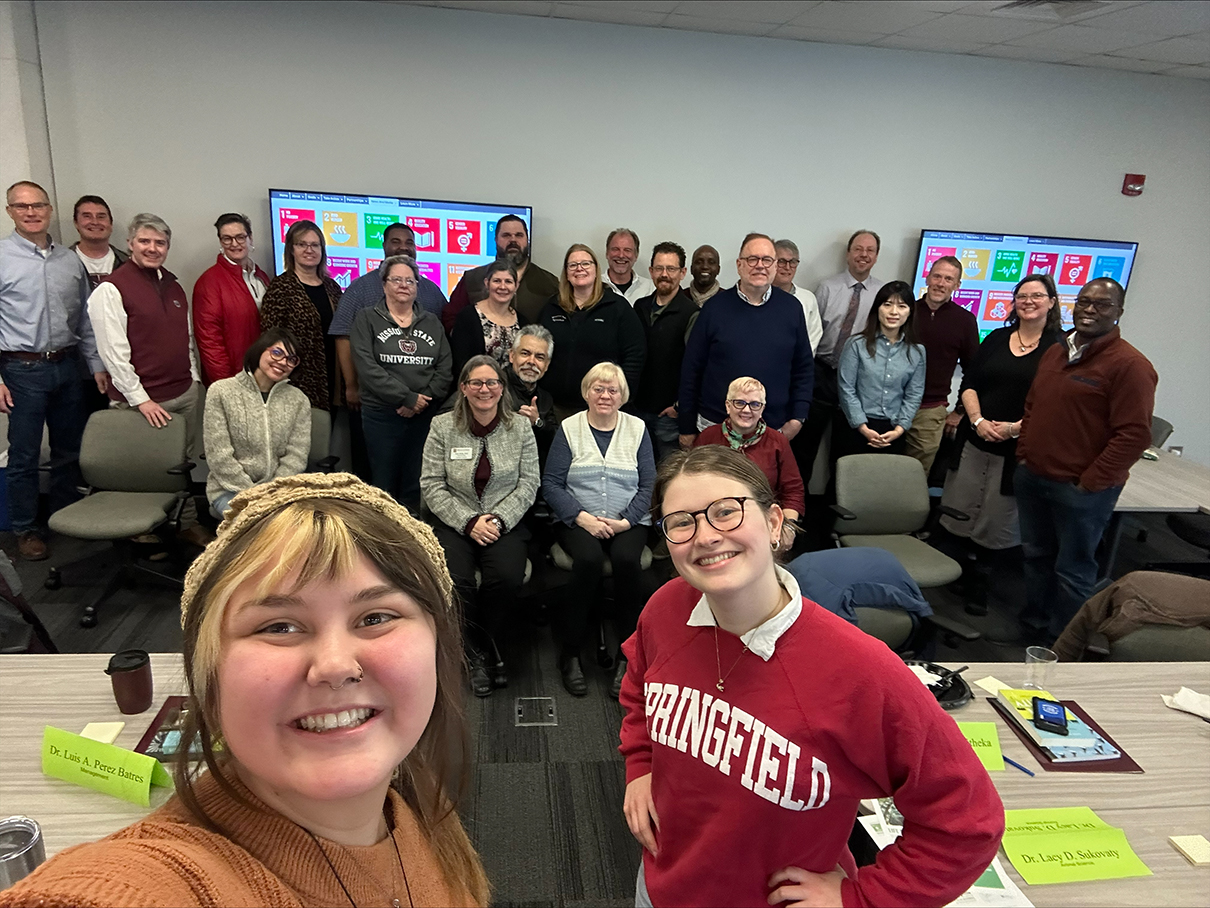
The Sustainability Fellows Program at Missouri State University is a learning community
for faculty, staff, and students dedicated to advancing sustainability efforts at
MSU. One goal of the program is to foster a shared understanding of sustainability
and to recognize how the pillars of sustainability can be integrated into discipline-specific
learning across disciplines.
Image Credit: Paige Tieken
The MSU Sustainability Fellows Program recognizes the work of the Brundtland Commission
which identified three “co-equal” pillars of sustainability: a) environment, (b) economy,
and c) equity (Portney, Sustainability, p. 6). “The argument is that sustainability
can be achieved only by simultaneously protecting the environment, preserving economic
growth and development, and promoting equity” (Portney, p. 6).
At Missouri State University, the sustainability fellows adapt this slightly to:
Environment
Economy
Society
Culture
The Sustainability Fellows Program advances this framework in concert with theSustainable Development Goals(SDGs) created by the United Nations.
FLC Goals
The Sustainability Fellows Program has 8 Program Outcomes which drive The Faculty
Fellows Program and the supplemental activities.
Shared Understanding: The program activates and sustains conversations about sustainability, including
meaningful ways to integrate sustainability (intentionally) into courses, curriculum
design, and campus activities.
Student Learning:The program promotes the integration of sustainability into courses across campus.
Teaching & Learning:The program fosters conversations about teaching and learning, including assessment,
to advance pedagogical practices that incorporate sustainability into course and curriculum
design.
Recognition:The program recognizes and makes visible faculty who are committed to sustainability.
Community Building:The program fosters connections across MSU (and the community) to allow ongoing community
building for those interested in sustainability.
Promotion & Tenure:The program allows faculty an opportunity to make their commitment to sustainability
visible.
AASHE Designation:The program supports MSU's goal of advancing its AASHE designation through curricular
advancements.
The goal of this Community of Practice (CoP) is to create a collaborative environment
where faculty can advance their knowledge and practice of Open Educational Resources
(OER) and Open Educational Practices (OEP). Faculty will engage in discussions of
current issues and emerging trends in open education, share experiences and challenges
from their own courses, explore tools and resources that support OER development and
dissemination, and receive feedback on individual or collaborative projects. You can
expect to make meaningful progress toward an OER-related project, such as course conversion,
resource creation or adaptation, open pedagogy implementation, assessment of OER impact,
or dissemination of open education scholarship.
This group's session schedule and sign up link will be posted in the spring when registration
opens. Check back to this website or follow the FCTL blog to be notified when you
can sign up for this group.