Join the FCTL to celebrate the innovative spirit and dedication of our esteemed faculty at the Spring Scholarship Summit! This event showcases the exceptional research, publications, and initiatives that our faculty members are leading in the realm of teaching and learning.
The Spring Scholarship Summit is an opportunity for faculty to present a poster of their current research or scholarly project. This event is the perfect place to network with colleagues and celebrate the scholarly achievements that are propelling our university forward. Plan to attend this special event to gain inspiration, share ideas, and recognize the invaluable contributions of our faculty to the entire campus-wide community.
Event Information
| Date | April 15, 2026 |
| Time |
Drop by Between 3:30PM to 5:00PM |
| Location | Meyer Library, 107 |
2026 Poster Presentations
Enhancing Accounting Education with LEGO® SERIOUS PLAY®: An Interactive Learning Approach
Kristen Thornton, Senior Instructor and Kimberly S Church, Director
College of Business, School of Accountancy
Discover how the LEGO® SERIOUS PLAY® methodology transforms accounting education by using hands-on, interactive learning to enhance problem-solving, communication, and critical thinking through 3D model building, storytelling, and experiential engagement.

Integrating Assignments into Occupational Therapy Education: Linking Experiential Learning and Technology Application
Naomie Corro, Assistant Professor
McQuery College of Health and Human Services, Occupational Therapy
Discover how 3D printing is transforming occupational therapy education. This poster sessions highlights a hands-on, experiential learning project in which OT students used 3D printing to design and fabricate assistive tools for real-world practice. Findings show meaningful gains in students' knowledge, perceived relevance to practice, and understanding of how emerging technologies can be integrated into OT curricula—supporting innovation, problem-solving, and client-centered thinking in future OT practitioners.
AI-Enabled Feedback Analytics to Support Teaching Excellence in Electrical Engineering Education
Shruti Pandey, Assistant Teaching Professor and Theresa Odun-Ayo, Director
College of Natural and Applied Sciences, Missouri S&T Cooperative Engineering Program
This work introduces a human-centered, AI-assisted framework for rubric-based formative feedback in undergraduate engineering courses. The system analyzes scanned student solutions using natural language processing and supervised learning to align reasoning steps with instructor-defined criteria. Instead of automating grading, the framework generates criterion-specific feedback and aggregates learning analytics to help instructors identify recurring misconceptions and adjust instruction strategically. By preserving instructor authority while reducing repetitive evaluation tasks, the approach supports scalable, transparent, and data-informed enhancement of teaching effectiveness.
AI as an Enhancement Tool: Revising Existing Artifacts Without Replacing Faculty Expertise
Judy Tarbox, Senior Instructor
Reynolds College of Arts, Social Sciences and Humanities, English
This poster showcases the revision of an existing FCTL-funded ePortfolio project integrating AI-enhanced multimedia components. The update models responsible, faculty-driven AI integration while preserving academic integrity and original authorship.
Digital Humanities at Mo State
Julia Troche, Associate Professor, and The Digital Humanities Lab Advisory: Heidi Backes, Angela Barker, Rachel Besara, John Chuchiak, Jason Jolley, Joshua Lambert, Luciane Maimone, Julia Troche, Leah Washburn, and Andrew Wasserman
Reynolds College of Arts, Social Sciences and Humanities
The Digital Humanities Lab at Missouri State University, located on the lower level of the library, opened in Fall 2024. Since then, numerous faculty members, staff, and students have been involved in Digital Humanities projects that intersect with the goals of the lab and directly use the lab's resources. This poster aims to provide an introduction to Digital Humanities at MoState by showcasing examples of past and ongoing projects of the Digital Humanities Lab.
Returning to the Elementary Classroom: Reflections from a Sabbatical Spent Co-Teaching with a First-Year Teacher
Chloe Bolyard, Associate Professor
College of Education, Teaching, Learning and Developmental Sciences
This inquiry uses the autobiographical curriculum theory, currere, to examine the presenter's return to the elementary classroom during a semester-long sabbatical spent co-teaching with a first-year teacher. After more than a decade in higher education, the presenter entered the classroom carrying commitments to equity, care, and humanizing pedagogy shaped by her teaching past and teacher education work. Across regressive, progressive, analytical, and synthetical moments, the presenter traces how these commitments were tested and reassembled through lived classroom encounters marked by shifting roles, institutional constraints, and ethical uncertainty. Rather than offering prescriptive solutions, this inquiry foregrounds the importance of presence, relational work, and grappling with discomfort in teacher preparation. The study contributes to curriculum studies by positioning return—not resolution—as central to ethical teaching and teacher education practice.
A Modern Mohs?: Reimagining the "Common" Kit Students Use to Identify Mineral Hardness
Lydia Tackett, Assistant Professor
College of Natural and Applied Sciences, School of Earth, Environment and Sustainability
For decades, students have used a kit in geology class and in the field of "common" items to determine the relative hardness of minerals, but many of these items are difficult to acquire today! In this poster, the presenter shows very preliminary data on items students self-reported to have with them and how they might relate to developing a more modern Mohs hardness scale with common objects.
Professional Purpose, Commitment and Pedagogical Risk-Taking: Career Motivations and Transformative Teaching in South African Social Work Education
Precious Mseba, Assistant Professor
McQueary College of Health and Human Services, Social Work Program
In a higher education landscape shaped by deep social inequalities, transformative teaching is both essential and demanding. This study explores how social work educators' career motivations and sense of professional purpose influence their willingness to engage in pedagogical risk-taking within South African social work education. Drawing on in-depth interviews with lecturers, the article reveals how commitments to social justice, altruism, vocational callings, and people-centered values drive the use of transformative and discomfort-based pedagogies. At the same time, it highlights the emotional, ethical, and institutional challenges educators face when teaching for social change. Offering fresh insight into the often-overlooked role of educators' motivations, this article makes a compelling case for stronger institutional support to sustain transformative social work education.
Women Writing War Memories
Jiang Linshan, Assistant Professor
Reynolds College of Arts, Social Sciences and Humanities, History
Explore women writers' war experiences and memories of the Second Sino-Japanese War and the Asia-Pacific War.
Survey of Chronic and Recurring Back Pain in University Voice Students
Heather Nelson, Per Course Faculty and Veronika Yerina, Student
Reynolds College of Arts, Social Sciences and Humanities
Chronic pain is a reality for many adults and can greatly affect quality of life. The incidence and severity of chronic and recurring back pain among university students studying singing has largely been unreported. This survey study seeks to explore the experiences of voice students and how back pain, in particular, impacts quality of life and their academic pursuits.
*Not pictured: Veronika Yerina
Transforming Teaching and Learning Through Open Educational Resources
Tracy Stout
University Library
Open Educational Resources (OER) are freely accessible, openly licensed materials that faculty can retain, remix, revise, reuse, and redistribute to support teaching and learning. Recent research shows OER adoption can not only reduce textbook costs but potentially improve completion rates and grades. This poster highlights benefits and research findings on OER adoption including enhancing equity, inclusion, and academic freedom. In addition, the poster showcases OER initiatives for promoting awareness and adoption. Attendees will be invited to explore and discuss potential future directions for OER at Missouri State University.
Ozarkaeology: Integrating Public Affairs, Experiential Learning, and Career Readiness in Cultural Resources Management
Kevin Cupka-Head, Director Center for Archaeological Research
Reynolds College of Arts, Social Sciences and Humanities, Center for Archaeological Research
Supported by funding from the National Park Service and the Missouri State Historic Preservation Office, and in partnership with the Sociology, Gerontology and Anthropology department and private landowners, the Warren Center for Archaeological Research taught a field methods course in the Fall of 2024 and 2025. As they survey remote landscapes and record new historic sites, students learn through doing and make meaningful contributions to Missouri's archaeological record. After completion, students may apply for paid archaeological technician positions with the Center, where they will further their career readiness in a supportive, professional setting.
Social Media as a Marketing Tool for College Programs
Natalie Allen, Associate Professor and Sarah Murray, Assistant Professor
McQueary College of Health and Human Services, School of Health Sciences
Social media platforms, specifically Instagram and Facebook, offer cost-effective marketing solutions that resonate with prospective students and parents. This multi-year study examines how college programs can leverage platforms to expand audience reach, showcase program offerings and faculty expertise, and create engagement opportunities. Additionally effective marketing solutions that resonate with prospective students and parents, social media can be used to gather data and feedback to continually improve programs. This research demonstrates measurable impacts on program visibility, student inquiries, and recruitment outcomes with minimal budget investments.
Exploring Stress, Occupational Balance, Coping, and Well-Being in Healthcare Graduate Students
Sapna Chakraborty, Professor
McQueary College of Health and Human Services, Occupational Therapy
This mixed-methods research study explored the effects of stressors, occupational balance, and coping strategies on students' well-being to determine which of these constructs might most affect healthcare students. The occupational therapy and occupational science concepts of occupational performance and balance in self-care, productivity, and leisure could help describe how occupational disruption could influence health and well-being. Factors that could impact stress, performance, participation, and engagement included students' age, financial standing, social roles, family responsibilities, educational environment, and coping capacity. The knowledge about the stressors and occupational disruptions in healthcare programs could help students and educators to support and maintain students' well-being during graduate education.
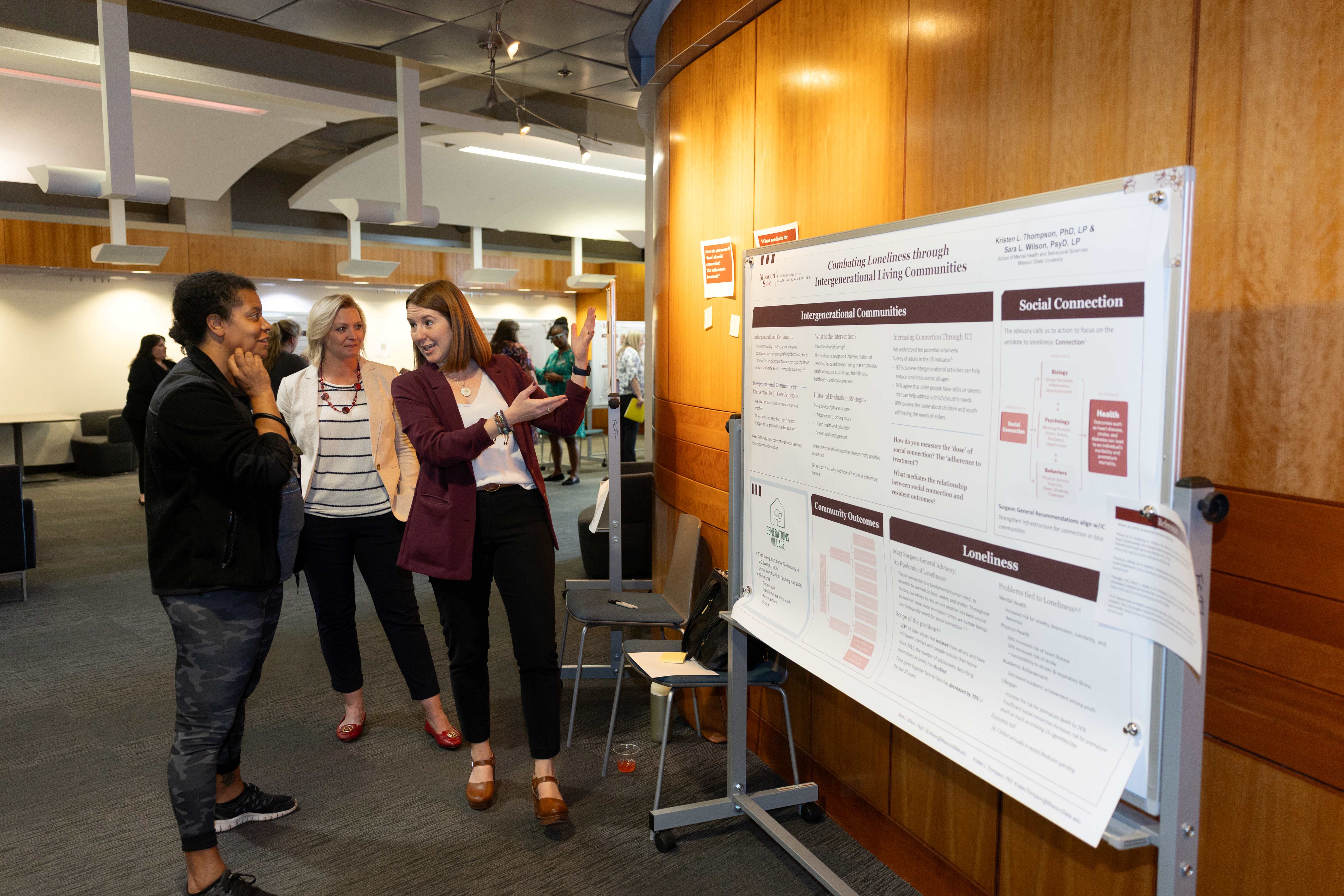
Trauma-Informed Leadership Training for Future Military Leaders: A Collaborative Pilot with Missouri State University ROTC
Kristen Thompson, Assistant Professor, Sara Wilson, Assistant Professor, and Lieutenant Colonel Kyle Reeves
McQueary College of Health and Human Services, School of Mental Health and Behavioral Sciences
This poster presents a collaborative initiative between Psychology and the Missouri State University Military Science/ROTC program to develop and implement trauma-informed leadership training for future military officers. The presenters discuss the rationale for integrating trauma-informed principles into military leadership development and share pilot outcome data from the program's inaugural training cohort.
*Not pictured: Lieutenant Colonel Kyle Reeves
Empowering All Learners: Experiences of Students with Intellectual and Developmental Disabilities in Inclusive Postsecondary Education
Xiaoning Sun, Assistant Professor
College of Education, Special Education, Leadership and Professional Leadership
Despite the rapid expansion of the Inclusive Postsecondary Education (IPSE) programs and the growing body of evidence demonstrating their positive outcomes, challenges persist, especially in program access and students' transitions into program learning and adulthood. This study examined the perceptions of eight IPSE students regarding program values and outcomes. Results indicated that students held positive values toward their IPSE program. They perceived challenges as catalysts for personal growth and described their improvement in daily living skills, academic learning, and socialization. They also expressed their concerns about employment and shared ideas for enhancing the program. These findings extend the existing literature by foregrounding students' voices and highlighting the need for future research that centers on developing comprehensive systems supporting program access, ongoing program support, and individualized interventions on academic enabling behavior, self-determination, functional living skills, job preparation, and social and communication skills.
When Advantages Become Liabilities: Entrepreneurial Traits and Opportunity Perception During Disruptive Events
Zonghui Li, Assistant Professor
College of Business, Management
This study examines how long-term orientation (LTO) and proactivity shape entrepreneurial opportunity perception in the context of the COVID-19 pandemic. Drawing on cognitive psychology and Conservation of Resources (COR) theory, the presenter argues that although LTO and proactivity typically facilitate opportunity identification, extreme disruption and heightened stress may fundamentally alter how these traits operate. Specifically, entrepreneurs high in LTO or proactivity may shift attention from opportunity exploration to resource preservation, thereby suppressing opportunity perception during crises. Using data from the 2020 Global Entrepreneurship Monitor Adult Population Survey, the presenter empirically tests these arguments. The findings challenge the assumption that these traits are universally beneficial demonstrate how cognitive attributes can become liabilities in crisis contexts, advancing entrepreneurship research by revealing how entrepreneurial traits shape threat-based interpretation of crises.
From Telling Stories to Family Memoir
Andrea Miller, Professor and Rowan Pattison, MSU Student
University Library
The process of documenting family stories can be both easier and harder than you might think. This poster will discuss a variety of topics, including what a memoir is and why you should try to write one. Tips will be shared on sources of information, methods of capturing and writing stories, and ways of navigating sticky issues that might arise.
*Not pictured: Rowan Pattison
It's all Greek or Russian or Hebrew to Me: Romanization Tables in Cataloging
Raegan Wiechert, Associate Professor, Andrea Miller, Professor, and Auguste Cann, MSU Student
University Library
How do libraries add an item in a non-Latin script to the catalog when the catalogers cannot even read its title, much less have a keyboard composed of those letters? In this poster, the presenters will discuss the functions of letters and alphabets, what romanization is and why it is needed, and the process of finding and using tools such as the ALA-LC Romanization Tables.
*Not pictured: Auguste Cann
Think about presenting next year!
Do you have something to share?
We are currently looking for poster session presenters. Here are some ideas of the different types of projects that would be ideal for sharing at the summit:
- Research & Publications: Discover groundbreaking research and impactful publications that are shaping the future of education.
- Faculty Learning Communities: Engage with dynamic groups committed to collaborative learning and professional growth.
- Scholarship of Teaching and Learning (SoTL): Explore insightful projects that enhance educational practices and student learning outcomes.
- Fellowship Initiatives: Learn about prestigious fellowship programs and the transformative work being conducted by our faculty.
Past Summit Presenters and Presentations