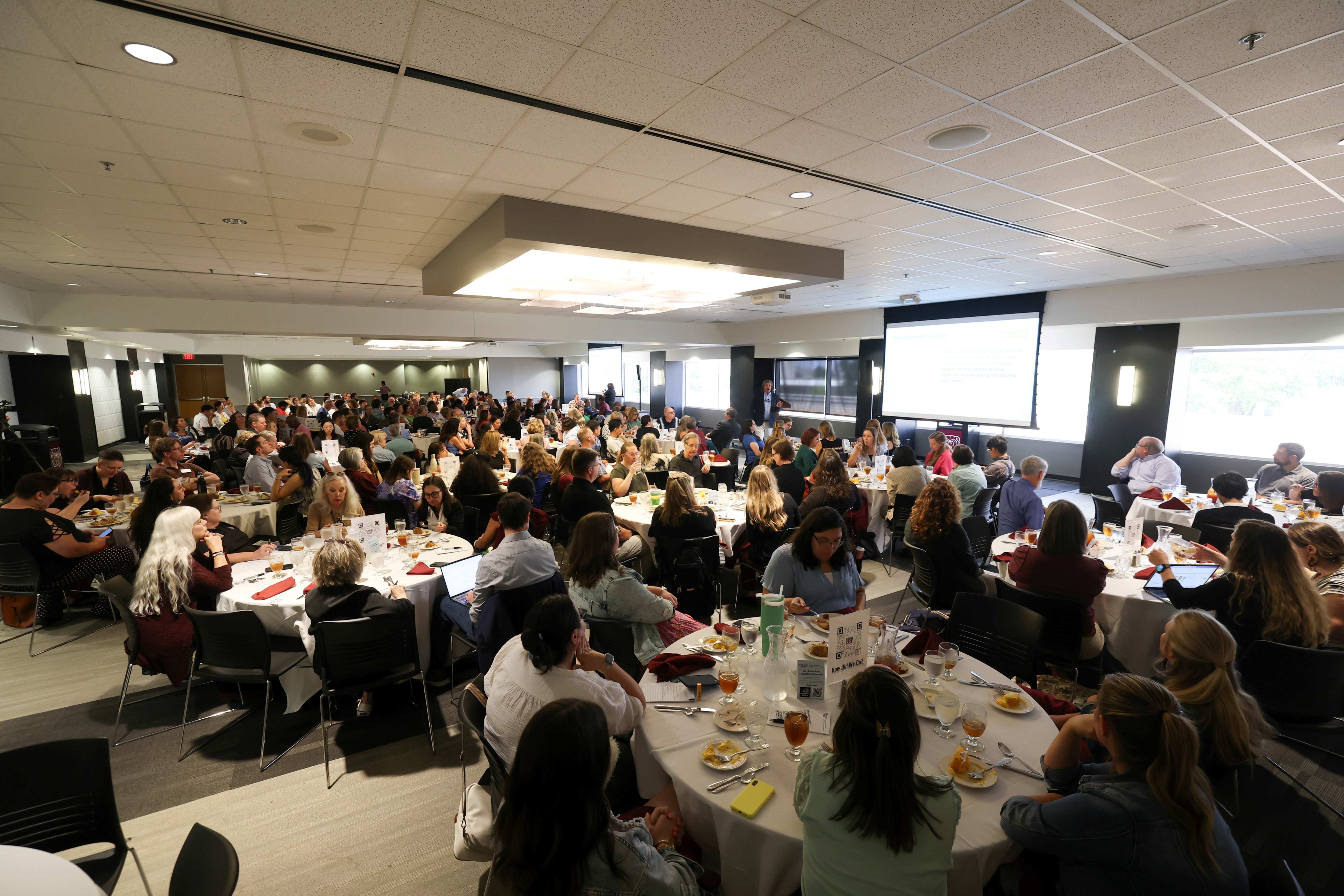
Storytelling, Memory, and Embodied Learning: Why the Moments Matter More than the
Materials
Presented by: Micheal Foster
Ballroom East
This session explores how embodied learning—learning that shapes identity, behavior,
and professional presence—emerges through memorable human moments rather than content
coverage alone. Drawing on narrative experience and teaching practice, the session
argues that while students often forget specific material, they remember who we were
when it mattered, and those moments make later learning durable.
Through storytelling and guided reflection, the presentation distinguishes between
cognitive acquisition and embodied learning, reframing forgetting as a natural cognitive
process rather than instructional failure. Participants are introduced to three types
of memorable classroom moments—recognition, disruption, and mutual presence—and examine
how relationship functions as the container for meaning.
Rather than focusing on activities or techniques, the session centers teaching presence,
modeling, and relational decision‑making as mechanisms for lasting impact. Faculty
across disciplines will leave with a clearer understanding of why moments matter and
how intentional human engagement can transform learning from information students
remember for a test into understanding they carry forward.
Critique CHATGPT: Methods in Assignment Creation to Compare and Contrast LLM Responses
to Required Texts
Presented by: Robert Geibler
PSU 308 A-B
We live in an era where students run rampant with the use of generative AI to complete
assignments, especially in online courses. Students often believe large language models
(LLMs) such as CHATGPT provide adequate responses to discussion questions and peer-reviewed
research. However, assignments challenging the accuracy and precision of LLMs are
often few and far between. In this session, I discuss strategies in developing assignments
that require students to ask CHATGPT to answer questions or interpret articles and
subsequently using required course texts to critique the CHATGPT responses. My course
evaluation data indicates that students report a better understanding of course materials,
acknowledgement of the limitations of generative AI, and an appreciation for learning
how to use LLMs such as CHATGPT responsibly in academic contexts. Assignment creation,
facilitation, challenges, and adaptations are discussed in this session.
I'm Booked Until Finals: Integrating Trade Press Books into the Classroom
Presented by: Taleyna Morris
PSU 308 C
Some students feel like it's not worth doing the reading because the instructor will
just repeat the material. Some faculty feel like they have to repeat material because
students don't complete the reading. This session will focus on integrating reading
into the classroom. Possibilities for selecting books or textbooks, challenges to
using audiobooks, and possibilities for creating assignments based on the in-class
discussion/reading. This session focuses on strategies for classes of 25 students
or less.
Brightspace Drop-In Lab
Presented by: Stacy Rice & Eric Taylor
PSU 309/310
Designing Collaborative Learning Experiences that Connect the Classroom to Real-World
Practice
Presented by: Tara Stulce; Stacy Goddard; Cody Smith; Natalie Allen; Sarah Murray;
McCall Christian; Allan Liggett; Jessica Willis
PSU 312
Students from multiple McQueary College of Health and Human Services programs—including
exercise science, health services, dietetics, and athletic training—are advancing
Missouri State University’s Public Affairs mission through interprofessional collaboration.
These students engage in community-focused, ethical leadership by forming collaborative
healthcare teams and partnering with Magers Employee Wellness.
Within these cross-disciplinary teams, students counsel and educate Missouri State
employees through the Interprofessional Wellness Program. This initiative aligns with
key goals of the University’s Strategic Plan by providing hands-on experiences in
exercise programming, nutrition education, corrective movement, and behavior change
strategies. Students apply discipline-specific expertise while developing the ability
to collaborate effectively across health professions.
This innovative program emphasizes experiential learning and strengthens communication,
professionalism, and real-world clinical skills, preparing students to enter the health
workforce as confident, collaborative practitioners.
Enhancing Course Quality with QM and Brightspace
Presented by: Stacy Rice
PSU 400
Looking to refresh or improve your course? In this session, we'll walk through simple,
practical ways to strengthen your course design using Quality Matters (QM) standards.
We'll look at the QM Self-Review process and share how QM's Improving Your Online
Course (IYOC) workshop can help you refine a course you've already taught.
We'll also introduce new Brightspace templates designed to make course organization
easier while supporting key QM standards, saving you time and helping create a more
consistent experience for your students.
To wrap things up, we'll preview the Brightspace New Experience so you know what's
coming, what to expect during the transition, and how these updates will support your
teaching. By the end of this session, you'll be able to conduct your own QM Self-Review,
explain the purpose and benefits of the IYOC workshop, use new Brightspace templates
to better organize and align your course, and recognize upcoming changes in the Brightspace
New Experience and prepare for the transition.
Using the CARE Bear Teaching Philosophy to Engage Students in the Classroom
Presented by: Keith McShan
PSU 314
Ever wonder how you can merge summer camp experience, coaching, and sport and exercise
psychology into a teaching philosophy? 2026 Teaching Excellence Award Winner Dr. Keith
McShan will share how his CARE Bears teaching philosophy enhances student learning.
“CARE” stands for Coach-Athlete Relationship and Environments (i.e., caring and creating
mastery experiences). The Bears' part of the teaching philosophy has multiple meanings.
First, drawing inspiration from the television show CARE Bears, part of the Bears'
teaching philosophy centers on creating childlike fun in the classroom. Secondly,
the Bears also represent school spirit and pride in what it means to be a Missouri
State Bear. The CARE Bears teaching philosophy values quality relationships, positive,
fun, and school-spirited environments. Participants who attend this session will leave
with research-backed practices that have been shown to engage, motivate, and excite
students and athletes in the classroom, helping them excel academically.
From Curiosity to Scholarship: A Faculty Training Model for AI-Assisted Health Research
with NIH All of Us Data
Presented by: Molly Lancaster; Oghenekaro "Karo" S Okwis
PSU 313
What if you could turn a health research question into a publishable analysis without
writing a single line of code? This session introduces the MO State All of Us Research
Consortium, a new faculty development program that pairs faculty with graduate students
and provides structured training in using generative AI tools (Claude, ChatGPT) to
critically engage with cloud-based health data from the NIH All of Us Research Program.
No programming experience required. We'll walk you through the training platform built
in Brightspace, share early lessons from our summer 2026 pilot, and show you what
critical engagement with AI actually looks like in practice: not blind reliance, but
a deliberate consult-code-verify process. Attendees will leave with a clear path to
join the 2026-2027 cohort and begin producing scholarly work with free data, statistical
support, and a built-in accountability community.
From Inbox Overload to Instant Answers: Your 24/7 Chatbot Course Assistant
Presented by: Annice McLean; Ching-Wen Chang; Krista Tate
PSU 315
Students often have questions about assignments, deadlines, and course expectations--24/7.
In this interactive session, discover how a course chatbot can provide students with
instant access to key information while supporting clear communication in your course.
Participants will see a working chatbot created live in under 15 minutes, demonstrating
how it can guide students through syllabus details, answer common questions, and connect
them to course resources. No coding, programming, or technical expertise required—this
approach is designed for faculty at any comfort level with technology. Leave with
practical ideas and ready-to-use strategies for integrating a chatbot into your own
courses to enhance student support and engagement.
Bringing Assessment to Life: Turning Learning into Real Understanding
Presented by: Theresa Odun-Ayo; Shruti Pandey
PSU 317 A
Assessment is often treated as a checkpoint at the end of learning; but what if it
could be used to create learning instead? In this interactive faculty workshop, participants
will experience how assessment can actively support understanding through a hands-on
exploration of a simple circuit analysis concept. No prior experience with circuits
is needed. Through structured questioning, real-time feedback, and reflection, attendees
will see how formative assessment can surface thinking, address misconceptions, and
build conceptual understanding. The session models practical approaches to designing
questions, prompts, and feedback that make student thinking visible and support learning
in real time. Participants will leave with adaptable strategies for integrating formative
assessment as a meaningful part of the learning process across disciplines.
Instructional Trainwreck: Recovery and Renewal
Presented by: Gautam Bhattacharyya
PSU 317 B
Despite best intentions and best practices, instructors – even well-seasoned ones
– can have courses or semesters in which student evaluations feel mercilessly brutal.
This presentation will focus on how I coped with one such situation during the last
academic year. Principally, I decided upon three key actions. First, I had to own
the students’ comments, without making excuses. When multiple students mention similar,
negative perceptions and experiences, it should be clear that the environment was
flawed. Second, I gathered more information. I had informal conversations with past
students of that course to ask them how to best handle certain classroom management
issues. I also sought the advice of colleagues who would be kind, but direct. Third,
I developed and implemented a plan incorporating all the advice and feedback. Notably,
I candidly discussed with the new cohort of students mistakes I made in the previous
semester. Bottom line, I had to practice what I preach and be completely vulnerable
with the students.