Missouri State University

Academic Experience

A college campus is a learning community that is devoted to the creation, dissemination and incorporation of information and knowledge. Teaching, learning and accessing information are all critical functions that are potentially enhanced by digital technologies. You should understand how technology is used in classes generally, and especially in your areas of interest or major, and the extent to which faculty use these technologies in interactions with students.

Coursework-in and out of class

1.1 How does the campus use technology to enhance teaching, learning, and access to information in your areas of interest?

Missouri State offers quality academic programs that focus on the career success of our students, and technologies are available to enhance the learning experience in all academic disciplines.
More than 80 discipline-specific computer classrooms and labs are available throughout campus, that, in addition to the open computer labs, provide more than 1,800 computers dedicated to student use. These departmental labs host equipment specialized for their majors. Access technologies are provided in labs and classrooms to serve students with disabilities.
Students may also benefit from the use of CD and DVD educational materials and distance learning opportunities while completing their education at Missouri State University.
For teaching assistance, Missouri State has an Academic Development Center, which is a comprehensive instructional support center for faculty. Among other things, this center helps faculty incorporate technology into their instruction in the best way possible to help students learn. Faculty make use of internet connections, projectors, DVDs, sound systems, document cameras, student response systems and interactive whiteboards to present information to their classes and to encourage student participation.

1.2 Are classrooms equipped with technology for instructors and/or students? What technology-rich lab facilities are available to students for course-specific assignments?

Missouri State University outfits its classrooms with additional instructional technology each year. Faculty members use these various forms of media to enrich each student’s learning experience. Students find the technology in classrooms beneficial when delivering presentations. In addition, the Educational Technology Center (ETC) has portable instructional technology available to students, faculty and staff for use in the delivery of courses, presentations, assignments and other official campus use.
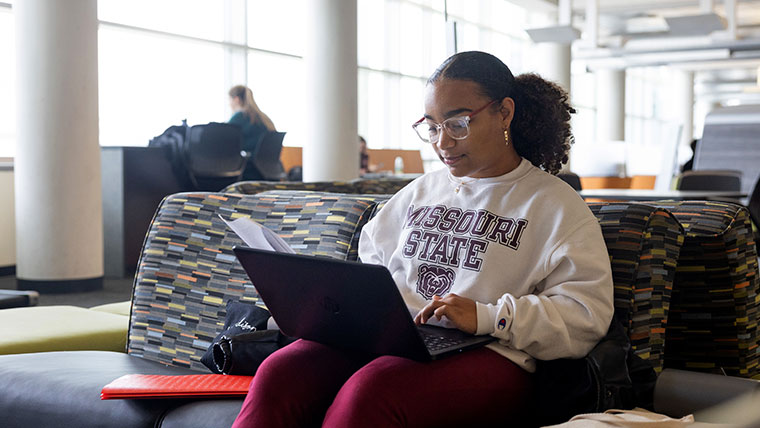
Students may take advantage of various technology-rich labs across campus. Open labs maintained by computer services are equipped with standard business and academic software applications. Additionally, individual departments on campus maintain their own labs with multimedia production capabilities which are available to students enrolled in specific department courses. For general use by students, faculty and staff, ETC created an open multimedia production lab with extended hours. This lab, located on the second floor of Meyer Library, offers Apple OSX and Windows PC based scanning workstations, Apple OSX based video and audio editing workstations, as well as video duplication and conversion workstations.

1.3 In both introductory and specialized courses, what opportunities are there for you to collaborate with other students using technology?

Many faculty use Blackboard in their classes. There are also Internet classes, blended classes ( a combination of telecourse and face-to-face), telecourses, courses taught using a DVD format and courses where the instructor teaches at one location but the class is sent live to other sites through interactive

1.4 Does the school give credit for courses taken electronically (online/at a distance) from other institutions and sources of instruction?

Yes. Credit is given for all courses that meet the criteria for transfer courses. Missouri State also offers Internet-based courses and degree programs via Missouri State Online.

Support services

1.5 What facilities and help services are available to students working on multimedia (audio and video) projects?

The multimedia lab in Meyer Library has both PCs and Macs available for multimedia projects. The lab has scanners, audio production systems, digital editing stations for video and audio, slide scanning equipment, media format transfer stations, and a variety of multimedia software to aid students. Additional equipment is available through equipment lending. Students may also take advantage of departmental multimedia labs which are available for students enrolled in particular courses.
Assistance with multimedia projects is available in the ETC multimedia lab from lab assistants and from department lab monitors. ETC also offers training sessions for faculty, staff and students.

1.6 Are library collections and resources-such as catalogs, research databases, special collections, course reserves, full-text electronic journals, books and streaming media-available online and accessible off-campus?

Online resources and services comprise a growing portion of the Missouri State Libraries' collections.
The library offers a large array of electronic resources accessible from anywhere on campus. Off-campus access to most databases requires a University password.
The library contains many groups of information resources:
  • Library Catalogs: Missouri State, SWAN, & MOBIUSThe Missouri State Libraries' catalog of library materials lists holdings for 866,786 books, 930,195 government documents, 1,050,614 microforms, 36,372 audiovisuals, 3,351 periodical subscriptions and 178,168 cartographic items in the Meyer Library and the branch libraries. Missouri State's online catalog is part of SWAN (Southwest Academic Network), a regional member of the statewide MOBIUS Consortium's shared online catalog. This Missouri database of academic library materials, along with the new MOBIUS direct delivery service, greatly enhances the campus community’s access to materials. The online catalog can be accessed 24/7.
  • Indexes and DatabasesA full array of indexing and abstracting databases give access to articles and other scholarly materials for research, many of which provide the full text of materials cited and presented. The indexes and databases are listed by Subject, Title, Full Text, and Most Popular featuring new or specialized databases. Indexing and abstracting services are available in virtually every major academic discipline. Full-text coverage includes general interest periodicals and newspapers, as well as general coverage in a broad array of academic disciplines. The index and database lists also provide access to specialized databases in arts and letters, business, natural and applied sciences, education, humanities and public affairs and health and human services.

  • eTexts In addition to full-text articles in its searchable subject databases, the Libraries provide direct access to over 20,000 eJournals and eNewspapers.

  • Subject and Research Resources Featured here are electronic reference resources in the Missouri State Libraries’ collections and Pathfinders that include suggested databases, reference materials, books, periodicals, government documents and web sites to organizations and resources on subjects related to the colleges, departments and courses offered at Missouri State.

  • Selected Internet Resources
    Contains information categories available by topic or by major, each with a large number of websites, carefully chosen for their applicability and quality by the Missouri State Libraries' electronic resources librarian and others. This resource provides assistance and tools with which to search the Internet.

A number of other more specialized online resources are available only in the Meyer Library, including the World News Connection databases of foreign newspaper and news services, selected technical and industrial standards in the world-wide Standards and several specific subject indexes.

1.7 Can the library deliver documents to you electronically, either via e-mail or through Web posting? Does the library charge a fee when information resources that you need are not available in its collections?

For classes offered through the Springfield campus, instructors have the option of placing non-book course reserve materials online. These materials are scanned and placed in a searchable database accessible via the web.
To stay in compliance with copyright and fair use guidelines, the materials are password protected. Instructors provide the password to students as part of their course syllabus.

1.8 Does the library provide research assistance in a variety of ways, such as in person, by phone, by email and through Web services? When are these forms of assistance available?

Research assistance is provided in person and by telephone during library hours. Questions can also be submitted electronically to Ask a Librarian. Responses will then be sent by e-mail. More in-depth research sessions can be requested using the Research Consultation Service form.
Access to materials not held at Missouri State and not available to borrow in MOBIUS can be requested through interlibrary loan. That request process is now electronic, and if possible, materials are delivered electronically to borrowers, primarily articles.

Looking toward graduation and a career

1.9 Does the campus offer general or profession-specific training programs that will ensure you are fluent in current information technologies when you graduate?

Missouri State believes computer skills are a valuable asset to all students. These skills are encouraged and developed in many ways:
  • All students are required to take an introductory class, Computers For Learning, which teaches computer literacy concepts and introductory skills.

  • There are several open-access computer labs across campus which students can use, including one lab which is open 24 hours. Lab assistants and full-time supervisors are available in these labs.

  • Most classes will require students to develop skills by asking for assignments completed on a computer.

  • Students will be asked to communicate with their instructors using email or the Internet.

  • Online training tutorials are available to students.

  • Many professors use specialized software to facilitate student interaction via the web, post class syllabi and due dates, give tests, and respond to student queries.

  • Students are taught, either in class or in the library, skills necessary to conduct research using resources available through the Missouri State Libraries.

  • The various colleges on campus also offer profession-specific training programs which could range anywhere from website design to data-entry.