
Imagining and Making Missouri's Future
In order for Missouri State University students to be educated and successful in the fullest sense, the process of incubating new ideas must also be accompanied by informed discussion, debate, and understanding of the uses, values, and purposes of new discoveries and creative products. What implications will such advances have for how individuals live and work? How will they affect our local communities and our global partners? What risks might they pose, and what dangers could they reduce? How should new discoveries be regulated, by whom, and for what duration of time?
Missouri State must assure that its education of students prepares them to confront these and many other vexing questions. To do so, the University must provide educational experiences that:
Ultimately, to imagine a well-conceived future, the University should insist on rigorous expectations for its students, and it must be clear about what it means to be well-educated for the 21st century. There are five traits of educated students:
They cultivate their aesthetic tastes – Educated students push their creative limits and stretch their aesthetic appreciation. The University years are a great time for students to sharpen their eyes for art, tune their ears to music, and turn their minds to all kinds of dramatic and creative expression.
They become critical thinkers – They can discern what is a sturdy basis for knowledge and beliefs versus what is mere bias or preference. Universities should recruit people away from illusions and toward truth. One of the main goals of a first-rate university is to teach students how to think and reason well, and that is what we will ask students to embrace as a personal goal.
They are serious readers who become broadly literate – Reading is the vehicle by which students travel and learn their own interiors. It introduces them to the life of the mind, and it opens windows on their own lives. Habitual reading remains one of life’s single most empowering and liberating activities.
They dedicate themselves to becoming curious and contributing citizens – Students need to find a personal intellectual interest that captures their hearts and drives them to approach each day eager to learn a little more. Students need to grow an obsession for some area of knowledge where they insist on being an expert and through which they make a difference for others. This specific expertise also should be complemented by an understanding of the global issues that effective citizens need to develop throughout their lives. Further, students need to develop the skills necessary for successful collaboration and teamwork.
They balance an in-depth mastery of at least one academic discipline with a broad appreciation of the liberal arts – By the time they graduate, students should be extremely capable in the academic field of their choosing. But that specialty should be built on a broad educational foundation to help provide context and understanding.
Missouri State's learning environment extends beyond the brick and mortar classrooms.
The focus of Missouri State’s mission continues to be the development of educated persons who have an understanding of themselves and the diverse social and natural world in which they live, who are creative people of vision, and who are capable of making informed and meaningful decisions. These educated persons should possess the five traits previously identified. In order to achieve these aims, it is essential that the faculty, staff, and administration of Missouri State University serve as role models and leaders.
The mission of the University, with its rededicated emphasis upon student learning as its primary purpose, and with a statewide mission in public affairs, acknowledges that teaching, scholarship, and service are to be regarded as integrated, complementary activities. The University’s new performance-based compensation system will reward faculty who excel in these three areas, as well as provide a stronger basis for the granting of promotion, tenure, and salary increases.
Academic departments, schools, and colleges support both the individual and collective efforts of faculty in fulfilling their obligations to the University and the public they serve. These units have several important responsibilities:
In an effort to support lifelong learning and to be of service to the community, it will be necessary to provide and promote nontraditional learning experiences. The Center for Continuing and Professional Education and Ozarks Public Television will use their expanded facilities to offer additional non-credit opportunities for people in the metropolitan community served by the University.
On June 16, 1995, Missouri Governor Mel Carnahan signed into law Senate Bill 340 which gave Missouri State University a statewide mission in public affairs. This mission defines a primary way in which a Missouri State education is different from that of other universities and one way by which we educate our students to imagine the future.
The United States, a pluralist gathering of races and cultures, banded together not by blood or religion, by territory or tradition, but by a political idea, is a nation formed by its dedication to civic principles. These principles embedded in our fundamental national documents make it clear that American citizens are expected to fulfill civic responsibilities by competent participation in public affairs. The obligations of civic participation are not unique to Americans but are incumbent on all those who are fortunate enough to live in democratic republics.
A leading American political thinker and statesman, Thomas Jefferson, contended that the status of "citizen" called for every member of the community to become involved in the business of society. To imagine the future, the University has a special responsibility to educate students about social goals, public purposes and values, and the ethics of citizenship as well as to encourage students to have a personal sense of responsibility for the global society.
Students accompany one another inside Ellis Hall's Practice rooms.
Good citizenship takes place at several different levels. Students are members of multiple communities–the University, the neighborhood, the city, and the state, as well as the nation. Students also are citizens in a larger philosophical sense. Students belong to a moral community composed of all human beings. The members of the Missouri State campus community affirm their citizenship in the larger world community by ensuring that differences of nationality, ethnicity, or social-economic class do not become barriers between us. Helping students become responsible citizens at these different levels takes time and deliberate efforts on the part of all educators.
Public affairs in higher education is not restricted to politics, humanities, or the social sciences. It is present in all areas of life that require knowledge, participation, civic skills, and the willingness to work for the common good. Public affairs involves educating persons to become responsible citizens and leaders. The University should define the skills of responsible citizenship and ensure that its unique education develops these skills.
In order to educate for public life and for the future, the University must foster a community where all individuals are called upon to respond to public affairs issues and to develop a sense of public spiritedness, tolerance, and understanding of multicultural concerns. Students are exposed to a common core of knowledge through the General Education Program in order to promote the general welfare of community, state, nation, and globe. This common core imparts historical and comparative perspectives on public affairs–e.g., problems of order, justice, liberty, equality, stability, and avoidance of civil and international strife. Capstone courses allow the student to investigate in depth a particular social problem or issue of his or her choice.
Education in public affairs should be a recognizable and measurable goal. Public affairs, while not a curriculum, must be present and expressed through all academic disciplines. Students are taught how to communicate effectively in the public sphere through the arts, through logic, and through the written and spoken word. They are exposed to ethical and global issues; political, environmental, and technological concerns; and issues of human diversity. Teachers are prepared for public and private schools, underscoring the importance of educated persons for a flourishing civic society. Scientific and social research are used to promote a healthy citizenry which is vital to stable and productive societies. Students are educated to participate in our democratic society as fully involved and informed citizens; and science and the environment are studied to promote environmentally responsible growth. Being exposed to these issues in public affairs will help develop the student’s capacity to analyze and resolve contemporary problems in the metropolitan area, in the nation, and in the international community.
Public affairs education takes place not only in the public space of the classroom, but also outside the University. Internships, field experiences, practicums, cooperative projects, government service, volunteer programs, and residential life programs that help develop leaders all contribute to inculcating in students a sense of individual and community responsibility.
Community outreach through public affairs research centers, adult continuing education, distance learning courses, public broadcasting, and telecommunication linkages with other universities will use faculty expertise to address state and community problems. Missouri State’s commitment to its statewide mission also is reflected in campus lectures on public issues in which the community is invited to participate. The challenge presented by a focus on public affairs, however, is not just about what kind of curriculum, community service or public forums should be in place. It is about discovering solutions to the problems that all citizens face as members of a democratic society in a world shared by many.
Each year, more than 14,000 students receive in excess of $112 million in financial aid at Missouri State.
We live in a world of increasingly political, economic, social, cultural, linguistic, environmental, and geo-strategic interdependence and complexity that requires educated persons to have a global frame of reference. Therefore, Missouri State University must provide its students, faculty, and administrators, as well as the community it serves, with cross-cultural experiences that develop mutual understanding and respect of cultural differences.
To develop these abilities and sensibilities is part of a college education that prepares students for their future obligation to become active global participants and citizens. For this reason, Missouri State University is committed to provide all stakeholders with increased opportunities for educational and experiential exchanges and study tours, and contacts with foreign students and scholars on campus.
To fulfill its obligations to be an effective force for global understanding, the University will pursue several strategies, including:
A major way in which the University can help imagine the future is to form centers that assemble faculty and student talent and focus that talent on those issues that loom as the biggest threats to a progressive future. The Community and Social Issues Institute (CSII) has been developed with this purpose prominently in mind.
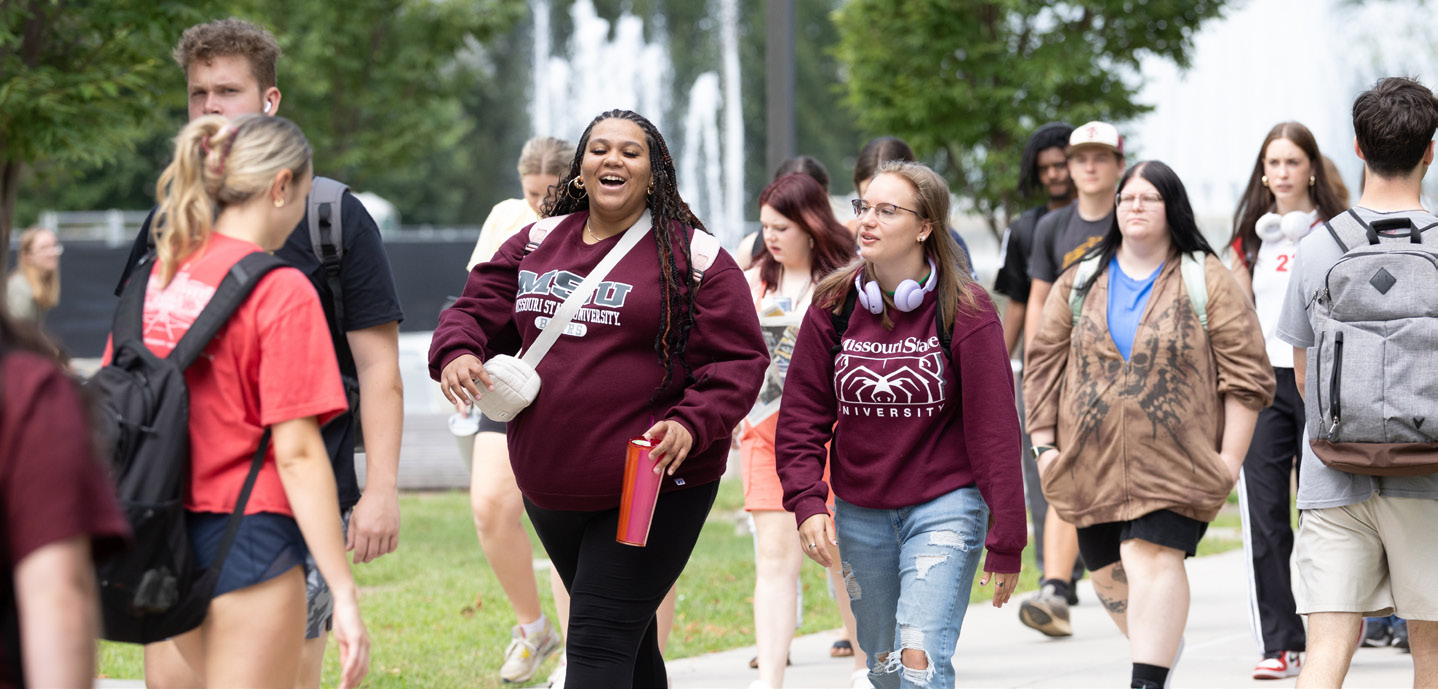
Missouri State's scenic campus offers seasonal color all year round.
The mission of the Community and Social Issues Institute is to provide high-quality research and data that accurately and honestly portray social conditions and problems in the community. The Institute will work with existing agencies to develop strategies that address and remediate significant social problems. The Institute’s research can range from studies that generate primary data to projects that focus on evaluating program effectiveness.
One example of a social problem that could be attacked by the Institute is risk-related behavior, particularly by youth. Young people often are drawn to risky behavior (examples include alcohol and drug use, sexual behaviors, tobacco use) because of psychological temperament, physiological predispositions, peer pressure, and feelings of invincibility. These behaviors are usually established during early childhood, strengthened in adolescence, and persist into adulthood. In addition to causing serious dysfunctions and health problems, these behaviors also contribute to the educational and social problems that confront the nation, including failure to complete high school, unemployment and crime. For example, children living around or near methamphetamine production and use face double jeopardy: they are often victims of different types of abuse; and, they tend to take on risky behavior patterns that follow them throughout their youth and persist into their adult lives.
The Institute will focus its research efforts on:
As a first step to build the CSII, the University will recruit a senior-level scholar to serve as the Director.